Gutscheinbedingungen

*Gültig bis 20.07.2026 auf alle Bücher. Ausgeschlossen sind Zeitschriften, Prozentbücher und Abos | Einlösbar in allen Buchhandlungen von Orell Füssli, Barth Bücher, Buchladen Rapunzel, Papeterie Köhler, Schuler Orell Füssli, Stauffacher und ZAP unter Vorweisung des Gutscheins, auf www.orellfüssli.ch durch Eingabe des Gutscheincodes. Beim Service „eBooks verschenken“ und bei eBook-Käufen via eReader nicht einlösbar | Mindesteinkaufswert: Fr. 30.- | Nicht mit anderen Rabatten kumulierbar.

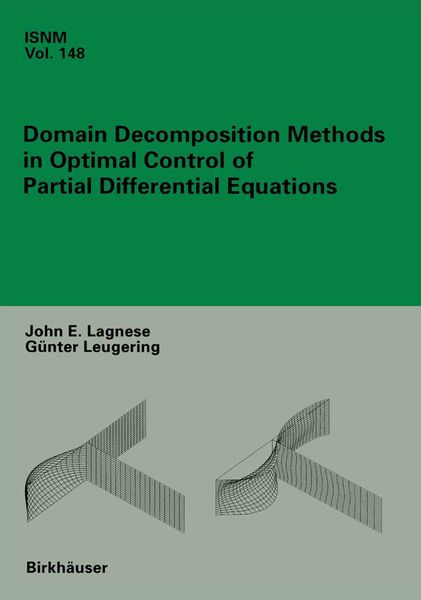
  • Produktbild: Domain Decomposition Methods in Optimal Control of Partial Differential Equations
  • Produktbild: Domain Decomposition Methods in Optimal Control of Partial Differential Equations
Band 148

Domain Decomposition Methods in Optimal Control of Partial Differential Equations

Fr. 137.00

inkl. gesetzl. MwSt., Versandkostenfrei


Beschreibung

Produktdetails

Einband

Taschenbuch

Erscheinungsdatum

23.10.2012

Verlag

Springer Basel

Seitenzahl

443

Maße (L/B/H)

23.5/15.5/2.5 cm

Gewicht

698 g

Auflage

Softcover reprint of the original 1st ed. 2004

Sprache

Englisch

ISBN

978-3-0348-9610-8

Beschreibung

Produktdetails

Einband

Taschenbuch

Erscheinungsdatum

23.10.2012

Verlag

Springer Basel

Seitenzahl

443

Maße (L/B/H)

23.5/15.5/2.5 cm

Gewicht

698 g

Auflage

Softcover reprint of the original 1st ed. 2004

Sprache

Englisch

ISBN

978-3-0348-9610-8

Herstelleradresse

Springer-Verlag GmbH
Tiergartenstr. 17
69121 Heidelberg
DE

Email: GPSR Kontakt

Noch keine Bewertungen vorhanden

Verfassen Sie die erste Bewertung zu diesem Artikel

Helfen Sie anderen Kundinnen und Kunden durch Ihre Meinung.

Kundinnen und Kunden meinen

Bewertungen (0)

  • Produktbild: Domain Decomposition Methods in Optimal Control of Partial Differential Equations
  • Produktbild: Domain Decomposition Methods in Optimal Control of Partial Differential Equations
  • 1 Introduction.- 2 Background Material on Domain Decomposition.- 2.1 Introduction.- 2.2 Domain Decomposition for 1-d Problems.- 2.2.1 Unbounded Domains.- 2.2.2 Bounded Domains.- 2.2.3 Semi-discretization.- 2.3 Domain Decomposition Methods for Elliptic Problems.- 2.3.1 Review of Basic Methods.- 2.3.2 Virtual Controls.- 2.3.3 The Basic Algorithm of P.-L. Lions.- 2.3.4 An Augmented Lagrangian Formulation.- 2.3.5 General Elliptic Problems and More General Splittings.- 2.3.6 An a Posteriori Error Estimate.- 2.3.7 Interpretation as a Damped Richardson iteration.- 2.3.8 A Serial One-Dimensional Problem.- 3 Partial Differential Equations on Graphs.- 3.1 Introduction.- 3.2 Partial Differential Operators on Graphs.- 3.3 Elliptic Problems on Graphs.- 3.3.2 Domain Decomposition.- 3.3.3 Convergence.- 3.3.4 Interpretation as a Richardson Iteration.- 3.4 Hyperbolic Problems on Graphs.- 3.4.1 The Model.- 3.4.2 The Domain Decomposition Procedure.- 4 Optimal Control of Elliptic Problems.- 4.1 Introduction.- 4.2 Distributed Controls.- 4.2.2 Domain Decomposition.- 4.2.3 A Complex Helmholtz Problem and its Decomposition.- 4.2.4 Convergence.- 4.2.5 Methods for Elliptic Optimal Control Problems.- 4.2.6 An A Posteriori Error Estimate.- 4.3 Boundary Controls.- 4.3.2 Domain Decomposition.- 4.3.3 Convergence.- 4.3.4 An A Posteriori Error Estimate.- 5 Control of Partial Differential Equations on Graphs.- 5.1 Introduction.- 5.2 Elliptic Problems.- 5.2.1 The Global Optimal Control Problem on a Graph.- 5.2.2 Domain Decomposition.- 5.2.3 Distributed Controls.- 5.2.4 Boundary Controls.- 5.3 Hyperbolic Problems.- 5.3.1 The Global Optimal Control Problem on a Graph.- 5.3.2 The Domain Decomposition Procedure.- 6 Control of Dissipative Wave Equations.- 6.1 Introduction.- 6.2 Optimal Dissipative Boundary Control.- 6.2.1 Setting the Problem.- 6.2.2 Existence and Regularity of Solutions.- 6.2.3 The Global Optimality System.- 6.3 Time Domain Decomposition.- 6.3.1 Description of the Algorithm.- 6.3.2 Convergence of the Iterates.- 6.3.3 A Posteriori Error Estimates.- 6.3.4 Extension to General Dissipative Control Systems.- 6.4 Decomposition of the Spatial Domain.- 6.4.1 Description of the Algorithm.- 6.4.2 Convergence of the Iterates.- 6.4.3 A Posteriori Error Estimates.- 6.5 Space and Time Domain Decomposition.- 6.5.1 Sequential Space-Time Domain Decomposition.- 6.5.2 Sequential Time-Space Domain Decomposition.- 7 Boundary Control of Maxwell’s System.- 7.1 Introduction.- 7.2 Optimal Dissipative Boundary Control.- 7.2.1 Setting the Problem.- 7.2.2 Existence and Uniqueness of Solution.- 7.2.3 The Global Optimality System.- 7.3 Time Domain Decomposition.- 7.3.1 Description of the Algorithm.- 7.3.2 Convergence of the Iterates.- 7.3.3 A Posteriori Error Estimates.- 7.4 Decomposition of the Spatial Domain.- 7.4.1 Description of the Algorithm.- 7.4.2 Convergence of the Iterates.- 7.4.3 A Posteriori Error Estimates.- 7.5 Time and Space Domain Decomposition.- 7.5.1 Sequential Space-Time Domain Decomposition.- 7.5.2 Sequential Time-Space Domain Decomposition.- 8 Control of Conservative Wave Equations.- 8.1 Introduction.- 8.2 Optimal Boundary Control.- 8.2.1 Setting the Problem.- 8.2.2 Existence and Regularity of Solutions.- 8.2.3 The Global Optimality System.- 8.3 Time Domain Decomposition.- 8.3.1 Description of the Algorithm.- 8.3.2 Convergence of the Iterates.- 8.3.3 A Posteriori Error Estimates.- 8.3.4 Extension to General Conservative Control Systems.- 8.4 Decomposition of the Spatial Domain.- 8.4.1 The Local Optimality Systems.- 8.4.2 The Domain Decomposition Algorithm.- 8.4.3 Convergence of the Iterates.- 8.5 The Exact Reachability Problem.- 8.5.1 The Global Optimality System.- 8.5.2 The Limit of the Local Optimality Systems.- 8.5.3 Application to Domain Decomposition.- 8.5.4 Convergence to the Global Optimality System.- 9 Domain Decomposition for 2-D Networks.- 9.1 Elliptic Systems on 2-D Networks.- 9.1.2 Examples.- 9.1.3 Existence and Uniqueness of Solutions.- 9.1.4 Domain Decomposition.- 9.1.5 Convergence of the Algorithm.- 9.2 Optimal Control on 2-D Networks.- 9.2.1 Optimal Final Value Control.- 9.2.2 Existence and Regularity of Solutions.- 9.3 Decomposition of the Spatial Domain.- 9.3.2 The Decomposition Algorithm.- 9.3.3 Convergence of the Algorithm.