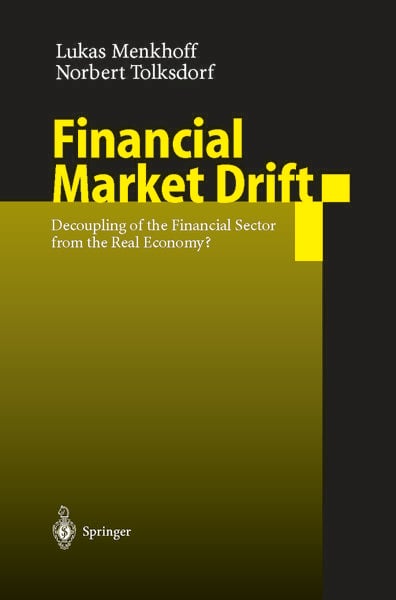
Financial Market Drift Decoupling of the Financial Sector from the Real Economy?
-
- Hardcover
- Taschenbuch ausgewählt
- eBook
-
Sprache:Englisch
Fr. 138.00
inkl. gesetzl. MwSt.,
Beschreibung
Produktdetails
Einband
Taschenbuch
Erscheinungsdatum
01.11.2012
Abbildungen
IX, 234 p.
Verlag
Springer BerlinSeitenzahl
234
Maße (L/B/H)
23.5/15.5/1.4 cm
Gewicht
382 g
Auflage
Softcover reprint of the original 1st edition 2001
Sprache
Englisch
ISBN
978-3-642-62507-7
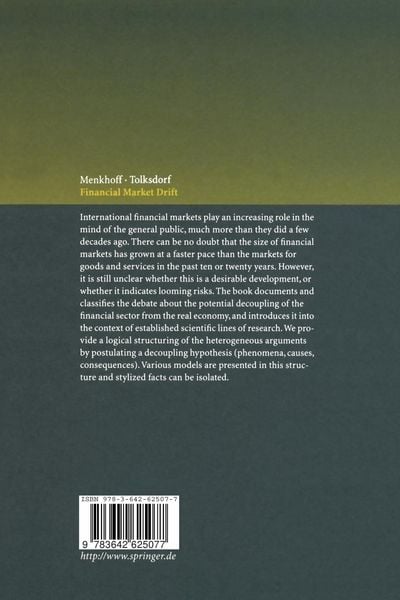
International financial markets play an increasing role in the mind of the general public, much more than they did a few decades ago. There can be no doubt that the size of financial markets has grown at a faster pace than the markets for goods and services in the past ten or twenty years. However, it is still unclear whether this is a desirable development, or whether it indicates looming risks. The book documents and classifies the debate about the potential decoupling of the financial sector from the real economy, and then to introduce it into the context of established scientific lines of research. We try to provide a logical structuring of the heterogeneous arguments by postulating a decoupling hypothesis (phenomena, causes, consequences). Various models are presented in this structure and stylized facts can be isolated.
Noch keine Bewertungen vorhanden
Verfassen Sie die erste Bewertung zu diesem Artikel
Helfen Sie anderen Kundinnen und Kunden durch Ihre Meinung.