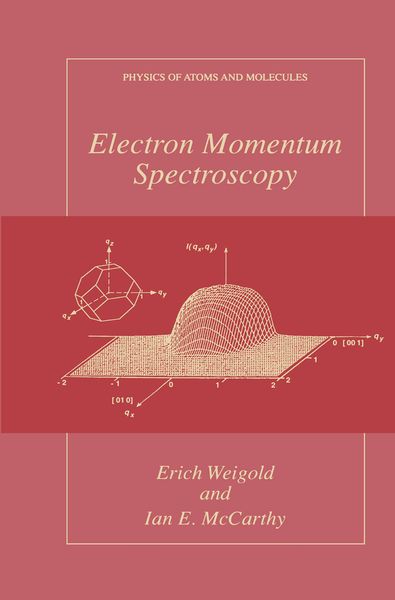

Electron Momentum Spectroscopy
Aus der Reihe
Physics of Atoms and Molecules
-
- Hardcover
- Taschenbuch ausgewählt
-
Sprache:Englisch
Fr. 241.00
inkl. gesetzl. MwSt.,
Beschreibung
Produktdetails
Einband
Taschenbuch
Erscheinungsdatum
27.09.2012
Verlag
Springer UsSeitenzahl
273
Maße (L/B/H)
23.5/15.5/1.6 cm
Gewicht
441 g
Auflage
Softcover reprint of the original 1st ed. 1999
Sprache
Englisch
ISBN
978-1-4613-7164-9
Electron Momentum Spectroscopy measures the energy-momentum density of the electrons in atoms, molecules and solids by means of a kinematically-complete ionization reaction initiated by an electron beam. The construction of spectrometers and the acquisition and reduction of cross-section data are described in detail. The quantum theory of the reaction is explained and the experimental verification is given. It is shown how to extract quasiparticle orbitals, and coefficients describing electron correlations of the data. These quantities are derived from the many-body theory of the electronic structure of atoms, molecules and solids. The relationship to less complete methods of investigating electronic structure is discussed.
Examples are given of the determination of atomic and molecular orbitals and quantities relating them to the observed states of the residual ion. For amorphous, polycrystalline and crystalline solids and surfaces, examples show the energy-momentum density of valence electron bands, and effects due to electron diffraction and plasmon excitation.
The book aims to give a complete account of electron momentum spectroscopy to date. Its significance is that it is a sensitive and experimentally-verifiable test of essentially every aspect of calculations of electronic structure. It is the only such probe available.
Examples are given of the determination of atomic and molecular orbitals and quantities relating them to the observed states of the residual ion. For amorphous, polycrystalline and crystalline solids and surfaces, examples show the energy-momentum density of valence electron bands, and effects due to electron diffraction and plasmon excitation.
The book aims to give a complete account of electron momentum spectroscopy to date. Its significance is that it is a sensitive and experimentally-verifiable test of essentially every aspect of calculations of electronic structure. It is the only such probe available.
Noch keine Bewertungen vorhanden
Verfassen Sie die erste Bewertung zu diesem Artikel
Helfen Sie anderen Kundinnen und Kunden durch Ihre Meinung.