
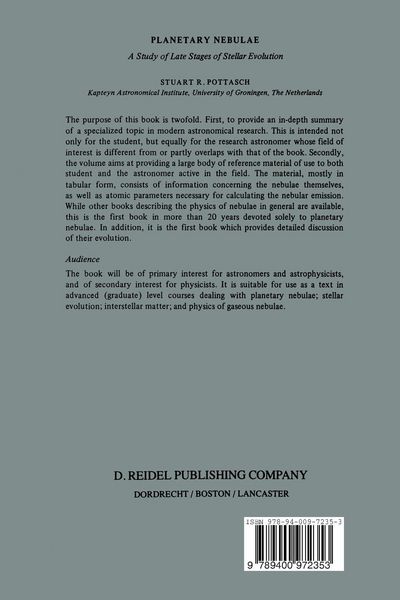
• Produktbild: Planetary Nebulae
  • Produktbild: Planetary Nebulae
Band 107

Planetary Nebulae A Study of Late Stages of Stellar Evolution

Fr. 191.00

inkl. gesetzl. MwSt., Versandkostenfrei


Beschreibung

Produktdetails

Einband

Taschenbuch

Erscheinungsdatum

15.10.2011

Abbildungen

IX, 326 p.

Verlag

Springer Netherland

Seitenzahl

326

Maße (L/B/H)

23.5/15.5/1.9 cm

Gewicht

517 g

Auflage

1. Auflage

Sprache

Englisch

ISBN

978-94-009-7235-3

Beschreibung

Produktdetails

Einband

Taschenbuch

Erscheinungsdatum

15.10.2011

Abbildungen

IX, 326 p.

Verlag

Springer Netherland

Seitenzahl

326

Maße (L/B/H)

23.5/15.5/1.9 cm

Gewicht

517 g

Auflage

1. Auflage

Sprache

Englisch

ISBN

978-94-009-7235-3

Herstelleradresse

Springer-Verlag KG
Sachsenplatz 4-6
1201 Wien
AT

Email: GPSR Kontakt

Noch keine Bewertungen vorhanden

Verfassen Sie die erste Bewertung zu diesem Artikel

Helfen Sie anderen Kundinnen und Kunden durch Ihre Meinung.

Kundinnen und Kunden meinen

Bewertungen (0)

  • Produktbild: Planetary Nebulae
  • Produktbild: Planetary Nebulae
  • I: History, Morphology and Evolution.- A Historical Review.- II: Distribution of Planetary Nebulae in the Galaxy.- A. Methods of discovering planetary nebulae.- B. Distribution in galactic coordinates.- C. Radial velocities of the nebulae.- D. Extragalactic planetary nebulae.- III: Interpretation of Emission Lines and Nebular Abundances.- A. Recombination lines.- B. Collisionally excited lines.- C. Line formation in heavier elements by other processes.- D. Nebular models.- E. Abundances in planetary nebulae.- IV: Nebular Continuum Emission.- A.Sources of continuum emission.- B. Comparison of theory with observations.- C. Separation of continuum radiation from the nebula and the exciting star.- D. Radio continuum radiation.- E. Comparison of radio continuum with hydrogen line emission.- V: Distance to the Nebulae.- A. Extinction.- B. Distances to individual nebulae.- C. Mass of the nebula.- D. Statistical methods for determining distances.- E. Absolute nebular flux.- F. The space density of nearby nebulae and their distribution with height above the galactic plane.- VI: Morphology, Expansion and Mass Loss.- A. Morphology: measurements.- B. Nebular expansion.- C. Morphology: models and classification.- D. Morphology: ‘halo’ structures.- E. Morphology: four individual cases.- F. Mass loss from the central star: ultraviolet lines.- G. Other evidence for mass loss: visual lines.- VII: The Temperature of the Central Stars.- A. The line spectra.- B. The continuous spectrum of the central star.- C. Model atmospheres.- D. ‘Zanstra’ temperatures.- E. ‘Stoy’ temperatures.- F. Temperatures derived from nebular ionization equilibrium.- VIII: Infrared and Millimeter Radiation.- A. Infrared continuous emission.- B. Interpretation as dust emission.- C. Energy input to thedust.- D. Consequences for the central star temperature determination.- E. Broad and narrow infrared emission features.- F. Molecular hydrogen.- G. Carbon monoxide emission.- IX: Evolution of the Central Star.- A. Observational evidence.- B. Theoretical models.- C. Comparison of theory and observation.- X: Evolution from Red Giant to Planetary Nebula.- A. The cool giants.- B. The Mira variables.- C. The OH/IR masers.- D. Protoplanetary nebulae and symbiotic stars.- E. FG Sge and its nebula.- F. Discussion of the evolution.- XI: Influence of Planetary Nebulae on the Interstellar Medium.- A. The mass input.- B. The dust input.- C. Kinetic energy input.- D. Element abundance changes.- E. The far-ultraviolet radiation field.- Appendix I: Positions and other Information of the Brightest Planetary Nebulae and Their Central Stars.- Appendix II: Infrared Continuum Flux from Planetary Nebulae.- Author Index.- Index of Individual Objects.