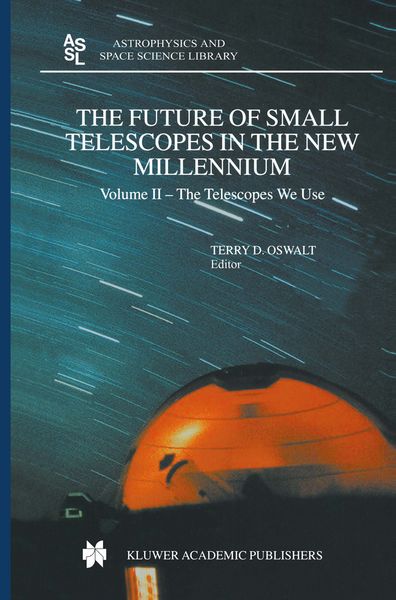
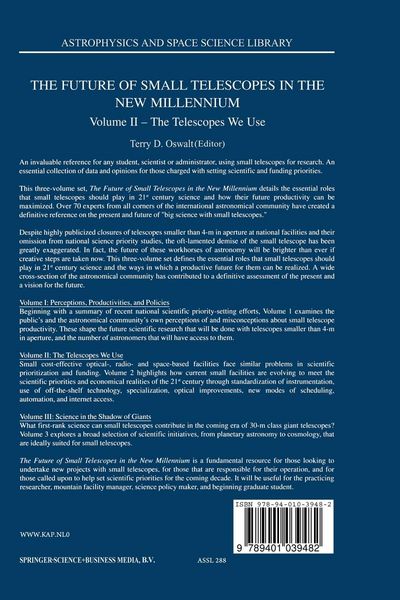
The Future of Small Telescopes in the New Millennium Volume I – Perceptions, Productivities, and Policies Volume II – The Telescopes We Use Volume III – Science in the Shadows of Giants
Aus der Reihe
Astrophysics and Space Science Library
-
- Taschenbuch ausgewählt
-
Sprache:Englisch
Fr. 360.00
inkl. gesetzl. MwSt.,
Beschreibung
Produktdetails
Einband
Taschenbuch
Erscheinungsdatum
21.10.2012
Herausgeber
Terry D. OswaltVerlag
Springer NetherlandSeitenzahl
1031
Maße (L/B/H)
23.5/15.5/2 cm
Gewicht
546 g
Auflage
1. Auflage
Sprache
Englisch
ISBN
978-94-010-3948-2
The motivation for these volumes is to provide a vision for the future of small telescopes. While this is an admirable task, ultimately I believe that as happens all the time in science - the prognostications will be overtaken by a rapidly changing scientific reality. As Virginia Trimble points out in chapter 1, the kinds of big questions that face us as astronomers today are rather different than the ones that drove the construction of astronomical facilities through much of the twentieth century. Right now, it appears that small telescopes will not have a lot of influence in answering those questions, though they will of course contribute enormously to the many issues discussed throughout the three volumes. Weare on the verge of opening a whole new parameter space that may revolutionize the way we think of small telescopes and their role in astronomy - the domain of the rapidly variable sky. While the LSST is the most prominent example, it is a long way in the future. Nemiroff & Rafert (chapter 2) consider the value of monitoring large parts of the sky on a continuous basis, using technology similar to a webcam. They have installed their CONCAM2 at four locations, including Kitt Peak. A related project, built and operated by the Harvard graduate student Gaspar Bakos - HAT-l (Hungarian Automated Telescope) - also is in operation at Kitt Peak.
Noch keine Bewertungen vorhanden
Verfassen Sie die erste Bewertung zu diesem Artikel
Helfen Sie anderen Kundinnen und Kunden durch Ihre Meinung.