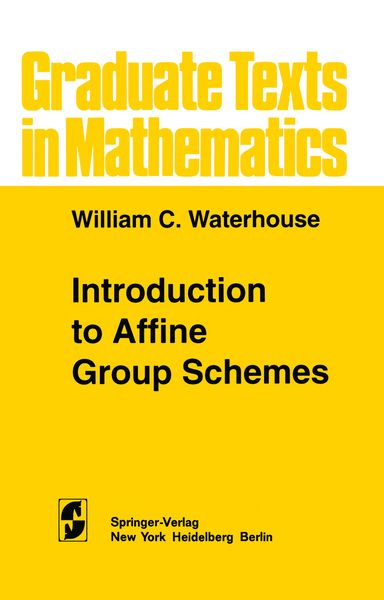

• Produktbild: Introduction to Affine Group Schemes
  • Produktbild: Introduction to Affine Group Schemes
Band 66

Introduction to Affine Group Schemes

Fr. 126.00

inkl. gesetzl. MwSt., Versandkostenfrei


Beschreibung

Produktdetails

Einband

Taschenbuch

Erscheinungsdatum

12.10.2011

Verlag

Springer Us

Seitenzahl

164

Maße (L/B/H)

23.5/15.5/1.1 cm

Gewicht

283 g

Auflage

Softcover reprint of the original 1st ed. 1979

Sprache

Englisch

ISBN

978-1-4612-6219-0

Beschreibung

Produktdetails

Einband

Taschenbuch

Erscheinungsdatum

12.10.2011

Verlag

Springer Us

Seitenzahl

164

Maße (L/B/H)

23.5/15.5/1.1 cm

Gewicht

283 g

Auflage

Softcover reprint of the original 1st ed. 1979

Sprache

Englisch

ISBN

978-1-4612-6219-0

Herstelleradresse

Springer-Verlag KG
Sachsenplatz 4-6
1201 Wien
AT

Email: GPSR Kontakt

Noch keine Bewertungen vorhanden

Verfassen Sie die erste Bewertung zu diesem Artikel

Helfen Sie anderen Kundinnen und Kunden durch Ihre Meinung.

Kundinnen und Kunden meinen

Bewertungen (0)

  • Produktbild: Introduction to Affine Group Schemes
  • Produktbild: Introduction to Affine Group Schemes
  • I The Basic Subject Matter.- 1 Affine Group Schemes.- 1.1 What We Are Talking About.- 1.2 Representable Functors.- 1.3 Natural Maps and Yoneda’s Lemma.- 1.4 Hopf Algebras.- 1.5 Translating from Groups to Algebras.- 1.6 Base Change.- 2 Affine Group Schemes: Examples.- 2.1 Closed Subgroups and Homomorphisms.- 2.2 Diagonalizable Group Schemes.- 2.3 Finite Constant Groups.- 2.4 Cartier Duals.- 3 Representations.- 3.1 Actions and Linear Representations.- 3.2 Comodules.- 3.3 Finiteness Theorems.- 3.4 Realization as Matrix Groups.- 3.5 Construction of All Representations.- 4 Algebraic Matrix Groups.- 4.1 Closed Sets in kn.- 4.2 Algebraic Matrix Groups.- 4.3 Matrix Groups and Their Closures.- 4.4 From Closed Sets to Functors.- 4.5 Rings of Functions.- 4.6 Diagonalizability.- II Decomposition Theorems.- 5 Irreducible and Connected Components.- 5.1 Irreducible Components in kn.- 5.2 Connected Components of Algcbraic Matrix Groups.- 5.3 Components That Coalesce.- 5.4 Spec A.- 5.5 The Algebraic Meaning of Connectedness.- 5 6 Vista: Schemes.- 6 Connected Components and Separable Algebras.- 6.1 Components That Decompose.- 6.2 Separable Algebras.- 6.3 Classification of Separable Algebras.- 6.4 Etale Group Schemes 49 6 5 Separable Subalgcbras.- 6.5 Separable Subalgcbras.- 6.6 Connected Group Schemes.- 6.7 Connected Components of Group Schemes.- 6.8 Finite Groups over Perfect Fields.- 7 Groups of Multiplicative Type.- 7.1 Separable Matrices.- 7.2 Groups of Multiplicative Type.- 7.3 Character Groups.- 7.4 Anisotropic and Split Tori.- 7.5 Examples of Tori.- 7.6 Some Automorphism Group Schcmes.- 7.7 A Rigidity Theorem.- 8 Unipotent Groups.- 8.1 Unipotent Matrices.- 8 2 The Kolchin Fixed Point Theorem.- 8.3 Unipotent Group Schemes.- 8.4 Endomorphisms of Ga..- 8.5 Finite Unipotent Groups.- 9 Jordan Decomposition.- 9.1 Jordan Decomposition of a Matrix.- 9.2 Decomposition in Algebraic Matrix Groups.- 9.3 Decomposition of Abelian Algebraic Matrix Groups.- 9.4 Irreducible Representations of Abelian Group Schemes.- 9.5 Decomposition of Abelian Group Schemes.- 10 Nilpotent and Solvable Groups.- 10.1 Derived Subgroups.- 10.2 The Lie-Kolchin Triangularization Theorem.- 10.3 The Unipotent Subgroup.- 10.4 Decomposition of Nilpotent Groups.- 10.5 Vista: Borel Subgroups.- 10.6 Vista: Differential Algebra.- III The Infinitesimal Theory.- 11 Differentials.- 11.1 Derivations and Differentials.- 11.2 Simple Properties of Differentials.- 11.3 Differentials of Hopf Algebras.- 11.4 No Nilpotents in Characteristic Zero.- 11.5 Differentials of Field Extensions.- 11.6 Smooth Group Schemes.- 11.7 Vista: The Algebro-Geomctric Meaning of Smoothness.- 11.8 Vista: Formal Groups.- 12 Lie Algebras.- 12.1 Invariant Operators and Lie Algebras.- 12.2 Computation or Lie Algebras.- 12.3 Examples.- 12.4 Subgroups and Invariant Subspaces.- 12.5 Vista: Reductive and Semisimple Groups.- IV Faithful Flatness and Quotients.- 13 Faithful Flatness.- 13.1 Definition of Faithful Flatness.- 13.2 Localization Properties.- 13.3 Transition Properties.- 13.4 Generic Faithful Flatness.- 13.5 Proof of the Smoothness Theorem.- 14 Faithful Flatness of Hopf Algebras.- 14.1 Proof in the Smooth Case.- 14.2 Proof with Nilpotents Present.- 14.3 Simple Applications.- 14.4 Structure of Finite Connected Groups.- 15 Quotient Maps.- 15.1 Quotient Maps.- 15.2 Matrix Groups over$$ bar k $$/k.- 15.3 Injections and Closed Kmbeddings.- 15.4 Universal Property of Quotients.- 15.5 Sheaf Property of Quotients.- 15.6 Coverings and Sheaves.- 15.7 Vista: The Etale Topology.- 16 Construction of Quotients.- 16.1 Subgroups as Stabilizers.- 16.2 Difficulties with Coset Spaces.- 16.3 Construction of Quotients.- 16.4 Vista: Invariant Theory.- V Descent Theory.- 17 Descent Theory Formalism.- 17.1 Descent Data.- 17.2 The Descent Theorem.- 17.3 Descent of Algebraic Structure.- 17.4 Example: Zariski Coverings.- 17.5 Construction of Twisted Forms.- 17.6 Twisted Forms and Cohomology.- 17.7 Finite Galois Extensions.- 17.8 Infinite Galois Extensions.- 18 Descent Theory Computations.- 18.1 A Cohomology Exact Sequence.- 18.2 Sample Computations.- 18.3 Principal Homogeneous Spaces.- 18.4 Principal Homogeneous Spaces and Cohomology.- 18.5 Existence of Separable Splitting Fields.- 18.6 Example: Central Simple Algebras.- 18.7 Example: Quadratic Forms and the Arf Invariant.- 18.8 Vanishing Cohomology over Finite Fields.- Appendix: Subsidiary Information.- A.1 Directed Sets and Limits.- A.2 Exterior Powers.- A.3 Localization. Primes, and Nilpotents.- A.4 Noetherian Rings.- A.5 The Hilbert Basis Theorem.- A.6 The Krull Intersection Theorem.- A.7 The Nocthcr Normalization Lemma.- A.8 The Hilbert Nullstellensatz.- A.9 Separably Generated Fields.- A.10 Rudimentary Topological Terminology.- Further Reading.- Index of Symbols.