Band 289
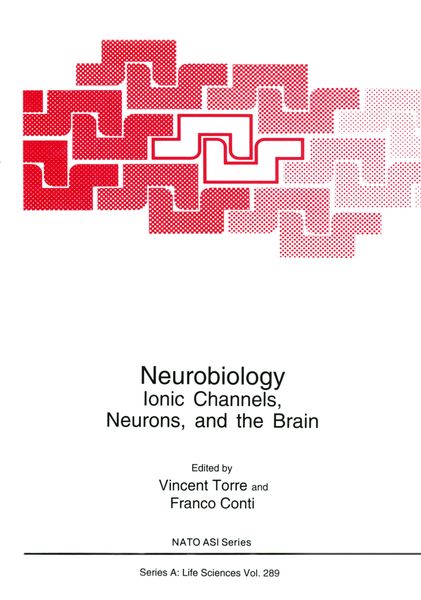
Neurobiology Ionic Channels, Neurons and the Brain
Aus der Reihe
NATO Science Series A:
-
- Hardcover
- Taschenbuch ausgewählt
- eBook
-
Sprache:Englisch
Fr. 72.90
inkl. gesetzl. MwSt.,
Beschreibung
Produktdetails
Einband
Taschenbuch
Erscheinungsdatum
23.10.2012
Abbildungen
IX, 393 p.
Herausgeber
Franco Conti + weitereVerlag
Springer UsSeitenzahl
393
Maße (L/B/H)
25.4/17.8/2.3 cm
Gewicht
764 g
Auflage
1996
Sprache
Englisch
ISBN
978-1-4613-7706-1
Understanding how the brain works is undoubtedly the greatest challenge for human intelligence and one of the most ambitious goals of contemporary science. We are certainly far from this goal, but significant advancements in several fields of Neuroscience and Neurobiology are being obtained at an increasing pace. The NATO ASI School in Neurobiology, held in Erice May 2-12,1995, as the 23rd Course of the International School of Biophysics, provided an update on three basic topics: Biophysics and Molecular Biology ofIon Channels, Sensory Transduction, and Higher Order Functions. Current knowledge on these subjects was covered by formal lectures and critical discussions between lecturers and participants. This book collects original contributions from those scientists who attended the School. Many students presented their results in poster sessions, steering lively informal discussions. A selection of these contributions is also included. A major portion of the program of the School was devoted to a general overview of current trends of thought and experimental approaches in neurobiology, emphasising the importance of understanding molecular aspects of the elementary events underlying sensory transduction and processing in the nervous system, without indulging however in a pure reductionistic view of such complex phenomena. Recent studies of molecular biology and the electrophysiology of heterologously expressed ionic channels, have shed new light on the molecular mechanisms underlying ionic permeation of excitable membranes and its regulation by physical and chemical parameters.
Noch keine Bewertungen vorhanden
Verfassen Sie die erste Bewertung zu diesem Artikel
Helfen Sie anderen Kundinnen und Kunden durch Ihre Meinung.