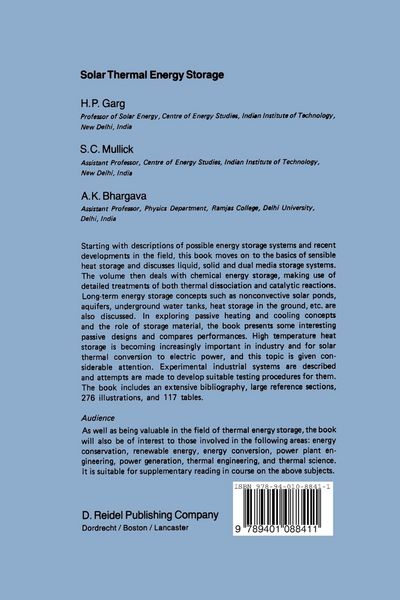
• Produktbild: Solar Thermal Energy Storage
  • Produktbild: Solar Thermal Energy Storage

Solar Thermal Energy Storage

Fr. 359.00

inkl. gesetzl. MwSt., Versandkostenfrei


Beschreibung

Produktdetails

Einband

Taschenbuch

Erscheinungsdatum

19.10.2011

Verlag

Springer Netherland

Seitenzahl

642

Maße (L/B/H)

23.5/15.5/3.6 cm

Auflage

Softcover reprint of the original 1st ed. 1985

Sprache

Englisch

ISBN

978-94-010-8841-1

Beschreibung

Rezension

`
...compulsory reading for those doing research in solar energy storage.
'

International Journal of Heat Mass Transfer, 30 (1987)

Produktdetails

Einband

Taschenbuch

Erscheinungsdatum

19.10.2011

Verlag

Springer Netherland

Seitenzahl

642

Maße (L/B/H)

23.5/15.5/3.6 cm

Auflage

Softcover reprint of the original 1st ed. 1985

Sprache

Englisch

ISBN

978-94-010-8841-1

Herstelleradresse

Springer-Verlag GmbH
Tiergartenstr. 17
69121 Heidelberg
DE

Email: ProductSafety@springernature.com

Kundinnen und Kunden meinen

0 Bewertungen

Informationen zu Bewertungen

Zur Abgabe einer Bewertung ist eine Anmeldung im Konto notwendig. Die Authentizität der Bewertungen wird von uns nicht überprüft. Wir behalten uns vor, Bewertungstexte, die unseren Richtlinien widersprechen, entsprechend zu kürzen oder zu löschen.

Die Bewertungen sind nach Format, Anzahl Sterne und Datum sortiert.

Verfassen Sie die erste Bewertung zu diesem Artikel

Helfen Sie anderen Kund*innen durch Ihre Meinung

Kundinnen und Kunden meinen

0 Bewertungen filtern

  • Produktbild: Solar Thermal Energy Storage
  • Produktbild: Solar Thermal Energy Storage
  • 1 Importance and modes of energy storage.- 1.1 The importance of energy storage.- 1.2 Influence of type and extent of mismatch on storage.- 1.3 Size and duration of storage.- 1.4 Applications.- 1.4.1 Stationary applications.- 1.4.2 Transport applications.- 1.5 Quality of energy and modes of energy storage.- 1.6 Thermal energy storage.- 1.6.1Sensible heat storage.- 1.6.2 Storage in phase change materials (PCM).- 1.7 Mechanical energy storage.- 1.7.1 Storage as potential energy.- 1.7.2 Storage as kinetic energy.- 1.7.3 Energy storage in a compressed gas.- 1.8 Electrical and magnetic energy storage.- 1.8.1 Storage in electrical cap ac i tors.- 1.8.2 Storage in electromagnets.- 1.8.3 Storage in magnets with superconducting coils.- 1.8.4 Storage in a battery.- 1.9 Chemical energy storage.- 1.9.1 Synthetic fuels.- 1.9.2 Thermochemical storage.- 1.9.3 Electrochemical storage.- 1.9.4 Photochemical storage.- References.- 2 Sensible heat storage.- 2.1 Sensible heat storage basics.- 2.2 Sensible heat storage and type of load.- 2.3 Sensible heat storage media.- 2.4 Well-mixed liquid storage.- 2.5 Stratified liquid storage.- 2.5.1 Analytical studies on thermally stratified hot water tanks.- 2.5.2 Experimental studies on thermally stratified hot water storage tanks.- 2.5.3 Forced stratification in liquids.- 2.6 Containers for water storage.- 2.7 Packed bed storage system.- References.- Appendix -I.- Appendix - II.- 3 Latent heat or phase change thermal energy storage.- 3.1 Basics of latent heat storage.- 3.1.1 Heat of fusion (Latent heat).- 3.1.2 Employment of latent heat storage system.- 3.2 Liquid-solid transformation.- 3.2.1 Nucleation and supercooling.- 3.2.2 The rate of crystal growth.- 3.2.3 Types of solidification or crystallization.- 3.2.4 Melting and freezing characteristics.- 3.2.5 Interpretation of freezing curves.- 3.2.6 Relative rates of heat and mass transport.- 3.2.7 Binary phase diagrams.- 3.3 Phase change materials (PCM).- 3.3.1 Solid-solid transitions.- 3.3.2 Solid-liquid transformations.- i) Salt hydrates.- ii) Other inorganic compounds.- iii) Paraffins.- iv) Non paraffin organic solids.- v) Clathrate and semi-clathrate hydrates.- vi)Eutectics.- 3.4 Selection of PCM.- 3.5 Storage in salt hydrates.- 3.5.1 Nucleation and crystallization.- 3.5.2 Incongruent melting.- 3.5.3 Thickening agents.- 3.5.4 Some promising salt hydrates and the binary phase diagrams.- 3.6 Prevention of incongruent melting and thermal cycling.- 3.6.1 Thickening agents.- 3.6.2 Extra water principle.- 3.6.3 Rolling cylinder method.- 3.6.4 Adding SrCl2 6H2 C in CaCl2 H2O system.- 3.7 Storage in paraffins.- 3.8 Heat transfer in PCM.- 3.8.1 Freezing of tops of ponds.- 3.8.2 An approximate analytical model for a periodic process.- 3.8.3 Heat-exchange with fluid-flow between trays holding PCM.- 3.9 Heat exchange arrangement and containment of PCM.- 3.9.1 Encapsulation of PCM.- 3.9.2 Containment.- 3.9.3 Compatibility.- 3.9.4 Special heat exchangers for PCM.- (A) Passive systems.- (B) Active systems.- 3.10 Storage in PCM undergoing solid-solid transition.- 3.10.1 Storage in modified high density polyethylene (HDPE).- 3.10.2 Storage in layer perovskites and other organometallic compounds.- 3.11 Heat of solution storage and heat exchangers.- 3.11.1 Crystallization from saturated solution.- 3.11.2 Heat exchangers in heat-of-solution storage system.- References.- 4 Chemical energy storage.- 4.1 Introduction.- 4.2 Selection Criterion.- 4.2.1 Thermodynamic considerations.- 4.2.2 Reversibility.- 4.2.3 Reaction rates.- 4.2.4 Controllability.- 4.2.5 Ease of storage.- 4.2.6 Safety.- 4.2.7 Availability and Cost.- 4.2.8 Product separation.- 4.2.9 Reaction with water and oxygen.- 4.2.10 Technology.- 4.2.11 Catalyst availability and lifetime.- 4.3 Energy storage in thermal dissociation type of reactions.- 4.3.1 Thermal dissociation of SO3.- 4.3.2 Dissociation of Ammonia.- 4.3.3 Thermal dissociation of inorganic hydroxides.- 4.3.4 Thermal decomposition of carbonates.- 4.3.5 Decomposition of sulfates.- 4.3.6 Thermal decomposition of CS2.- 4.3.7 Organic hydrogenation/dehydrogenation reaction.- 4.3.8 Thermal dissociation of ammoniated salts.- 4.3.9 Oxides-Peroxides and super oxides decomposition.- 4.3.10 Hydride decomposition.- 4.3.11 The reaction N2 O4 2N0+02.- 4.4 Methane based reactions.- 4.5 Heat transformation (HT) and chemical heat pumps (CHP).- 4.5.1 Working materials for CHP and HT.- 4.5.2 Thermal efficiency of CHP cycles.- 4.5.3 Ammoniates based CHP.- 4.5.4 Salt hydrates in chemical heat pump.- 4.5.5 Hydrides in CHP and HT.- 4.5.6 Methanolated salts.- 4.5.7 Heat of solution systems.- 4.6 Three step approach.- 4.7 Energy storage by adsorption.- References.- 5 Longterm energy storage.- 5.1 Solar ponds.- 5.1.1 Classification of solar ponds.- i) Shallow solar pond.- ii) Salt gradient solar ponds.- iii) Partitioned solar pond (PSP).- iv) Viscosity stabilized ponds.- v) Membrane stratified solar pond.- vi) Saturated solar pond.- 5.1.2 Thermal stability of solar ponds.- 5.1.3 Salt properties.- 5.1.4 Passage of solar insolation into solar pond.- 5.1.5 Creation and maintenance of solar pond.- 5.1.6 Performance analysis of a solar pond.- 5.1.7 Heat extraction.- 5.1.8 Applications.- i) Space heating.- ii) Domestic water or swimming pool heating.- iii) Industrial process heat.- iv) Power production.- v) Desalination.- 5.1.9 Some remarks.- 5.2 Energy storage in aquifers.- 5.2.1 Operational strategies.- 5.2.2 Theoretical studies.- 5.2.3 Characteristics of the aquifer.- 5.3 Heat storage in underground water tanks.- 5.4 Heat storage in the ground.- References.- 6 Energy storage in building materials.- 6.1 Introduction.- 6.2 Basic passive designs.- 6.2.1 Direct gain systems.- 6.2.2 Convective loops.- 6.2.3 Thermal storage walls.- 6.2.4 Roof ponds.- 6.2.5 Attached sunspace.- 6.3 PCM in building panels.- 6.4 Experiments on PCM building panels.- 6.5 Applications.- References.- 7 High temperature heat storage.- 7.1 Introduction.- 7.2 Techniques for thermal energy storage.- 7.3 Sensible heat storage systems.- 7.3.1 Rock bed storage system.- 7.3.2 Rock bed-liquid (Dual medium) storage system.- 7.3.3 Two stage thermal storage in unpressurized liquids.- 7.3.4 Molten slag storage system.- 7.3.5 Thermal storage in large hollow steel ingots.- 7.3.6 Thermal energy storage in sand (fluidized bed).- 7.4 Phase change energy storage systems and ceramic pellets.- 7.4.1 Phase change salt and ceramic 570 pellets with air as working fluid.- 7.4.2 Phase change salt/metal storage systems.- 7.4.3 Phase change storage material with heat exchanger.- 7.4.4 Energy storage boiler.- 7.4.5 Storage heat in PCM and use of scraper for removing solid boundary layer.- 7.5 Chemical reactions.- 7.5.1 Catalytic decomposition reactions.- 7.5.2 Thermal dissociation reactions.- References.- 8 Testing of thermal energy storage system.- 8.1 Introduction.- 8.2 Historical development.- 8.3 Related studies.- 8.4 Basis and evolution of testing procedures.- 8.5 Standard procedure.- 8.5.1 ASHRAE 94-77.- 8.5.2 NBSIR 74-634.- 8.6 Some comments.- References.- Appendices.- Appendix 1 Conversion of units.- Appendix 2 Physical properties of some solid materials.- Appendix 3 Physical properties of some building and insulating materials.- Appendix 4 Physical properties of some liquids.- Appendix 5 Physical properties of some liquid metals.- Appendix 6 Physical properties of saturated water.- Appendix 7 Physical properties of saturated steam.- Appendix 8 Physical properties of some gases.- Appendix 9 Physical properties of dry air at atmospheric pressure.- Appendix 10 Freezing points of aqueous solutions.- Appendix11 Properties of typical refrigerants.- Appendix 12 Storage capacities.- Appendix 13 Properties of some promising latent-heat thermal energy storage materials.- Appendix 14 Solubility behavior of candidate salts for salt-gradient solar pond.