• Produktbild: Modern Agriculture and the Environment
  • Produktbild: Modern Agriculture and the Environment
Band 71

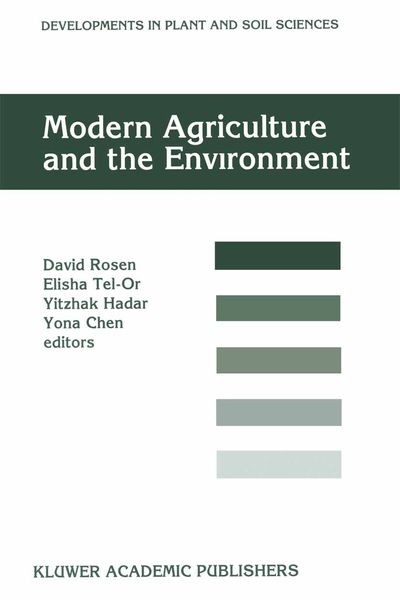
Modern Agriculture and the Environment Proceedings of an International Conference, held in Rehovot, Israel, 2–6 October 1994, under the auspices of the Faculty of Agriculture, the Hebrew University of Jerusalem

Fr. 72.90

inkl. gesetzl. MwSt., Versandkostenfrei


Beschreibung

Produktdetails

Einband

Taschenbuch

Erscheinungsdatum

06.11.2012

Herausgeber

David Rosen + weitere

Verlag

Springer Netherland

Seitenzahl

646

Maße (L/B/H)

24/16/3.6 cm

Gewicht

1056 g

Auflage

Softcover reprint of the original 1st ed. 1997

Sprache

Englisch

ISBN

978-94-010-6279-4

Beschreibung

Rezension

`
This wide coverage of different aspects of the environmental problems related to agriculture will be a valuable text for agriculturists, policy makers and environmentalists as well as for students and researchers dealing with soil productivity.
'

Agrochimica, XLI:5 (1997)

Produktdetails

Einband

Taschenbuch

Erscheinungsdatum

06.11.2012

Herausgeber

Verlag

Springer Netherland

Seitenzahl

646

Maße (L/B/H)

24/16/3.6 cm

Gewicht

1056 g

Auflage

Softcover reprint of the original 1st ed. 1997

Sprache

Englisch

ISBN

978-94-010-6279-4

Herstelleradresse

Springer-Verlag GmbH
Tiergartenstr. 17
69121 Heidelberg
DE

Email: ProductSafety@springernature.com

Kundinnen und Kunden meinen

0 Bewertungen

Informationen zu Bewertungen

Zur Abgabe einer Bewertung ist eine Anmeldung im Konto notwendig. Die Authentizität der Bewertungen wird von uns nicht überprüft. Wir behalten uns vor, Bewertungstexte, die unseren Richtlinien widersprechen, entsprechend zu kürzen oder zu löschen.

Die Bewertungen sind nach Format, Anzahl Sterne und Datum sortiert.

Verfassen Sie die erste Bewertung zu diesem Artikel

Helfen Sie anderen Kund*innen durch Ihre Meinung

Kundinnen und Kunden meinen

0 Bewertungen filtern

  • Produktbild: Modern Agriculture and the Environment
  • Produktbild: Modern Agriculture and the Environment
  • Section I: Towards Environmentally Acceptable Pest Management.- 1. Safer and more effective insecticides for the future.- 2. From Homo economicus to Homo ecologicus: towards environmentally safe pest control.- 3. Classical biological control: an environmental boon or bane?.- 4. Soil disinfestation: environmental problems and solutions.- 5. Minimizing environmental damage originating from pesticide utilization: abiotic photochemical control and remediation.- 6. Neem, eco-friendly, IPM-compatible plant-derived bioinsecticide: some new findings.- 7. Utilization of scorpion insecticidal neurotoxins and baculoviruses for the design of novel selective biopesticides.- 8. Nitrogen fixing cyanobacteria as BTi toxin genes delivery system — a biotechnological approach to control malaria mosquitoes.- 9. Structure-function analysis of PBAN/MRCH: a basis for antagonist design.- 10. Estimation of metolachlor volatilization from agricultural fields using a micrometeorological approach.- 11. Titanium dioxide photocatalysis for the treatment of contaminated waters.- Section II: Fertilisers in Agroecosystems.- 12. Site-oriented ecosystem management: precondition to reducing the contamination of waters and the atmosphere.- 13. Minimising surface and ground-water pollution from fertiliser applications.- 14. Considerations in fertiliser application to prevent ground-water contamination.- 15. Application of controlled release fertilisers in the Florida citrus industry.- Section III: Environmental Aspects of Aquaculture.- 16. Aquaculture and the environment: change and challenge.- 17. Biological removal of inorganic nitrogen and organic matter in closed, intensive fish culture systems.- 18. Ultrastructure and cellular activity of fish skin in metal-polluted water.- Section IV: Modelling ofAgricultural Pollution.- 19. Modelling pesticide transport in porous media.- 20. Comparative ecosystem research as a basis for agro-ecological modelling.- 21. Application of EPIC within an integrated modelling system to evaluate soil erosion in the Canadian Prairies.- 22. A model to predict the release rate of nitrogen from polymer-coated urea.- Section V: Wastewater Treatment and Irrigation.- 23. Sewage sludge: land utilisation and the environment: toxic organic considerations.- 24. New technologies for disinfection of domestic effluents for agricultural reuse.- 25. Effects of irrigation with secondary sewage effluent on the transport of soil-borne pesticides.- 26. Early detection of irrigation environmental risks using monitoring manholes: a case study of the Southern Ukraine.- 27. Use of wastewater from livestock farms for irrigation in Yugoslavia.- Section VI: Recycling of Municipal and Agricultural Wastes.- 28. Composting and recycling of organic wastes.- 29. Impacts of compost quality on plant disease severity.- 30. Suppressiveness of municipal solid waste composts to plant diseases induced by soilborne pathogens.- 31. On the agronomic use of municipal solid waste compost: principles and applications.- 32. Chemical and electron spin resonance properties of municipal solid waste composts.- 33. Variations with pedoclimatic conditions of an anaerobically digested liquid sewage sludge C mineralisation and its N-NO3-availability.- 34. Solid waste management in Israel.- Section VII: Pollution by Heavy Metals.- 35. Biofiltration of heavy metals by the aquatic fern Azolla.- 36. Modelling the mobilising effect of olive mill wastewater on heavy metals adsorbed by a soil.- 37. Soil microbial biomass as marker of heavy metal contamination and bioavailability.- 38. Copper andlead species in soil and their uptake by plants when applied as carbonates.- 39. Levels of copper, zinc and manganese in the vineyard soils of Dão wine region — Portugal.- Section VIII: Bioremediation.- 40. Bioremediation in agriculture: dream or reality?.- 41. Microbial transformation of pesticides in agricultural soil.- 42. Biological atrazine destruction mediated by bacteria.- 43. Removal of lead from aqueous solutions by a Brevibacterium strain.- 44. Polycyclic aromatic hydrocarbon degradation by white rot fungi.- 45. Potential utilisation of phenoloxidases immobilised in organic gels for decontamination of polluted sites.- Section IX: Economic and Policy Aspects of Natural Resources.- 46. Economics and sustainable development.- 47. Homogeneity and heterogeneity of bio-resources in economic models.- 48. Problems and prospects in the political economy of trans-boundary water issues.- 49. Australian decentralised water allocation.- 50. The practical impact of ecological chemical principles.- 51. Reuse of effluent: Israel as a model.