
KI-Beratung Beta

Gutscheinbedingungen

*Gültig bis 08.11.2026 auf (fast) alles. Ausgeschlossen sind tolino shine, Smartboxen, Zeitschriften, Tickets, Lebensmittel, Gaming-Elektroartikel, Tinte/Toner, Gutscheine, Geschenkkarten, Blumen, Dienstleistungen und Abos | Einlösbar in allen Buchhandlungen von Orell Füssli (ausser bei Transa Books), Barth Bücher, Buchladen Rapunzel, Papeterie Köhler, Schuler Orell Füssli, Stauffacher und ZAP unter Vorweisung des Gutscheins, auf orellfüssli.ch durch Eingabe des Gutscheincodes. Beim Service „eBooks verschenken“ und bei eBook-Käufen via eReader nicht einlösbar | Mindesteinkaufswert: Fr. 30.- | Nicht mit anderen Rabatten kumulierbar.

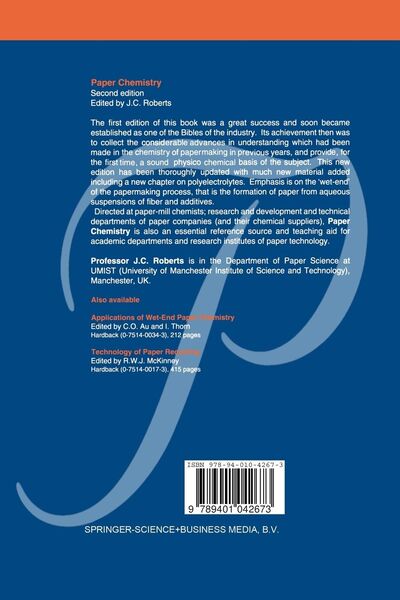
  • Produktbild: Paper Chemistry
  • Produktbild: Paper Chemistry

Paper Chemistry

Fr. 241.00

inkl. gesetzl. MwSt., Versandkostenfrei


Beschreibung

Produktdetails

Einband

Taschenbuch

Erscheinungsdatum

18.09.2012

Abbildungen

XIII, 267 p.

Herausgeber

J.C. Roberts

Verlag

Springer Netherland

Seitenzahl

267

Maße (L/B/H)

23.5/15.5/1.6 cm

Gewicht

435 g

Auflage

Second Edition 1996

Sprache

Englisch

ISBN

978-94-010-4267-3

Herstelleradresse

Springer-Verlag GmbH
Tiergartenstr. 17
69121 Heidelberg
DE

Email: ProductSafety@springernature.com

Noch keine Bewertungen vorhanden

Verfassen Sie die erste Bewertung zu diesem Artikel

Helfen Sie anderen Kundinnen und Kunden durch Ihre Meinung.

Kundinnen und Kunden meinen

Bewertungen (0)

  • Produktbild: Paper Chemistry
  • Produktbild: Paper Chemistry
  • 1 Applications of paper chemistry.- 1.1 Introduction.- 1.2 Paper chemical use in specific product grades.- 1.3 Trends in paper chemical use.- References.- 2 Accessibility of cellulose.- 2.1 Introduction.- 2.2 The concept of accessibility.- 2.3 Determination of crystallinity/accessibility of cellulose.- References.- 3 Electrokinetics of the papermaking industry.- 3.1 Introduction.- 3.2 The electrical double layer.- 3.3 Origin of the charge on papermaking fines, fibres, mineral pigments and fillers.- 3.4 The classical coagulation theory, DLVO theory.- 3.5 Electrophoresis and electrokinetic phenomena – calculation of the zeta potential.- 3.6 Some experimental methods of determining the zeta potential.- 3.7 Polyelectrolyte titrations.- References.- 4 Mechanisms of flocculation and stabilisation of suspensions by organic polymers.- 4.1 Introduction.- 4.2 Behaviour of suspensions of bare particles.- 4.3 A brief insight into polymer conformations in solution and at solid/liquid interfaces.- 4.4 Effect of nonionic polymers on suspension stability: Bridging flocculation and steric stabilization.- 4.5 Flocculation by polyelectrolytes.- 4.6 Conclusions.- References.- 5 Retention aids.- 5.1 Introduction.- 5.2 The chemical nature of retention aids.- 5.3 Mode of action of retention aids.- 5.4 Concluding remarks.- References.- 6 Dry-strength additives.- 6.1 Introduction.- 6.2 Cationic starch.- 6.3 Vegetable gums.- 6.4 Polyacrylamide resins.- References.- 7 Wet-strength chemistry.- 7.1 Introduction.- 7.2 Mechanisms of wet-strength development.- 7.3 The chemistry and application of commercial wet-strength resins.- 7.4 Testing of wet-strength papers.- 7.5 Assessing the efficiency of wet-strength resins.- 7.6 Future trends.- References.- 8 The sizing of paper with rosin and alum at acidpHs.- 8.1 Introduction.- 8.2 Background.- 8.3 Sizing theories.- 8.4 Rosin sizing at pHs greater than 5.5.- 8.5 Summary.- References.- 9 Neutral and alkaline sizing.- 9.1 Introduction.- 9.2 Reasons for changing to neutral sizing.- 9.3 Alkyl ketene dinners.- 9.4 Alkenyl succinic anhydride.- 9.5 Comparisons between AKD and ASA sizing.- 9.6 Neutral rosin sizing systems.- References.- 10 Dyes and fluorescent whitening agents for paper.- 10.1 Introduction.- 10.2 Basic concepts of colour.- 10.3 Classification of dyes and pigments.- 10.4 Dyes and pigments for paper.- 10.5 Application of dyes and pigments for paper.- 10.6 Fluorescent whitening agents (FWAs).- 10.7 Ecotoxicology.- Acknowledgements.- References.- 11 Physical and chemical aspects of the use of fillers in paper.- 11.1 Introduction.- 11.2 Filler properties.- 11.3 Retention.- 11.4 The effect of filler on paper properties.- 11.5 General summary.- References.- 12 Measurement and control.- 12.1 Introduction.- 12.2 Current status of wet-end chemistry measurement.- 12.3 Problems in measurement and control in wet-end chemistry.- 12.4 On-line wet-end chemistry instrumentation.- 12.5 Process control in wet-end chemistry.- 12.6 On-line retention monitoring systems.- 12.7 Monitoring of on-line surface charge.- 12.8 Methodology for complete automatic retention control.- 12.9 Applicability of new sensing devices and techniques.- 12.10 Concluding remarks.- References.- 13 Practical applications of paper chemistry.- 13.1 Introduction.- 13.2 Retention.- 13.3 Starch.- 13.4 Sizing.- 13.5 Deposit control.- 13.6 Difficulties and limitations of practical applications.- References.