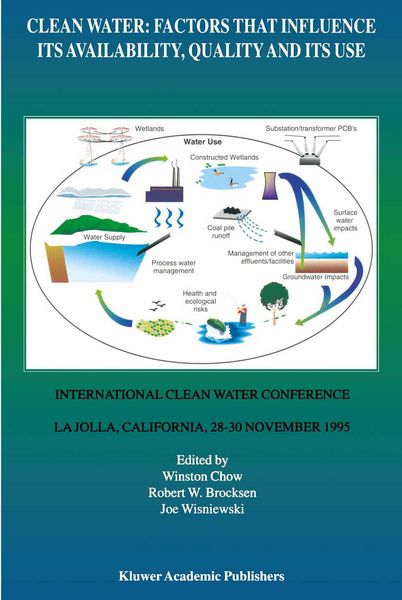
Clean Water: Factors that Influence Its Availability, Quality and Its Use International Clean Water Conference held in La Jolla, California, 28–30 November 1995
-
- Hardcover
- Taschenbuch ausgewählt
-
Sprache:Englisch
Fr. 72.90
inkl. gesetzl. MwSt.,
Beschreibung
Produktdetails
Einband
Taschenbuch
Erscheinungsdatum
20.09.2011
Abbildungen
IX, 354 p.
Herausgeber
Winston Chow + weitereVerlag
Springer NetherlandSeitenzahl
354
Maße (L/B/H)
24/16/2 cm
Gewicht
588 g
Auflage
Softcover reprint of the original 1st ed. 1996
Sprache
Englisch
ISBN
978-94-010-6619-8
ACKNOWLEDGEMENTS IX PART I CONFERENCE SUMMARY STATEMENT R. W. BROCKSEN, W. CHOW, E. D. DAUGHERTY, Y. G. MUSSALLI, J. WISNIEWSKI and A. L. WOODIS I Clean Water: Factors that Influence its Availability, Quality and its Use: Summary of the International Water Conference 3-7 PART II WATER RESOURCE OVERVIEWS S. PECK I Managing and Protecting Our Water Resources 11-20 R. BROCKSEN, W. CHOW and K. CONNOR I Addressing Electric Utility Surface Water Challenges 21-29 C. LOHSE-HANSON I Lake Superior Binational Program: The Role of Electric Utilities 31-40 J. A. VEIL and D. O. MOSES I Consequences of Proposed Changes to Clean Water Act Thermal Discharges 41-52 PART III ECOLOGICAL I HEALTH RISKS c. SEIGNEUR, E. CONSTANTINOU and L. LEVIN I Multipathway Health Risk Assessment of Power Plant Water Discharges 55-64 C. W. CHEN, J. HERR, R. A. GOLDSTEIN, F. J. SAGONA, K. E. RYLANT and G. E. HAUSER I Watershed Risk Analysis Model for TVA's Holston River Basin 65-70 S. FERSON, L. R. GINZBURG and R. A. GOLDSTEIN I Inferring Ecological Risk from Toxicity Bioassays 71-82 C. ARQUIETT, M. GERKE and I. DATSKOU I Evaluation of Contaminated Groundwater Cleanup Objectives 83-92 G. L. BOWIE, J. G. SANDERS, G. F. RIEDEL, C. C. GILMOUR, D. L. BREITBURG, G. A. CUTIER and D. B. PORCELLA / Assessing Selenium Cycling and Accumulation in Aquatic Ecosystems 93-104 D. W. RODGERS, J. SCHRODER and L.
Noch keine Bewertungen vorhanden
Verfassen Sie die erste Bewertung zu diesem Artikel
Helfen Sie anderen Kundinnen und Kunden durch Ihre Meinung.