
KI-Beratung Beta

  • Produktbild: Handbook of Psychopharmacology
  • Produktbild: Handbook of Psychopharmacology

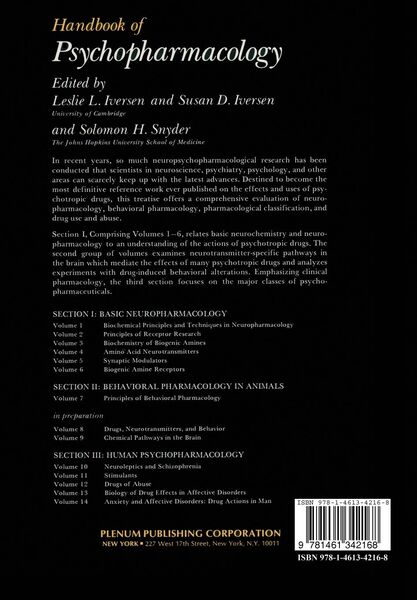
Handbook of Psychopharmacology Volume 7: Principles of Behavioral Pharmacology

Fr. 72.90

inkl. gesetzl. MwSt., Versandkostenfrei


Beschreibung

The first six volumes of the Handbook reviewed basic neuropharmacology, drawing on expertise in biochemistry, pharmacology and electrophysiology. The next three volumes focus attention on the functional importance of these basic neuropharmacological mechanisms for normal behavior. In order to study this...

Beschreibung

The first six volumes of the Handbook reviewed basic neuropharmacology, drawing on expertise in biochemistry, pharmacology and electrophysiology. The next three volumes focus attention on the functional importance of these basic neuropharmacological mechanisms for normal behavior. In order to study this interface in the intact functioning organism, appropriate methods for describing and quantifying behavior must be developed. The past twenty years have witnessed a revolution in the study of behavior which has taken us away from the often fruitless theoretical arguments to descriptive behaviorism. Technical achievements in the design of apparatus and the recording of behavior played an important role in these developments, and the resultant behavioral methods have been accepted and found useful in studying the effects of drugs. The development of psycho pharmacology as a discipline owes as much to these behavioral methods as it does to the basic neuropharmacological techniques pioneered for in vitro studies. In the first section of Volume 7, an effort has been made to provide reviews both of theory and practice in behavioral science. Milner's chapter deals with the concept of motivation in a theoretical framework. By contrast, the chapters by Morse et al. and Dews and DeWeese provide a more descriptive view of the various ways in which aversive stimuli control behavior and the importance of schedules of reinforcement in determining the profile of responding in the animal. The equal importance of observational behav ioral methods is well illustrated by Mackintosh et al.

Produktdetails

Einband

Taschenbuch

Erscheinungsdatum

05.11.2011

Abbildungen

XVI, 454 p.

Herausgeber Leslie Iversen

Produktdetails

Einband

Taschenbuch

Erscheinungsdatum

05.11.2011

Abbildungen

XVI, 454 p.

Herausgeber Leslie Iversen
Verlag Springer Us
Seitenzahl

454

Maße (L/B/H)

24.4/17/2.6 cm

Gewicht

808 g

Auflage

Softcover reprint of the original 1st ed. 1977

Sprache

Englisch

ISBN

978-1-4613-4216-8

Herstelleradresse

Springer-Verlag KG
Sachsenplatz 4-6
1201 Wien
AT

Email: ProductSafety@springernature.com

Noch keine Bewertungen vorhanden

Verfassen Sie die erste Bewertung zu diesem Artikel

Helfen Sie anderen Kundinnen und Kunden durch Ihre Meinung.

Kundinnen und Kunden meinen

Bewertungen (0)

  • Produktbild: Handbook of Psychopharmacology
  • Produktbild: Handbook of Psychopharmacology
  • Methods for Studying Unconditioned and Conditioned Behavior.- 1 The Contribution of Ethological Techniques to the Study of Drug Effects.- 2 A Critique of the Methods Available for the Measurement of Spontaneous Motor Activity.- 3 The Study of Sequences of Motor Behavior.- 4 Schedules of Reinforcement.- 5 Control of Behavior by Noxious Stimuli.- 6 Theories of Reinforcement, Drive, and Motivation.- 7 New Considerations in the Neuropsychology of Motivated Behaviors.- 8 Animal Behavioral Models of Relevance to Psychiatry.- Factors That Influence Behavioral Responses to Drugs.- 9 Pharmacogenetics.- 10 Experimental and Clinical Aspects of Drug Dependence.- 11 Social Experience as a Determinant of Normal Behavior and Drug Effect.- 12 Developmental Psychopharmacology.