Gutscheinbedingungen

*Gültig bis 04.08.2026 auf (fast) alles. Ausgeschlossen sind Smartboxen, Zeitschriften, Tickets, Lebensmittel, Gaming-Elektroartikel, Tinte/Toner, Gutscheine, Geschenkkarten, Blumen und Abos | Einlösbar in allen Buchhandlungen von Orell Füssli, Barth Bücher, Buchladen Rapunzel, Papeterie Köhler, Schuler Orell Füssli, Stauffacher und ZAP unter Vorweisung des Gutscheins, auf www.orellfüssli.ch durch Eingabe des Gutscheincodes. Beim Service „eBooks verschenken“ und bei eBook-Käufen via eReader nicht einlösbar | Mindesteinkaufswert: Fr. 30.- | Nicht mit anderen Rabatten kumulierbar.

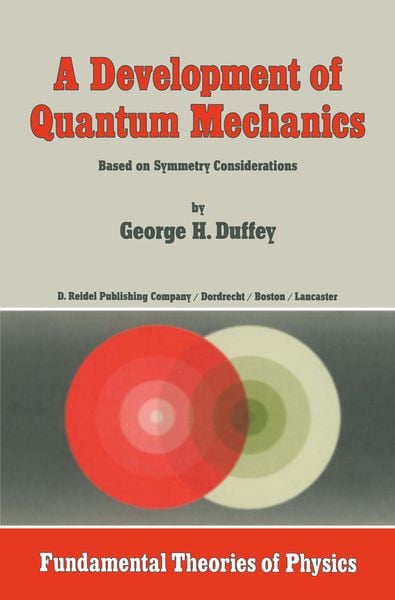
  • Produktbild: A Development of Quantum Mechanics
  • Produktbild: A Development of Quantum Mechanics
Band 2

A Development of Quantum Mechanics Based on Symmetry Considerations

Fr. 72.90

inkl. gesetzl. MwSt., Versandkostenfrei


Beschreibung

Produktdetails

Einband

Taschenbuch

Erscheinungsdatum

26.09.2011

Verlag

Springer Netherland

Seitenzahl

356

Maße (L/B/H)

23.5/15.5/2 cm

Gewicht

546 g

Auflage

1984

Sprache

Englisch

ISBN

978-94-010-8800-8

Beschreibung

Produktdetails

Einband

Taschenbuch

Erscheinungsdatum

26.09.2011

Verlag

Springer Netherland

Seitenzahl

356

Maße (L/B/H)

23.5/15.5/2 cm

Gewicht

546 g

Auflage

1984

Sprache

Englisch

ISBN

978-94-010-8800-8

Herstelleradresse

Springer-Verlag KG
Sachsenplatz 4-6
1201 Wien
AT

Email: GPSR Kontakt

Noch keine Bewertungen vorhanden

Verfassen Sie die erste Bewertung zu diesem Artikel

Helfen Sie anderen Kundinnen und Kunden durch Ihre Meinung.

Kundinnen und Kunden meinen

Bewertungen (0)

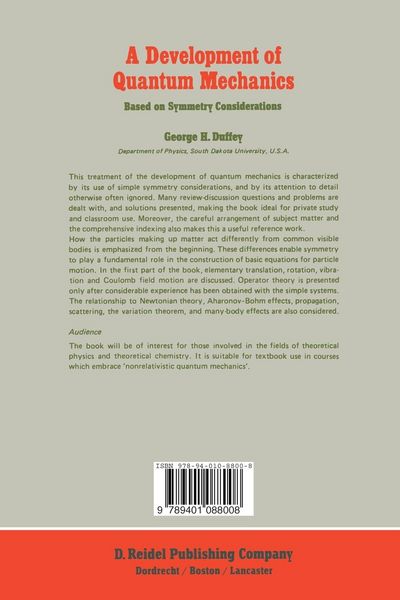
  • Produktbild: A Development of Quantum Mechanics
  • Produktbild: A Development of Quantum Mechanics
  • 1 / Quantization of Translatory Motion.- 1.1. Background Remarks on Time and Space.- 1.2. The Statistical Nature of Position, Velocity, and Momentum.- 1.3. A State Function Governing Translation.- 1.4. Diffraction by Neighboring Parallel Slits.- 1.5. Diffraction by Molecules.- 1.6. Dependence of the Function for a Definite Energy State on Time.- 1.7. Independent Movements within a State.- 1.8. The Continuum of Translational States.- 1.9. Periodic, Rectangularly Symmetric, Free Motion.- 1.10. Enumerating and Filling Translational States.- 1.11. Translational Energy of an Ideal Gas.- 1.12. Standing-Wave Translational Functions.- 1.13. Confined Rectangularly Symmetric Motion.- 1.14. Attenuated Motion.- 1.15. Joining Regions of Differing Potentials 3.- Discussion Questions.- Problems.- References.- 2 / Quantization of Rotatory Motion.- 2.1. Separation of Different Modes of Motion from Each Other.- 2.2. One-Particle Model for a Linear Rotator.- 2.3. Variation of ? in a Spherically Symmetric Field.- 2.4. The Rotational State Described by the Traveling Wave.- 2.5. Quantization of the Simple Rotator.- 2.6. Standing-Wave Rotational Functions.- 2.7. Energy Levels for a Two-Dimensional Rotator.- 2.8. Rotational Spectrum of a Linear Molecule.- 2.9. Broadening of Spectral Lines.- 2.10. Angular Momenta and the Resultant Energies for a Nonlinear Rotator.- 2.11. Quantizations of Prolate and Oblate Rotators.- 2.12. The Asymmetric Rotator.- 2.13. Dependence of ? on ? in a Spherically Symmetric Field.- 2.14. Explicit State Functions for Angular Motion in a Central Field.- Discussion Questions.- Problems.- References.- 3 / Quantization of Vibratory Motion.- 3.1. Additional Concerted Movements.- 3.2. Vibrational Kinetic and Potential Energies for a Diatomic Molecule.- 3.3. Derivatives of the State Function in Regions where the Potential Energy is not Constant.- 3.4. The Schrödinger Equation for Simple Harmonic Motion.- 3.5. Suitable State Functions for the Harmonic Oscillator.- 3.6. Properties of the Harmonic Oscillator ?v’s.- 3.7. Transitions between Vibrational Energy Levels.- 3.8. Vibrational Spectrum of a Diatomic Molecule.- 3.9. Anharmonicities and their Net Effects.- 3.10. Spectra of Polyatomic Molecules.- 3.11. Raman Spectra.- 3.12. The State Sum for a Vibrational Mode.- 3.13. Operator Formulations of the Harmonic Oscillator Equation.- Discussion Questions.- Problems.- References.- 4 / Radial Motion in a Coulombic Field.- 4.1. A More Complicated Oscillation.- 4.2. Representing the Axial and Angular Motions of Two Particles Bound Together.- 4.3. Differential Equations Governing Variations in a State Function.- 4.4. An Orthogonal-Coordinate Representation of ?2.- 4.5. Separating the Radial Variable from the Angular Variables in the Schrödinger Equation.- 4.6. The Radial Equation for an Electron — Nucleus System.- 4.7. Laguerre Polynomials.- 4.8. Quantization of the Radial Motion.- 4.9. Electronic Spectrum of a Hydrogen-like Atom or Ion.- 4.10. Uninuclear Multi-electron Structures.- 4.11. Useful Operator Formulations of the Radial Equation.- Discussion Questions.- Problems.- References.- 5 / Quantum Mechanical Operators.- 5.1. Dependence of Observables on the State Function.- 5.2. Eigenvalue Equations.- 5.3. Formula for the Expectation Value.- 5.4. The Dirac Delta.- 5.5. Operators for Momenta and Energy.- 5.6. The Hamiltonian Operator.- 5.7. Shift Operators for the Harmonic Oscillator.- 5.8. Nodeless Solutions.- 5.9. Acceptable Wavy Solutions.- 5.10. The Inverse Operator as the Adjoint of an Operator.- 5.11. Shift Operators for a Hydrogen-like Atom.- 5.12. Spontaneous Decay of an Unstable State.- Discussion Questions.- Problems.- References.- 6 / Wave Packets, Potentials, and Forces.- 6.1. Mixing Wave Functions.- 6.2. Fourier Series and Fourier Integrals.- 6.3. Broadening of a Level Caused by Instability.- 6.4. A Gaussian Wave Packet and its Wavevector Representation.- 6.5. An Arbitrary Superposition of Simple Planar Waves.- 6.6. The De Broglie Angular Frequency.- 6.7. Variations of a Wave Function and Observable Properties with Time.- 6.8. Generalizing Newton’s Laws.- 6.9. Scalar and Vector Potentials.- 6.10. The Lorentz Force Law.- 6.11. Phase Changes along a Given Path through a Field.- 6.12. Quantization of Magnetic Flux.- 6.13. Effect of a Field on Two-Slit Diffraction.- 6.14. Magnetic and Electric Aharonov—Bohm Effects.- Discussion Questions.- Problems.- References.- 7 / Angular Motion in a Spherically Symmetric Field.- 7.1. Conditions on the Angular Eigenfunctions.- 7.2. The Homogeneous Polynomial Factor.- 7.3. Solutions Derived from the Reciprocal of the Radius Vector.- 7.4. Dependence on the Azimuthal Angle.- 7.5. Dependence on the Colatitude Angle.- 7.6. Normalizing the Angular Eigenfunctions.- 7.7. Mutual Orthogonality of the Angular Eigenfunctions.- 7.8. Spherical-Harmonic Analysis of a Pure Planar Wave.- 7.9. Schrödinger Equation for Radial Constituents of Free Motion.- Discussion Questions.- Problems.- References.- 8 / Operators for Angular Momentum and Spin.- 8.1. Rotational States, Spin States, and Suitable Composites.- 8.2. The Azimuthal-Angle Operator Governing Angular Momentum.- 8.3. Cartesian Angular-Momentum Operators.- 8.4. Expressions Governing Rotational Standing Waves.- 8.5. Angular Momentum Shift Operators.- 8.6. The Integral or Half-Integral of Quantum Number M.- 8.7. Magnetic Energy Associated with an Angular Momentum.- 8.8. Observing Spatial Quantization in a Beam.- 8.9. Eigenoperators and Eigenfunctions for Spin.- 8.10. Relating State Functions for Different Magnetic Quantum Numbers.- 8.11. Combining Angular Momenta.- Discussion Questions.- Problems.- References.- 9 / Propagation, Spreading, and Scattering.- 9.1. The Current Associated with Propagation.- 9.2. An Evolution Operator.- 9.3. Spreading of a Gaussian Wave Packet.- 9.4. Existence of Scattering Centers in Materials.- 9.5. Cross Sections Presented by Scattering Centers.- 9.6. Pure Outgoing, Incoming, and Standing Spherical Waves.- 9.7. Possible Effects of Centers on the Partial Waves.- 9.8. Contributions to Various Cross Sections.- 9.9. A Classical Model for Scattering Centers.- 9.10. Nuclear Radii.- 9.11. Resonance.- 9.12. The Resonant State with Reaction.- 9.13. Singularity in the Partial Wave Amplitude Ratio at a Physical State.- Discussion Questions.- Problems.- References.- 10 / Investigating Multiparticle Systems.- 10.1. Quantum Mechanical Particles and Quasi Particles.- 10.2. The Variation Theorem.- 10.3. Separation of Particle Variables.- 10.4. Indistinguishability of Identical Particles in a Quantal System.- 10.5. Fundamental Combinatory Rules.- 10.6. Symmetrizing and Antisymmetrizing Operations.- 10.7. Basis for the Pauli Exclusion Principle.- 10.8. Relating the Energy of a Plural Paired-particle System to One- and Two-Particle Effects.- Discussion Questions.- Problems.- References.- Answers to Problems.- Name Index.