• Produktbild: Optimal VLSI Architectural Synthesis
  • Produktbild: Optimal VLSI Architectural Synthesis
Band 158

Optimal VLSI Architectural Synthesis Area, Performance and Testability

Fr. 191.00

inkl. gesetzl. MwSt., Versandkostenfrei


Beschreibung

Produktdetails

Einband

Taschenbuch

Erscheinungsdatum

28.09.2012

Verlag

Springer Us

Seitenzahl

289

Maße (L/B/H)

23.5/15.5/1.7 cm

Gewicht

470 g

Auflage

1992

Sprache

Englisch

ISBN

978-1-4613-6797-0

Beschreibung

Produktdetails

Einband

Taschenbuch

Erscheinungsdatum

28.09.2012

Verlag

Springer Us

Seitenzahl

289

Maße (L/B/H)

23.5/15.5/1.7 cm

Gewicht

470 g

Auflage

1992

Sprache

Englisch

ISBN

978-1-4613-6797-0

Herstelleradresse

Springer-Verlag GmbH
Tiergartenstr. 17
69121 Heidelberg
DE

Email: GPSR Kontakt

Noch keine Bewertungen vorhanden

Verfassen Sie die erste Bewertung zu diesem Artikel

Helfen Sie anderen Kundinnen und Kunden durch Ihre Meinung.

Kundinnen und Kunden meinen

Bewertungen (0)

  • Produktbild: Optimal VLSI Architectural Synthesis
  • Produktbild: Optimal VLSI Architectural Synthesis
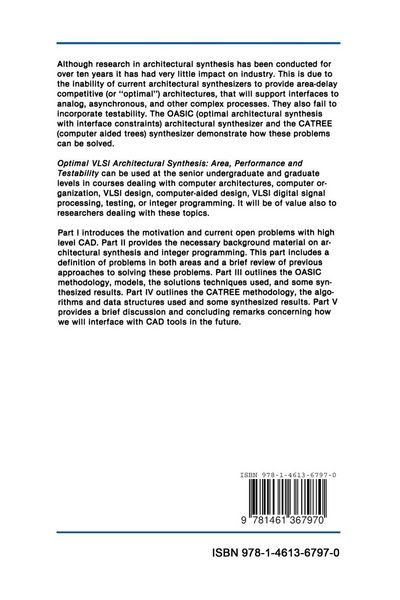
  • I: Introduction.- 1. Global VLSI Design Cycle.- 1.1 VLSI Design Cycle.- 1.2 Hybrid Systems Design.- 1.3 Impact Of Technologies.- 1.4 Test Considerations.- 1.5 Bottlenecks and Open Issues.- 1.6 focus of Text.- 2. Behavioral and Structural Interfaces.- 2.1 Input to an Architectural Synthesizer.- 2.2 Interface Primitives for External Processes.- 2.3 Output Primitives from an Architectural Synthesizer.- II: Review And Background.- 3. State of the Art Synthesis.- 3.1 Terminology and Subtask Definitions.- 3.2 High Level Transformations.- 3.3 Independent Subtask Optimization.- 3.3.1 Scheduling.- 3.3.2 Resource Allocation.- 3.4 Iterative and Simultaneous Approaches.- 3.5 Mathematical Approaches.- 3.5.1 Branch and Bound.- 3.5.2 Simulated Annealing.- 3.5.3 Makespan Scheduling.- 3.5.4 Feasibility Models.- 3.6 Timing Constrained Synthesis.- 3.7 Cost Functions for Design Evaluation.- 4. Introduction to Integer Programming.- 4.1 Applications and Models.- 4.2 Solution of Unstructured IPs.- 4.3 Polyhedral Approaches To Solving Ips.- 4.4 The Node Packing Problem.- 4.5 The Knapsack Problem.- III: Optimal Architectural Synthesis With Interfaces.- 5. A Methodology for Architectural Synthesis.- 5.1 Requirements for High Level Synthesis Tools.- 5.2 High Level Methodology.- 5.3 OASIC Methodology.- 5.4 An Introduction to OASIC.- 5.5 Oasic Terminology, Assumptions, and Preprocessing.- 5.5.1 terminology.- 5.5.2 Assumptions.- 5.5.3 Preprocessing.- 6. Simultaneous Scheduling, and Selection and Allocation Of Functional Units.- 6.1 The Formal Model.- 6.2 Cost Functions.- 6.3 Functional Unit Type Selection.- 7. Oasic: Area-Delay Constrained Architectural Synthesis.- 7.1 The Precedence Constrained Scheduling Model.- 7.2 Functional Unit Allocation.- 7.3 Register Allocation.- 7.4 Bus Allocation.- 7.5 Cost Functions.- 7.6 Application Specific Tightening of Con-straints.- 8. Support for Algorithmic Constructs.- 8.1 Conditional Code.- 8.2 Loops.- 8.3 Functional Pipelining.- 9. Interface Constraints.- 9.1 General Interface: Minimum and Max-imum Timing Constraints.- 9.2 Analog Interface: Fixed Timing Con-straint.- 9.3 Asynchronous Interface.- 9.4 Unknown Unbounded Delays.- 9.5 Complex Timing Constraints.- 10. Oasic Synthesis Results.- 10.1 Elliptical Wave Filter.- 10.1.1 Structured Model.- 10.1.2 Area-delay Optimized.- 10.2 Neural Network Algorithm.- 10.3 Conditional Code Example.- 10.4 Analog and Asynchronous interface Examples.- 10.6.1 Analog Interface.- 10.6.2 Asynchronous Interface.- IV: Testable Architectural Synthesis.- 11. Testability in Architectural Synthesis.- 11.1 Design and Test.- 11.1.1 Choices in Design and Test.- 11.2 Approaches to Testability.- 11.2.1 Test Measures and Tools.- 11.2.2 Design Modifications for Testability.- 11.3 Previous Research in Design for Test.- 11.4 Approaches To Test With Synthesis.- 11.4.1 Previous Research.- 11.4.2 Commercial Systems.- 11.5 Inadequacies of Current Synthesis With Test.- 11.5.1 Feedback.- 11.5.2 Integration.- 11.5.3 Constraint Estimation.- 12. The Catree Architectural Synthesis With Testability.- 12.1 problem description.- 12.2 Comparison With Previous Research.- 12.3 Two Synthesis With Test Methodologies:Catree & Catree2.- 12.4 Catree Design Synthesis Stages.- 12.4.1 Input Specification.- 12.4.2 Design Allocation.- 12.4.3 Catree Area and Delay Estimates.- 12.4.4 Test Incorporation.- 12.4.5 Feedback.- 12.5 Catree Synthesis Results.- 12.6 Catree Discussion.- 12.7 Catree2 Design Synthesis stages.- 12.7.1 Tree Formation and Functional Unit Binding.- 12.7.2 Test Incorporation.- 12.7.3 (Test) Register and Bus Binding.- 12.7.4 Feedback.- 12.8 Catree2 Experiments.- 12.9 Catree2 Discussion.- V: Summary and Future Research.- 13. Summary and Future Research.- 13.1 Oasic Summary.- 13.2 Catree Summary.- 13.3 Future Extensions.- 13.4 Concluding Remarks.- References.