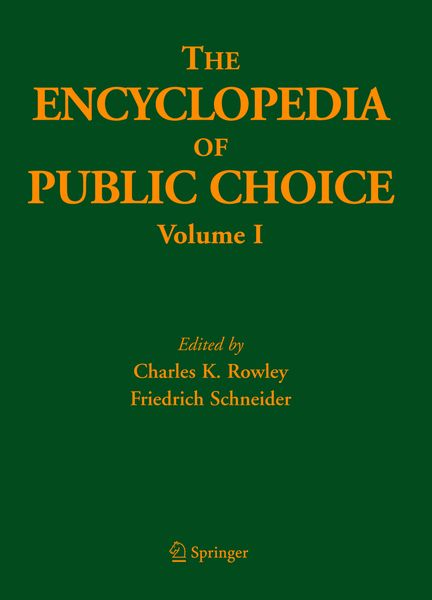
Produktbild: The Encyclopedia of Public Choice

The Encyclopedia of Public Choice

Fr. 598.00

inkl. gesetzl. MwSt., Versandkostenfrei


Beschreibung

Produktdetails

Einband

Set mit diversen Artikeln

Erscheinungsdatum

18.07.2013

Herausgeber

Charles Rowley + weitere

Verlag

Springer Us

Seitenzahl

1105

Maße (L/B/H)

27.9/21/6.3 cm

Gewicht

2788 g

Auflage

2004

Sprache

Englisch

ISBN

978-1-4757-8004-8

Beschreibung

Rezension

From the reviews of the first edition:


"… Many entries cover various aspects of voting, regulation, and government subsidy programs. Additional entries on al-Qaeda, blackmail, the medieval church, and women's suffrage reflect the wide-ranging interests of public-choice researchers. The writing, as nontechnical as possible, makes the encyclopedia accessible to readers in many disciplines. Summing Up: Recommended. Undergraduates and higher."

(L. M. Stuart, Choice, June 2004)


"The
Encyclopedia of Public Choice
will surely prove to be a major sourcework for students and scholars working in public choice and related areas. Professors Rowley and Schneider are major contributors to the public choice literature, and they have combined their talents and insights in this project to produce a work on public choice that will rank as a classic in the field. The coverage of subject matter is extensive and excellent, the individual contributors are well known scholars in the field, and these men and women have framed their papers not simply as surveys of a particular aspect of public choice theory or practice but as original contributions in their own right. My hat is off to the editors for a job well done."


(Robert D. Tollison, Professor of Economics, University of Mississippi)


"The
Encyclopedia of Public Choice
is a welcome addition to a literature that has grown by leaps and bounds over the past half century. Containing scores of carefully chosen concept entries, longer essays and autobiographies contributed by and about the field's founding fathers as well as several generations of younger scholars who have guided public choice into the intellectual mainstream, the Encyclopedia not only summarizes the major strides already taken by researchers working at the intersection of economics and political science, but breaks new ground in applying public choice reasoning to current events as diverse as corporateaccounting scandals, globalization and terrorism. Monumental in conception and written in a lively and accessible style, the
Encyclopedia
is an authoritative and comprehensive point of entry into a fertile research program that illuminates human behavior in a variety of non-market settings, such as committees, bureaucracies, legislatures and clubs, where collective action necessarily displaces individual action. The
Encyclopedia of

Public Choice
promises to become a reference work of lasting value for students of economics, sociology and political science, academicians, policymakers and observers of the public policy process. At long last, in the editorial team of Charles Rowley and Friedrich Schneider, public choice has its Samuel Johnson."

(William F. Shughart II, University of Mississippi, senior editor of The Elgar Companion to Public Choice (Edward Elgar, 2001)


"Those who teach the history of economic thought should find the biographies valuable. Students in my international trade class for advanced undergrads and graduate students from law and public policy … appreciate Hillman’s essays on trade policy. … these are good essays to bring balance to courses and contain excellent references for term papers. … as a reference for libraries and people looking for an introduction to the main concepts of the field, the two-volume set is very useful … ." (Edward Tower, Public Choice, 2006)


"This two-volume review of the public-choice tradition is written by a set of esteemed authors, many of whom can be considered the foremost experts on the topics on which they write … . All in all, a good book to have in your library for casual perusal and to check up specifics." (Keith Dowding, Political Studies Review, Vol. 2 (3), 2004)

Portrait

Prof. Dr. Friedrich Schneider is Professor of Economics at Johannes Kepler University of Linz.

Produktdetails

Einband

Set mit diversen Artikeln

Erscheinungsdatum

18.07.2013

Herausgeber

Verlag

Springer Us

Seitenzahl

1105

Maße (L/B/H)

27.9/21/6.3 cm

Gewicht

2788 g

Auflage

2004

Sprache

Englisch

ISBN

978-1-4757-8004-8

Herstelleradresse

Springer-Verlag GmbH
Tiergartenstr. 17
69121 Heidelberg
DE

Email: ProductSafety@springernature.com

Kundinnen und Kunden meinen

0 Bewertungen

Informationen zu Bewertungen

Zur Abgabe einer Bewertung ist eine Anmeldung im Konto notwendig. Die Authentizität der Bewertungen wird von uns nicht überprüft. Wir behalten uns vor, Bewertungstexte, die unseren Richtlinien widersprechen, entsprechend zu kürzen oder zu löschen.

Die Bewertungen sind nach Format, Anzahl Sterne und Datum sortiert.

Verfassen Sie die erste Bewertung zu diesem Artikel

Helfen Sie anderen Kund*innen durch Ihre Meinung

Kundinnen und Kunden meinen

0 Bewertungen filtern

  • Produktbild: The Encyclopedia of Public Choice
  • Essays.- Public Choice and Constitutional Political Economy.- Public Choice: An Introduction.- Are Vote and Popularity Functions Economically Correct?.- Constitutional Political Economy.- Corruption.- Dictatorship.- Environmental Politics.- Experimental Public Choice.- Gordon Tullock at Four Score Years: An Evaluation.- Interest Group Behavior and Influence.- International Trade Policy: Departure from Free Trade.- James M. Buchanan.- Milton Friedman, 1912: Harbinger of the Public Choice Revolution.- Monetary Policy and Central Bank Behavior.- The Political Economy of Taxation: Positive and Normative Analysis When Collective Choice Matters.- Public Choice from the Perspective of Economics.- Public Choice from the Perspective of the History of Thought.- Public Choice Theory from the Perspective of Law.- Public Choice from the Perspective of Philosophy.- Public Choice from the Perspective of Sociology.- Public Finance.- Regulation and Antitrust.- Scholarly Legacy of Mancur Olson.- Shadow Economy.- Social Choice, Contracts and Logrolling.- Spatial Theory.- Trade Liberalization and Globalization.- William H. Riker.- Concepts.- Academia.- Al-Qaeda.- Alternative Voting Methods.- Altruism.- The Anatomy of Political Representation.- Approval Voting.- Arbitration and Bargaining.- Arrow’s Impossibility Theorem.- An ‘Austrian’ Perspective on Public Choice.- Autocracy.- Autocratic Succession.- Bicameralism.- Blackmail.- Black’s Single-Peakedness Condition.- Budgetary Processes.- Budget Deficits.- Bureaucratic Discretion.- Campaign Contributions and Campaign Finance.- Campaign Finance 1.- Campaign Finance 2.- Central Banks.- Chicago Political Economy.- The Clayton Act.- Coalitions and Power Indices.- Coalitions and Social Choice.- Coase Theorem and Political Markets.- Coercion.- Collective Action Under the Articles of Confederation.- Committee Assignments.- Committee Jurisdictions and PAC Contributions.- Committees in Legislatures.- Commons and Anticommons.- Constitution.- Constitutional Frameworks and Economic Progress.- The Constitution of the European Union.- Constitutional Political Economy.- The Contemporary Political Economy Approach to Bureaucracy.- Contractarianism.- Corruption 1.- Corruption 2.- Cost and Choice.- The Cost Disease of the Personal Services.- Customary Law.- The Demand-Revealing Process.- Deregulation of Postal Service.- Dictators and Social Contracts.- Direct Democracy.- Discrimination.- Dynamic Inconsistency.- Economic Freedom and its Measurement.- Economic Freedom and Political Freedom.- Economic Regulation.- The Economic Theory of Clubs.- Economists Versus the Public on Economic Policy.- Education and the State.- Efficiency of Democracy.- Efficiency of Democracy?.- The Efficiency of the Common Law Hypothesis.- Elected Versus Appointed Regulators.- Election Models.- Electoral College.- Electoral Competition in Mixed Systems of Representation.- The Elusive Median Voter.- Emerging from the Hobbesian Jungle.- Endogenous Morality.- Enron.- Environmental Politics and Economic Development.- The Euro.- European Political Integration.- Evolution of Institutions.- The Evolution of Law.- Experimental Economics and Public Choice.- Experimental Public Choice.- Expressive Voting and Redistribution.- Fair Division.- Fame and Politics.- Federal Reserve System.- Forecasting Presidential Elections in the United States.- Game Theory.- Game Theory in Public Choice.- Generality and the Efficiency of Government Decision Making.- Group Roles in Evolution and Cognition.- Growth of Local Government in the United States.- The Growth of Public Expenditure.- The Growth of the Relative Size of Government.- Heresthetics and the Evolution of the Us Constitution.- Homo Economicus.- Human Evolution and Political Behavior.- Ideology.- The Importance of the Middle in Spatial Politics.- Initiative and Referendum.- Institutions of Trade Protection.- Interest Groups 1.- Interest Groups 2.- International Game of Power.- International Organization.- Internet Voting.- Is Russia a Market Economy?.- Is Voting Rational?.- The Italian Public Finance Contribution to Public Choice.- The Judiciary.- The Law and Economics Movement.- Legal Precedents and Judicial Discretion.- Legal Rules and Standards.- Legislative Politics.- Legislators.- Leviathan Models of Government.- Logic of Collective Action.- The Logic of Liberty.- Logrolling 1.- Logrolling 2.- Meddlesome Preferences and Rent Extraction: The Tobacco Shakedown.- The Median in Politics.- The Median Voter Model.- Medieval Church.- Mercantilism.- Monetary Politics.- The New Deal.- Nonprofit Organizations.- The Origins of Social Choice Theory.- The Paradox of Rebellion.- Parchment Versus Guns.- Political and Cultural Nationalism.- Political Business Cycles.- Political Economics and Public Choice.- The Political Economy of FEMA Disaster Payments.- The Political Economy of Italian Electoral Reform.- Political Transaction-Cost Manipulation.- Pressure Groups and Uninformed Voters.- Principal-Agent Relationships in the Theory of Bureaucracy.- Prohibition.- Public Choice and Socialism.- Public Choice and the Chicago School of Antitrust.- Public Choice in Italy.- Public Enterprise.- Public Finance and the Median Voter Model.- Public Finance in Democratic Process.- Public Goods.- Public Schools.- Public Utility Regulation.- Rational Choice Approaches to Economic and Political History.- Rational Ignorance.- Rational Irrationality.- Reciprocity.- Redistributive Politics 1.- Redistributive Politics 2.- Regulating Government.- Regulatory Takings.- Rent Dissipation.- Rent Extraction.- Rent Seeking.- Rent Seeking and Political Institutions.- Rent-Seeking Games.- Rent Seeking in Development.- The Rule of Law.- Rules Versus Standards.- Self-Interest.- Selfish Gene.- September 11, 2001.- Single-Peaked Preferences and Median Voter Theorems.- The Social Cost of Rent Seeking.- Sortition.- Standard Oil and Microsoft: Antitrust Lessons.- State-Sponsored Murder as a Rent-Seeking Activity.- Structure-Induced Equilibrium.- Supply of Public Goods.- The Supreme Court.- Takings and Public Choice: The Persuasion of Price.- Term Limits 1.- Term Limits 2.- Terrorism.- The Theory and Measurement of Economic Freedom.- Totalitarianism.- Trade Protectionism.- Transitional Economies.- Transitions from Autocracy to Democracy.- Triangulation.- Underground Government: The Off-Budget Public Sector.- The Value of Voting Rights.- Votes for Women.- Voting Equipment, Minorities and the Poor.- Voting in U.S. Presidential Elections.- Voting Paradoxes in List Systems of Proportional Representation.- The War on Drugs.- Welfare Economics and Public Choice.- Welfare Economics and the Theory of the State.- Why Government Succeeds.