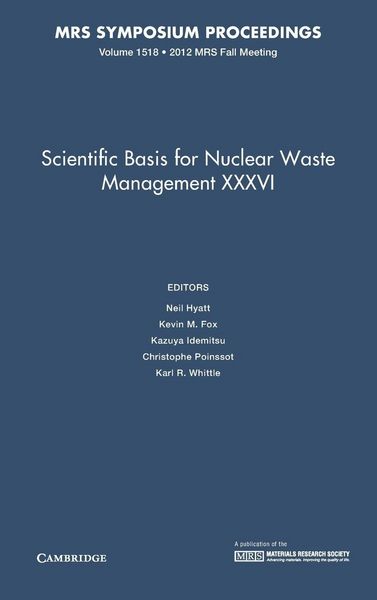

• Produktbild: Scientific Basis for Nuclear Waste Management XXXVI
  • Produktbild: Scientific Basis for Nuclear Waste Management XXXVI

Scientific Basis for Nuclear Waste Management XXXVI

Fr. 131.00

inkl. gesetzl. MwSt., Versandkostenfrei


Beschreibung

Produktdetails

Einband

Gebundene Ausgabe

Erscheinungsdatum

09.01.2014

Herausgeber

Neil Hyatt + weitere

Verlag

Cambridge University Press

Seitenzahl

304

Maße (L/B/H)

23.5/15.7/2.1 cm

Gewicht

594 g

Sprache

Englisch

ISBN

978-1-60511-495-8

Beschreibung

Produktdetails

Einband

Gebundene Ausgabe

Erscheinungsdatum

09.01.2014

Herausgeber

Verlag

Cambridge University Press

Seitenzahl

304

Maße (L/B/H)

23.5/15.7/2.1 cm

Gewicht

594 g

Sprache

Englisch

ISBN

978-1-60511-495-8

Herstelleradresse

Libri GmbH
Europaallee 1
36244 Bad Hersfeld
DE

Email: Libri GmbH

Noch keine Bewertungen vorhanden

Verfassen Sie die erste Bewertung zu diesem Artikel

Helfen Sie anderen Kundinnen und Kunden durch Ihre Meinung.

Kundinnen und Kunden meinen

Bewertungen (0)

  • Produktbild: Scientific Basis for Nuclear Waste Management XXXVI
  • Produktbild: Scientific Basis for Nuclear Waste Management XXXVI
  • Part I. Glass Wasteforms I: 1. The use of high durability alumino-borosilicate glass for the encapsulation of high temperature reactor (HTR) fuel; 2. Long-term aqueous alteration kinetics of an alpha-doped SON68 borosilicate glass; 3. Corrosion and alteration of lead borate glass in bentonite equilibrated water; 4. Vitrification of high molybdenum feeds in the presence of reprocessing waste liquor; 5. The effect of c-radiation on mechanical properties of model UK nuclear waste glasses; 6. Structural characterization and analysis of glasses in the Al2O3-B2O3-Fe2O3-Na2O-SiO2 system; 7. Infrared and raman spectroscopic study of glasses in the Al2O3-B2O3-Fe2O3-Na2O-SiO2 system; 8. XAFS study of Fe K edge in Al2O3-B2O3-Fe2O3-Na2O-SiO2 glasses; Part II. Ceramic Wasteforms - Beta Decay: 9. Thermal conversion of Cs-exchanged IONSIV IE-911 into a novel caesium ceramic wasteform by hot isostatic pressing; 10. Aging studies of Pu-238 and -239 containing calcium phosphate ceramic waste-forms; 11. Development of the synthetic rock technique for the immobilization of iodine: kinetics of the alumina matrix dissolution under high alkaline conditions; 12. A study on iodine release behavior from iodine-immobilizing cement solid; 13. Towards a silicate matrix for the immobilisation of Halide-rich wastes; 14. Decontamination of molten salt wastes for pyrochemical reprocessing of nuclear fuels; 15. Thermodynamic modeling and experimental tests of irradiated graphite molten salt decontamination; Part III. Technetium Solutions: 16. Ceramic immobilisation options for technetium; 17. Technetium incorporation into C14 and C15 laves intermetallic phases; 18. Technetium-99m transport and immobilisation in porous media: development of a novel nuclear imaging technique; Part IV. Spent Nuclear Fuel: 19. Modelling the activation of H2 on spent fuel surface and inhibiting effect of UO2 dissolution; 20. Corrosion study of SIMFUEL in aerated carbonate solution containing calcium and silicate; 21. Effects of matrix composition on instant release fractions from high burn-up nuclear fuel; 22. Reducing the uncertainty of nuclear fuel dissolution: an investigation of UO2 analogue CeO2; 23. Research and development on cementation of Liquid Radioactive Waste (LRW) resulting from spent nuclear fuel reprocessing in the Experimental Demonstration Center (EDC) of Mountain Chemical Combine; Part V. Waste Repositories: 24. NMR study of interlayer and non-interlayer porewater in water-saturated bentonite and montmorillonite; 25. Long-term corrosion of Zircaloy-4 and Zircaloy-2 by continuous hydrogen measurement under repository condition; 26. Radioelement solubilities in SR-site, the influence of variability and uncertainty; 27. Glass-iron-clay interactions in a radioactive waste geological disposal: a multiscale approach; 28. Suitability of bioapatite as backfill material for nuclear waste isolation; 29. Collocation and integration of back-end fuel cycle facilities with the repository: implications for waste forms; 30. Processing and disposal of radioactive waste: selection of technical solutions; 31. Assessment of the evolution of the redox conditions in the SKB ILW-LLW SFR-1 repository (Sweden); 32. Characterization of radionuclide retaining properties of backfill materials for near surface repositories for low and intermediate level radioactive wastes.