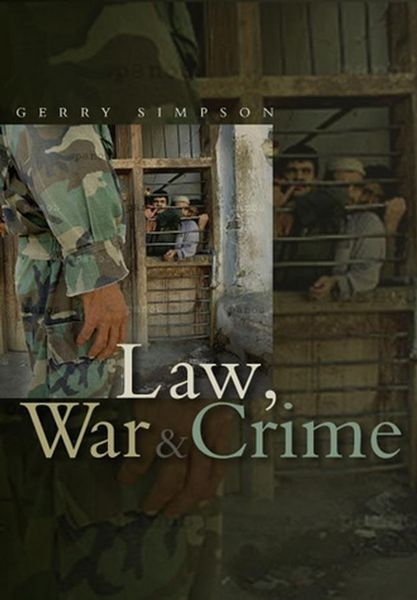
Law, War and Crime War Crimes, Trials and the Reinvention of International Law
-
- Hardcover
- Taschenbuch
- eBook ausgewählt
-
Form:Einzelkauf Download
-
Sprache:Englisch
-
eBook Format:ePUB
- PDF Fr. 65.00
- ePUB Fr. 22.00 ausgewählt
Fr. 22.00
inkl. gesetzl. MwSt.Beschreibung
Produktdetails
Format
ePUB
Kopierschutz
Ja
Family Sharing
Nein
Text-to-Speech
Ja
Erscheinungsdatum
18.04.2013
Verlag
John Wiley & Sons IncSeitenzahl
240 (Printausgabe)
Dateigröße
722 KB
Auflage
1. Auflage
Sprache
Englisch
EAN
9780745657318
From events at Nuremberg and Tokyo after World War II, to the
recent trials of Slobodan MiloSevic and Saddam Hussein,
war crimes trials are an increasingly pervasive feature of the
aftermath of conflict. In his new book, Law, War and Crime, Gerry
Simpson explores the meaning and effect of such trials, and places
them in their broader political and cultural contexts. The book
traces the development of the war crimes field from its origins in
the outlawing of piracy to its contemporary manifestation in the
establishment of the International Criminal Court in The
Hague.
Simpson argues that the field of war crimes is constituted by a
number of tensions between, for example, politics and law, local
justice and cosmopolitan reckoning, collective guilt and individual
responsibility, and between the instinct that war, at worst, is an
error and the conviction that war is a crime.
Written in the wake of an extraordinary period in the life of
the law, the book asks a number of critical questions. What does it
mean to talk about war in the language of the criminal law? What
are the consequences of seeking to criminalise the conduct of one's
enemies? How did this relatively new phenomenon of putting on trial
perpetrators of mass atrocity and defeated enemies come into
existence? This book seeks to answer these important questions
whilst shedding new light on the complex relationship between law,
war and crime.
recent trials of Slobodan MiloSevic and Saddam Hussein,
war crimes trials are an increasingly pervasive feature of the
aftermath of conflict. In his new book, Law, War and Crime, Gerry
Simpson explores the meaning and effect of such trials, and places
them in their broader political and cultural contexts. The book
traces the development of the war crimes field from its origins in
the outlawing of piracy to its contemporary manifestation in the
establishment of the International Criminal Court in The
Hague.
Simpson argues that the field of war crimes is constituted by a
number of tensions between, for example, politics and law, local
justice and cosmopolitan reckoning, collective guilt and individual
responsibility, and between the instinct that war, at worst, is an
error and the conviction that war is a crime.
Written in the wake of an extraordinary period in the life of
the law, the book asks a number of critical questions. What does it
mean to talk about war in the language of the criminal law? What
are the consequences of seeking to criminalise the conduct of one's
enemies? How did this relatively new phenomenon of putting on trial
perpetrators of mass atrocity and defeated enemies come into
existence? This book seeks to answer these important questions
whilst shedding new light on the complex relationship between law,
war and crime.
Noch keine Bewertungen vorhanden
Verfassen Sie die erste Bewertung zu diesem Artikel
Helfen Sie anderen Kundinnen und Kunden durch Ihre Meinung.