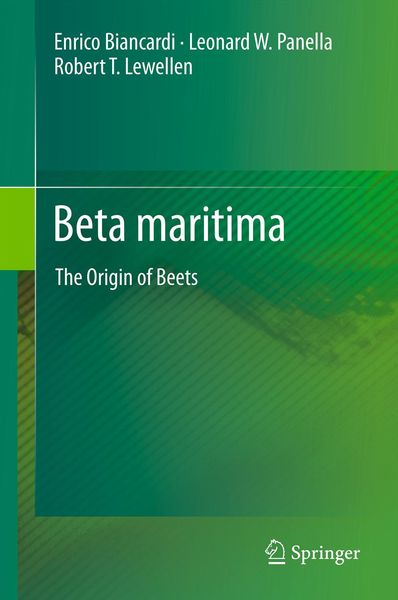
Beta maritima The Origin of Beets
-
- Hardcover
- Taschenbuch ausgewählt
- eBook
-
Sprache:Englisch
-
Verlag:Springer Us
- Springer Us Fr. 225.00 ausgewählt
- Springer Fr. 137.00
Fr. 225.00
inkl. gesetzl. MwSt.,
Beschreibung
Produktdetails
Einband
Taschenbuch
Erscheinungsdatum
03.03.2014
Abbildungen
XVIII, 294 p.
Verlag
Springer UsSeitenzahl
294
Maße (L/B/H)
23.5/15.5/1.7 cm
Gewicht
476 g
Auflage
2012 edition
Sprache
Englisch
ISBN
978-1-4899-9961-0
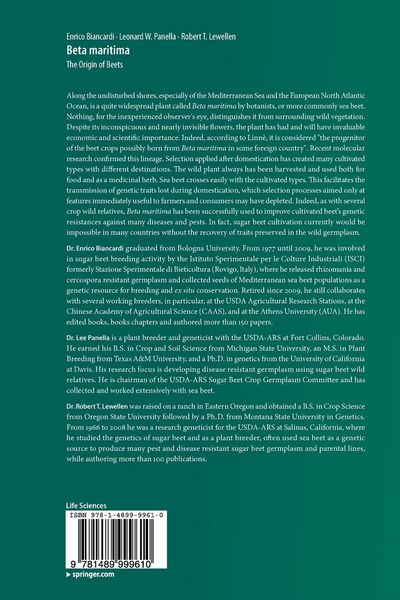
Along the undisturbed shores, especially of the Mediterranean Sea and the European North Atlantic Ocean, is a quite widespread plant called
Beta maritima
by botanists, or more commonly sea beet. Nothing, for the inexperienced observer's eye, distinguishes it from surrounding wild vegetation. Despite its inconspicuous and nearly invisible flowers, the plant has had and will have invaluable economic and scientific importance. Indeed, according to Linnè, it is considered "the progenitor of the beet crops possibly born from
Beta maritima
in some foreign country". Recent molecular research confirmed this lineage. Selection applied after domestication has created many cultivated types with different destinations. The wild plant always has been harvested and used both for food and as a medicinal herb. Sea beet crosses easily with the cultivated types. This facilitates the transmission of genetic traits lost during domestication, which selection processes aimed only at features immediately useful to farmers and consumers may have depleted. Indeed, as with several crop wild relatives,
Beta maritima
has been successfully used to improve cultivated beet’s genetic resistances against many diseases and pests. In fact, sugar beet cultivation currently would be impossible in many countries without the recovery of traits preserved in the wild germplasm.
Dr. Enrico Biancardi graduated from Bologna University. From 1977 until 2009, he was involved in sugar beet breeding activity by the Istituto Sperimentale per le Colture Industriali (ISCI) formerly Stazione Sperimentale di Bieticoltura (Rovigo, Italy), where he released rhizomania and cercospora resistant germplasm and collected seeds of Mediterranean sea beet populations as a genetic resource for breeding and
ex situ
conservation. Retired since 2009, he still collaborates with several working breeders, in particular, at the USDA Agricultural Research Stations, at the Chinese Academy of Agricultural Science (CAAS), and at the Athens University (AUA). He has edited books, books chapters and authored more than 150 papers.
Dr. Lee Panella is a plant breeder and geneticist with the USDA-ARS at Fort Collins, Colorado. He earned his B.S. in Crop and Soil Science from Michigan State University, an M.S. in Plant Breeding from Texas A&M University, and a Ph.D. in genetics from the University of California at Davis. His research focus is developing disease resistant germplasm using sugar beet wild relatives. He is chairman of the USDA-ARS Sugar Beet Crop Germplasm Committee and has collected and worked extensively with sea beet.
Dr. Robert T. Lewellen was raised on a ranch in Eastern Oregon and obtained a B.S. in Crop Science from Oregon State University followed by a Ph.D. from Montana State University in Genetics. From 1966 to 2008 he was a research geneticist for the USDA-ARS at Salinas, California, where he studied the genetics of sugar beet and as a plant breeder, often used sea beet as a genetic source to produce many pest and disease resistant sugar beet germplasm and parental lines, while authoring more than 100 publications.
Noch keine Bewertungen vorhanden
Verfassen Sie die erste Bewertung zu diesem Artikel
Helfen Sie anderen Kundinnen und Kunden durch Ihre Meinung.