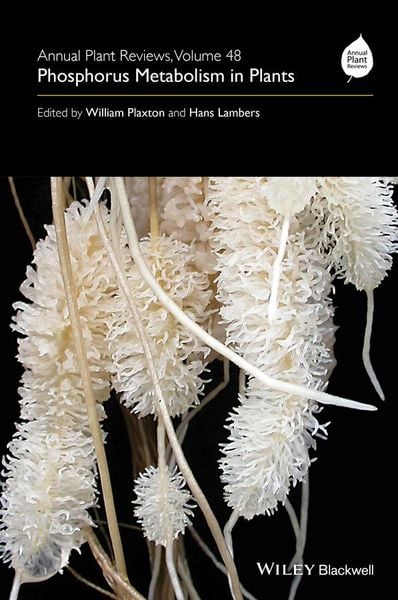
Band 48
Annual Plant Reviews Volume 48: Phosphorus Metabolism in Plants
Aus der Reihe
Annual Plant Reviews
Fr. 283.00
inkl. gesetzl. MwSt.,
Beschreibung
Produktdetails
Einband
Gebundene Ausgabe
Erscheinungsdatum
15.06.2015
Herausgeber
William Plaxton + weitereVerlag
John Wiley & SonsSeitenzahl
480
Maße (L/B/H)
23.6/15.7/2.5 cm
Gewicht
916 g
Auflage
Volume 48 edition
Sprache
Englisch
ISBN
978-1-118-95885-8
The development of phosphorus (P)-efficient crop varieties is urgently needed to reduce agriculture's current over-reliance on expensive, environmentally destructive, non-renewable and inefficient P-containing fertilizers. The sustainable management of P in agriculture necessitates an exploitation of P-adaptive traits that will enhance the P-acquisition and P-use efficiency of crop plants. Action in this area is crucial to ensure sufficient food production for the world's ever-expanding population, and the overall economic success of agriculture in the 21st century.
This informative and up-to-date volume presents pivotal research directions that will facilitate the development of effective strategies for bioengineering P-efficient crop species. The 14 chapters reflect the expertise of an international team of leading authorities in the field, who review information from current literature, develop novel hypotheses, and outline key areas for future research. By evaluating aspects of vascular plant and green algal P uptake and metabolism, this book provides insights as to how plants sense, acquire, recycle, scavenge and use P, particularly under the naturally occurring condition of soluble inorganic phosphate deficiency that characterises the vast majority of unfertilised soils, worldwide. The reader is provided with a full appreciation of the diverse information concerning plant P-starvation responses, as well as the crucial role that plant-microbe interactions play in plant P acquisition.
Annual Plant Reviews, Volume 48: Phosphorus Metabolism in Plants is an important resource for plant geneticists, biochemists and physiologists, as well as horticultural and environmental research workers, advanced students of plant science and university lecturers in related disciplines. It is an essential addition to the shelves of university and research institute libraries and agricultural and ecological institutions teaching and researching plant science.
This informative and up-to-date volume presents pivotal research directions that will facilitate the development of effective strategies for bioengineering P-efficient crop species. The 14 chapters reflect the expertise of an international team of leading authorities in the field, who review information from current literature, develop novel hypotheses, and outline key areas for future research. By evaluating aspects of vascular plant and green algal P uptake and metabolism, this book provides insights as to how plants sense, acquire, recycle, scavenge and use P, particularly under the naturally occurring condition of soluble inorganic phosphate deficiency that characterises the vast majority of unfertilised soils, worldwide. The reader is provided with a full appreciation of the diverse information concerning plant P-starvation responses, as well as the crucial role that plant-microbe interactions play in plant P acquisition.
Annual Plant Reviews, Volume 48: Phosphorus Metabolism in Plants is an important resource for plant geneticists, biochemists and physiologists, as well as horticultural and environmental research workers, advanced students of plant science and university lecturers in related disciplines. It is an essential addition to the shelves of university and research institute libraries and agricultural and ecological institutions teaching and researching plant science.
Noch keine Bewertungen vorhanden
Verfassen Sie die erste Bewertung zu diesem Artikel
Helfen Sie anderen Kundinnen und Kunden durch Ihre Meinung.