Gutscheinbedingungen

*Gültig bis 05.07.2026 auf (fast) alles. Ausgeschlossen sind Smartboxen, Zeitschriften, Tickets, Lebensmittel, Gaming-Elektroartikel, Tinte/Toner, Gutscheine, Geschenkkarten, Blumen und Abos | Einlösbar in allen Buchhandlungen von Orell Füssli, Barth Bücher, Buchladen Rapunzel, Papeterie Köhler, Schuler Orell Füssli, Stauffacher und ZAP unter Vorweisung des Gutscheins, auf www.orellfüssli.ch durch Eingabe des Gutscheincodes. Beim Service „eBooks verschenken“ und bei eBook-Käufen via eReader nicht einlösbar | Mindesteinkaufswert: Fr. 30.- | Nicht mit anderen Rabatten kumulierbar.

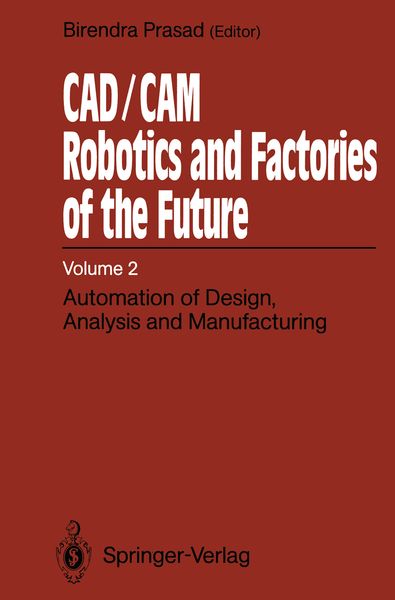
  • Produktbild: CAD/CAM Robotics and Factories of the Future
  • Produktbild: CAD/CAM Robotics and Factories of the Future

CAD/CAM Robotics and Factories of the Future Volume II: Automation of Design, Analysis and Manufacturing

Fr. 72.90

inkl. gesetzl. MwSt., Versandkostenfrei


Beschreibung

Produktdetails

Einband

Taschenbuch

Erscheinungsdatum

02.08.2012

Herausgeber

Birendra Prasad

Verlag

Springer Berlin

Seitenzahl

308

Maße (L/B/H)

23.5/15.5/1.9 cm

Gewicht

516 g

Auflage

Softcover reprint of the original 1st ed. 1989

Sprache

Englisch

ISBN

978-3-642-52325-0

Beschreibung

Produktdetails

Einband

Taschenbuch

Erscheinungsdatum

02.08.2012

Herausgeber

Birendra Prasad

Verlag

Springer Berlin

Seitenzahl

308

Maße (L/B/H)

23.5/15.5/1.9 cm

Gewicht

516 g

Auflage

Softcover reprint of the original 1st ed. 1989

Sprache

Englisch

ISBN

978-3-642-52325-0

Herstelleradresse

Springer-Verlag GmbH
Tiergartenstr. 17
69121 Heidelberg
DE

Email: GPSR Kontakt

Noch keine Bewertungen vorhanden

Verfassen Sie die erste Bewertung zu diesem Artikel

Helfen Sie anderen Kundinnen und Kunden durch Ihre Meinung.

Kundinnen und Kunden meinen

Bewertungen (0)

  • Produktbild: CAD/CAM Robotics and Factories of the Future
  • Produktbild: CAD/CAM Robotics and Factories of the Future
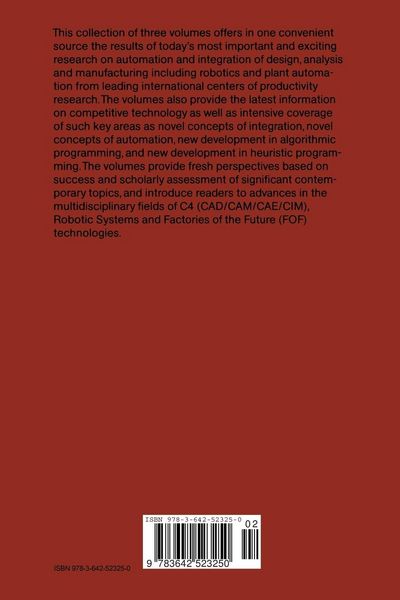
  • I: Computer-Aided Design.- 1. 1. Shape Optimization.- A Geometry-Based 2-Dimensional Shape Optimization Methodology and a Software System with Applications.- Optimum Design of Continuum Structures with SHAPE.- The Velocity Field Matrix in Shape Optimal Design.- Implementation Issues in Variational Geometry and Constraint Management.- I. 2. Probabilistic Design Optimization.- Probabilistic Vibration Analysis of Nearly Periodic Structures.- Experience Gained From First-Order Reliability Methods (FORM) in Structural Analyses.- Reliability Analysis of Layered Cylindrical Structures under Combined Mechanical and Thermal Loads.- Design Reliability Optimization Using Probabilistic Design Approach and Taguchi Methods.- I. 3. Optimum Design Applications.- Optimization of Frame Structures with Thin Walled Sections of Generic Shape.- Optimal Design of Box Beams with Coupled Bending and Torsion Using Multiple Frequency Constraints.- Experiences on Analysis and Optimal Design of Pyramidal Truss Panels.- A Computational Procedure for Automated Flutter Analysis.- I. 4. Design Methodologies.- Axisymmetric Boundary Element Design Sensitivity Analysis.- Simultaneous Computation of Multiple Sensitivities by a Boundary Element Structural Analysis Formulation.- Lagrangian Interpretation of Nonlinear Design Sensitivity Analysis with Continuum Formulation.- A New Reanalysis Technique Suitable of Being used in Design Automation and Optimization.- Calculating Functionals for Arbitrary Geometries.- I. 5. CAD/CAM Automation.- A Graphics User Interface for Interactive Three Dimensional Free-form Design.- XCAD: A CAD Object-oriented Virtual Solid Modeler for an Expert System Shell.- II: Automation in Manufacturing.- II. 1. Planning and Control.- Decentralization of Planning and Control in CIM.- An Intelligent Tactical Planning System: The Integration of Manufacturing Planning Islands Using Knowledge Based Technology.- Automated Process Planning for Mechanical Assembly Operations.- An Unorthodox Approach to Job-Scheduling.- II. 2. Group Technology.- Development of a Group Technology Workstation.- A Comparison of Hierarchical Clustering Techniques for Part/Machine Families Formulation.- An Application of Fuzzy Mathematics in the Formation of Group Technology Part Family.- Automatic Generation of Production Drawings and Part Routings for Valve Spools.- III: Applications of Artificial Intelligence.- III. 1. AI Tools.- THINK: A C Library for Artificial Intelligence Tasks.- Using Artificial Intelligence Paradigms in Solving Manufacturing Problems Demonstrated in the CPC Stacking/Destacking Expert System.- A LISP-Based Environment for Simulation of Robot Applications.- III. 2. AI Methodologies.- An Interactive Refutation Learning Approach for Skill Acquisition in Knowledge-Based CAD System.- KBSS: A Knowledge-Based System for Scheduling in Automated Manufacturing.- Action, Reflective Possibility, and the Frame Problem.- Development of AI-Based Automated Process Planning Systems.- Automated Fixture Selection for Rotational Parts.- III. 3. Decision Support Systems.- A Frame-Based User Enquiry Method for Supporting Strategic Operations Planning.- Construction of a Knowledge Base for the Detection of Decision Errors.- On Representing Human Heuristic Reasoning.- IV: Expert Systems.- IV. 1. Expert Systems for Diagnostics.- An Expert System to Diagnose Failures in Industrial Robots.- An Operations Analysis Expert System for Fiberglass Manufacturing.- Failure Detection and Diagnosis — Application to a Grinding-Classification Circuit.- IV. 2. Expert Systems for Design and Production.- Expert System for Specifying of CAD Software Systems.- An Expert System for IC Factory Design.- Towards an Expert System Architecture for Routine Design — Focusing on Constraint Representation and an Application Mechanism for Mechanical Design.- Knowledge-Based Design Aid for Axisymmetric Casting Parts.- IV. 3. Expert Systems for Scheduling, Assembly, and Planning.- Expert System Supervision of Robots During a Vision-Assisted Assembly Task.- Intelligent Lot-Size Advisor for MRP Systems.- Intelligent Scheduling Systems for Parallel Machines with Different Capability.- Expert System-Based Finite Scheduler.- of Volume I.- of Volume III.- Author Index (Volume II).