KI-Beratung Beta

  • Produktbild: Loop Transfer Recovery: Analysis and Design
  • Produktbild: Loop Transfer Recovery: Analysis and Design

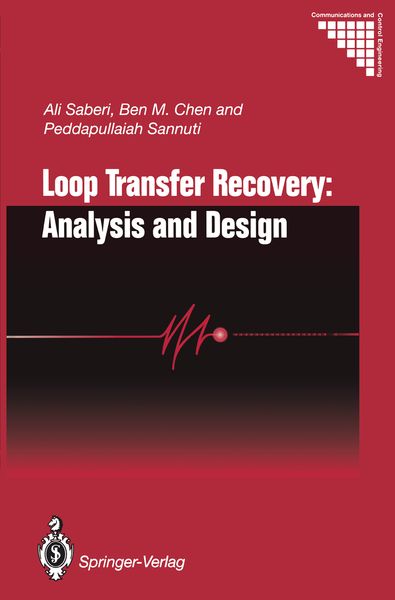
Loop Transfer Recovery: Analysis and Design

Fr. 149.00

inkl. gesetzl. MwSt., Versandkostenfrei


Beschreibung

Loop Transfer Recovery (LTR) is part of the Communications and Control Engineering Series (CCES) edited by Professors B.W. Dickinson, E.D. Sontag, M. Thoma, A. Fettweis, J.L. Massey and J.W. Modestino. Loop Transfer Recovery deals with several issues of analysis and design of the Loop Transfer Recovery...

Beschreibung

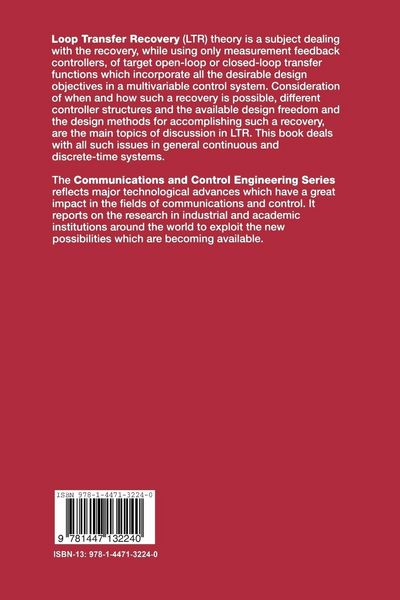
Loop Transfer Recovery (LTR) is part of the Communications and Control Engineering Series (CCES) edited by Professors B.W. Dickinson, E.D. Sontag, M. Thoma, A. Fettweis, J.L. Massey and J.W. Modestino. Loop Transfer Recovery deals with several issues of analysis and design of the Loop Transfer Recovery (LTR) problem. It discusses when and how an LTR is possible and outlines different controller structures and the available design freedom. An explanation of the actual design methods for accomplishing an LTR is given. Besides dealing with observer based measurement feedback controllers, which are commonly used for LTR, a new controller with a different architecture which out performs observer based controllers is presented. This publication will be of benefit to anyone who has completed a first graduate course in linear systems and state-space methods, together with an elementary knowledge of Linear Quadratic Control.

Produktdetails

Einband

Taschenbuch

Erscheinungsdatum

01.12.2011

Abbildungen

XIII, 352 p.

Verlag Springer London

Produktdetails

Einband

Taschenbuch

Erscheinungsdatum

01.12.2011

Abbildungen

XIII, 352 p.

Verlag Springer London
Seitenzahl

352

Maße (L/B/H)

23.5/15.5/2 cm

Gewicht

557 g

Auflage

Softcover reprint of the original 1st ed. 1993

Sprache

Englisch

ISBN

978-1-4471-3224-0

Herstelleradresse

Springer-Verlag KG
Sachsenplatz 4-6
1201 Wien
AT

Email: ProductSafety@springernature.com

Noch keine Bewertungen vorhanden

Verfassen Sie die erste Bewertung zu diesem Artikel

Helfen Sie anderen Kundinnen und Kunden durch Ihre Meinung.

Kundinnen und Kunden meinen

Bewertungen (0)

  • Produktbild: Loop Transfer Recovery: Analysis and Design
  • Produktbild: Loop Transfer Recovery: Analysis and Design
  • 1 Introduction.- 1.1 Introduction.- 1.2 Problem formulation.- 1.3 Preliminaries.- 2 Preliminary Analysis of Continuous LTR.- 2.1 Introduction.- 2.2 Preliminary analysis.- 2.A Proof of Lemma 2.2.1.- 2.B Proof of Proposition 2.2.2.- 3 Continuous LTR — Detailed Analysis.- 3.1 Introduction.- 3.2 Recovery analysis while not using the knowledge of F.- 3.3 Analysis for recoverable target loop transfer functions.- 3.4 Recovery analysis in a given subspace.- 3.5 Duality of LTRI and LTRO.- 3.A Proof of Lemma 3.2.1.- 3.B Proof of Lemma 3.2.2.- 3.C Proof of Proposition 3.2.2.- 3.D Proof of Lemma 3.2.3.- 3.E Proof of Corollary 3.3.2.- 3.F Proof of Lemma 3.4.2.- 3.G Proof of Lemma 3.4.3.- 4 Continuous LTR — Design.- 4.1 Introduction.- 4.2 Design constraints and the available freedom.- 4.3 ATEA design method.- 4.4 Optimization based design methods.- 4.5 Design for recovery over a specified subspace.- 4.6 LTR design for output break point.- 4.7 Comparison of ATEA and optimization based design algorithms.- 4.A Proof of Theorem 4.3.1.- 4.B Proof of Theorem 4.3.2.- 4.C Proof of Theorem 4.4.2.- 5 Introduction to Discrete LTR.- 5.1 Introduction.- 5.2 Problem formulation.- 5.3 Preliminaries.- 6 Preliminary Analysis of Discrete LTR.- 6.1 Introduction.- 6.2 Controller structures for discrete LTR.- 6.3 Preliminary analysis.- 6.A Proof of Proposition 6.3.1.- 7 Discrete LTR — Detailed Analysis.- 7.1 Introduction.- 7.2 Recovery analysis while not using the knowledge of F.- 7.3 Analysis for recoverable target loop transfer functions.- 7.4 Recovery analysis in a given subspace.- 7.5 Duality of LTRI and LTRO.- 7.A Proof of Lemma 7.2.2.- 7.B Proof of Corollary 7.3.1.- 7.C Proof of Theorem 7.4.4.- 8 Discrete LTR — Design.- 8.1 Introduction.- 8.2 Design constraints and the available freedom.-8.3 Design by eigenstructure assignment.- 8.4 Optimization based design methods.- 8.5 Design for recovery over a specified subspace.- 8.6 LTR design for output break point.- 8.A Proof of Theorem 8.4.1.- 9 Closed-Loop Transfer Recovery.- 9.1 Introduction.- 9.2 Continuous CLTR.- 9.3 Discrete CLTR.- 9.A Proof of Lemma 9.2.1.- 10 Some Issues of Controller Architecture.- 10.1 Introduction.- 10.2 Recoverability with an arbitrarily structured controller.- 10.3 CSS architecture based controllers for LTR.- 10.4 Design examples.- 10.5 Open research problems.- 10.A Proof of Theorem 10 2 1.- 10.B Proof of Lemma 10.3.1.- 10.C Proof of Theorem 10 3 1.