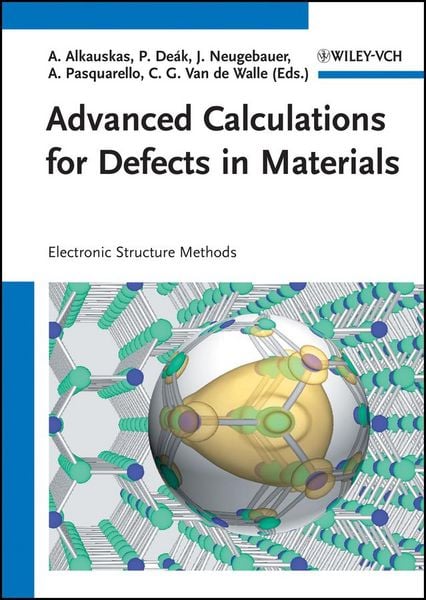
Advanced Calculations for Defects in Materials Electronic Structure Methods
-
- Einzelkauf Download ausgewählt
-
Sprache:Englisch
-
eBook Format:PDF
- PDF Fr. 142.00 ausgewählt
- ePUB Fr. 142.00
Fr. 142.00
inkl. gesetzl. MwSt.Beschreibung
Produktdetails
Format
Kopierschutz
Ja
Family Sharing
Nein
Text-to-Speech
Nein
Erscheinungsdatum
09.05.2011
Herausgeber
Audrius Alkauskas + weitereVerlag
Wiley-VCHSeitenzahl
402 (Printausgabe)
Dateigröße
7694 KB
Auflage
1. Auflage
Sprache
Englisch
EAN
9783527638543
This book investigates the possible ways of improvement by applying more sophisticated electronic structure methods as well as corrections and alternatives to the supercell model. In particular, the merits of hybrid and screened functionals, as well as of the +U methods are assessed in comparison to various perturbative and Quantum Monte Carlo many body theories. The inclusion of excitonic effects is also discussed by way of solving the Bethe-Salpeter equation or by using time-dependent DFT, based on GW or hybrid functional calculations. Particular attention is paid to overcome the side effects connected to finite size modeling.
The editors are well known authorities in this field, and very knowledgeable of past developments as well as current advances. In turn, they have selected respected scientists as chapter authors to provide an expert view of the latest advances.
The result is a clear overview of the connections and boundaries between these methods, as well as the broad criteria determining the choice between them for a given problem. Readers will find various correction schemes for the supercell model, a description of alternatives by applying embedding techniques, as well as algorithmic improvements allowing the treatment of an ever larger number of atoms at a high level of sophistication.
The editors are well known authorities in this field, and very knowledgeable of past developments as well as current advances. In turn, they have selected respected scientists as chapter authors to provide an expert view of the latest advances.
The result is a clear overview of the connections and boundaries between these methods, as well as the broad criteria determining the choice between them for a given problem. Readers will find various correction schemes for the supercell model, a description of alternatives by applying embedding techniques, as well as algorithmic improvements allowing the treatment of an ever larger number of atoms at a high level of sophistication.
Kundinnen und Kunden meinen
Verfassen Sie die erste Bewertung zu diesem Artikel
Helfen Sie anderen Kund*innen durch Ihre Meinung