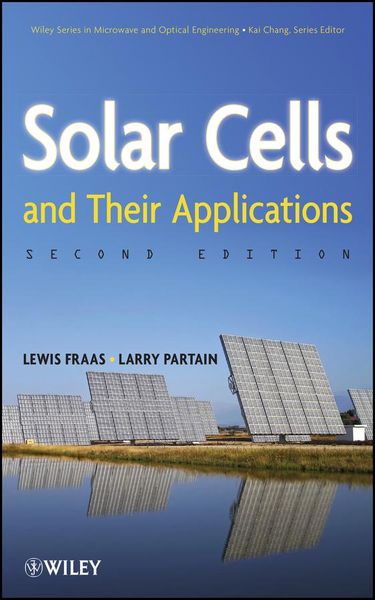
Solar Cells and Their Applications
Aus der Reihe
Wiley Series in Microwave and Optical Engineering
-
Form:Einzelkauf Download
-
Sprache:Englisch
-
eBook Format:ePUB
- PDF Fr. 119.00
- ePUB Fr. 119.00 ausgewählt
Fr. 119.00
inkl. gesetzl. MwSt.Beschreibung
Produktdetails
Format
ePUB
Kopierschutz
Ja
Family Sharing
Nein
Text-to-Speech
Ja
Erscheinungsdatum
29.10.2010
Verlag
John Wiley & Sons IncSeitenzahl
829 (Printausgabe)
Dateigröße
18085 KB
Auflage
2. Auflage
Sprache
Englisch
EAN
9781118024058
A major update of solar cell technology and the solar
marketplace
Since the first publication of this important volume over a
decade ago, dramatic changes have taken place with the solar market
growing almost 100-fold and the U.S. moving from first to fourth
place in the world market as analyzed in this Second Edition. Three
bold new opportunities are identified for any countries wanting to
improve market position. The first is combining pin solar cells
with 3X concentration to achieve economic competitiveness near
term. The second is charging battery-powered cars with solar
cell-generated electricity from arrays in surrounding
areas--including the car owners' homes--while
simultaneously reducing their home electricity bills by over ninety
percent. The third is formation of economic "unions" of sufficient
combined economic size to be major competitors.
In this updated edition, feed-in tariffs are identified as the
most effective approach for public policy. Reasons are provided to
explain why pin solar cells outperform more traditional pn solar
cells. Field test data are reported for nineteen percent pin solar
cells and for ~500X concentrating systems with bare cell
efficiencies approaching forty percent. Paths to bare cell
efficiencies over fifty percent are described, and key missing
program elements are identified. Since government support is needed
for new technology prototype integration and qualification testing
before manufacturing scale up, the key economic measure is
identified in this volume as the electricity cost in cents per
kilowatt-hour at the complete installed system level, rather than
just the up-front solar cell modules' costs in dollars per
watt.
This Second Edition will benefit technologists in the fields of
solar cells and systems; solar cell researchers; power systems
designers; academics studying microelectronics, semiconductors, and
solar cells; business students and investors with a technical
focus; and government and political officials developing public
policy.
marketplace
Since the first publication of this important volume over a
decade ago, dramatic changes have taken place with the solar market
growing almost 100-fold and the U.S. moving from first to fourth
place in the world market as analyzed in this Second Edition. Three
bold new opportunities are identified for any countries wanting to
improve market position. The first is combining pin solar cells
with 3X concentration to achieve economic competitiveness near
term. The second is charging battery-powered cars with solar
cell-generated electricity from arrays in surrounding
areas--including the car owners' homes--while
simultaneously reducing their home electricity bills by over ninety
percent. The third is formation of economic "unions" of sufficient
combined economic size to be major competitors.
In this updated edition, feed-in tariffs are identified as the
most effective approach for public policy. Reasons are provided to
explain why pin solar cells outperform more traditional pn solar
cells. Field test data are reported for nineteen percent pin solar
cells and for ~500X concentrating systems with bare cell
efficiencies approaching forty percent. Paths to bare cell
efficiencies over fifty percent are described, and key missing
program elements are identified. Since government support is needed
for new technology prototype integration and qualification testing
before manufacturing scale up, the key economic measure is
identified in this volume as the electricity cost in cents per
kilowatt-hour at the complete installed system level, rather than
just the up-front solar cell modules' costs in dollars per
watt.
This Second Edition will benefit technologists in the fields of
solar cells and systems; solar cell researchers; power systems
designers; academics studying microelectronics, semiconductors, and
solar cells; business students and investors with a technical
focus; and government and political officials developing public
policy.
Kundinnen und Kunden meinen
Verfassen Sie die erste Bewertung zu diesem Artikel
Helfen Sie anderen Kund*innen durch Ihre Meinung