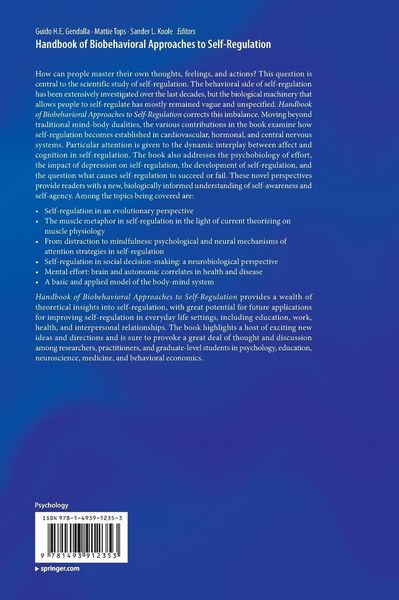
• Produktbild: Handbook of Biobehavioral Approaches to Self-Regulation
  • Produktbild: Handbook of Biobehavioral Approaches to Self-Regulation

Handbook of Biobehavioral Approaches to Self-Regulation

Fr. 242.00

inkl. gesetzl. MwSt., Versandkostenfrei


Beschreibung

Produktdetails

Einband

Gebundene Ausgabe

Erscheinungsdatum

23.09.2014

Abbildungen

XIV, 58 illus., 11 illus. in color., schwarz-weiss Illustrationen, farbige Illustrationen

Herausgeber

Guido H.E. Gendolla + weitere

Verlag

Springer Us

Seitenzahl

421

Maße (L/B/H)

26/18.3/2.8 cm

Gewicht

1012 g

Auflage

2015

Sprache

Englisch

ISBN

978-1-4939-1235-3

Beschreibung

Portrait

Guido H.E. Gendolla is Professor of Psychology at the University of Geneva, Switzerland, where he holds the chair for motivation psychology and directs the Geneva Motivation Lab. He earned his diploma in psychology (corresponding to MA) and his PhD at the University of Bielefeld, Germany, and his habilitation in psychology at the University of Erlangen, Germany. Gendolla’s research focuses on human motivation and explicit and implicit affect and is mainly concerned with involved psychophysiological processes. Most of his recent research activity was centered on implicit influences in the self-regulation of effort. He has authored numerous publications and his research has been supported by various grants of the Deutsche Forschungsgemeinschaft and the Swiss National Funds.

Mattie Tops is an Assistant Professor of Psychology at the VU University Amsterdam. He earned his diploma in psychology (corresponding to MA) at the Radboud University Nijmegen and his PhD at the University of Groningen, the Netherlands. He has published numerous articles and book chapters on the topics motivation and stress coping. Tops’ research focuses on stress (coping) hormones and brain mechanisms of self-regulation. His research has been supported by grants from the Netherlands Organization of Scientific Research (NWO).

Sander L. Koole is an Associate Professor of Psychology at the VU University Amsterdam. He has published many articles and book chapters on the topics emotion regulation and self-regulation. He has co-edited the Handbook of Experimental Existential Psychology and special issues in Social Cognition and Cognition and Emotion. His research has been supported by grants from the Netherlands Organization of Scientific Research (NWO) and the Templeton Foundation. He has been a residential fellow of the Center for Advanced Study in Behavioral Sciences at Stanford University. Koole’s research was recognized in 2011 by a Consolidator Grant of the EuropeanResearch Council, a grant that is awarded to researchers with the proven potential to become leaders in their field.

Produktdetails

Einband

Gebundene Ausgabe

Erscheinungsdatum

23.09.2014

Abbildungen

XIV, 58 illus., 11 illus. in color., schwarz-weiss Illustrationen, farbige Illustrationen

Herausgeber

Verlag

Springer Us

Seitenzahl

421

Maße (L/B/H)

26/18.3/2.8 cm

Gewicht

1012 g

Auflage

2015

Sprache

Englisch

ISBN

978-1-4939-1235-3

Herstelleradresse

Springer-Verlag KG
Sachsenplatz 4-6
1201 Wien
AT

Email: GPSR Kontakt

Noch keine Bewertungen vorhanden

Verfassen Sie die erste Bewertung zu diesem Artikel

Helfen Sie anderen Kundinnen und Kunden durch Ihre Meinung.

Kundinnen und Kunden meinen

Bewertungen (0)

Die Leseprobe wird geladen.
  • Produktbild: Handbook of Biobehavioral Approaches to Self-Regulation
  • Produktbild: Handbook of Biobehavioral Approaches to Self-Regulation
  • Part I: Integrative Perspectives: Introduction: Grounding Self-Regulation in the Brain and Body.- An evolving view of the structure of self-regulation.- Self-regulation in an evolutionary perspective.- Self-regulatory strength: neural mechanisms and implications for training.- The muscle metaphor in self-regulation in the light of current theorizing on muscle physiology.- Protective inhibition of self-regulation and motivation: extending a classic Pavlovian principle to social and personality functioning.- Part II: Interactions between Affect and Cognition in Self-Regulation: Affective modulation of cognitive control: A biobehavioral perspective.- Error monitoring under negative affect: A window into maladaptive self-regulation processes.- External signals of metacognitive control.- From distraction to mindfulness: Psychological and neural mechanisms of attention strategies in self-regulation.- Part III: The Central Nervous System and Self-Regulation: From the reward circuit to the valuation system: How the brain motivates the behavior.- Neural foundations of motivational orientations.- Motus moderari: A neuroscience-informed model for self-regulation of emotion and motivation.- More than the medial prefrontal cortex (MPFC): New advances in understanding the neural foundations of self-insight.- Self-regulation in social decision-making: A neurobiological perspective.- Part IV: Self-Regulation: Mental effort: Brain and autonomic correlates in health and disease.- Psychobiology of perceived effort during physical tasks.- Bounded effort automaticity: A drama in four parts.- The intensity of behavioral restraint: Determinants and cardiovascular correlates.- Self-striving: How self-focused attention affects effort-related cardiovascular activity.- Future thought and the self-regulation of energization.- Part V: Self-Regulatory Problems and Their Development: Depression and self-regulation: A motivational analysis and insights from effort-related cardiovascular reactivity.- Perinatal developmental origins of self-regulation.- Self-regulation through rumination: Consequences and mechanisms.- Biological aspects of self-esteem and stress.- A basic and applied model of the body-mind system.