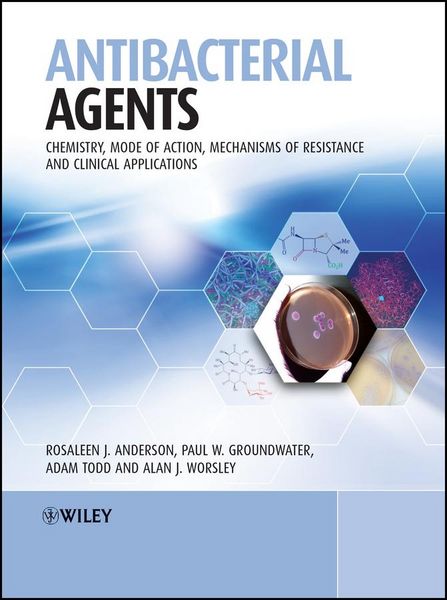
Antibacterial Agents Chemistry, Mode of Action, Mechanisms of Resistance and Clinical Applications
-
- Hardcover
- Taschenbuch
- eBook ausgewählt
-
Form:Einzelkauf Download
-
Sprache:Englisch
-
eBook Format:PDF
- PDF Fr. 124.00 ausgewählt
- ePUB Fr. 41.00
Fr. 124.00
inkl. gesetzl. MwSt.Beschreibung
Produktdetails
Format
Kopierschutz
Ja
Family Sharing
Nein
Text-to-Speech
Nein
Erscheinungsdatum
30.05.2012
Verlag
John Wiley & SonsSeitenzahl
376 (Printausgabe)
Dateigröße
13229 KB
Auflage
1. Auflage
Sprache
Englisch
EAN
9781118325438
Antibacterial agents act against bacterial infection either by
killing the bacterium or by arresting its growth. They do this by
targeting bacterial DNA and its associated processes, attacking
bacterial metabolic processes including protein synthesis, or
interfering with bacterial cell wall synthesis and function.
Antibacterial Agents is an essential guide to this important
class of chemotherapeutic drugs. Compounds are organised according
to their target, which helps the reader understand the mechanism of
action of these drugs and how resistance can arise. The book uses
an integrated "lab-to-clinic" approach which covers
drug discovery, source or synthesis, mode of action, mechanisms of
resistance, clinical aspects (including links to current
guidelines, significant drug interactions, cautions and
contraindications), prodrugs and future improvements.
Agents covered include:
* agents targeting DNA - quinolone, rifamycin, and nitroimidazole
antibacterial agents
* agents targeting metabolic processes - sulfonamide
antibacterial agents and trimethoprim
* agents targeting protein synthesis - aminoglycoside, macrolide
and tetracycline antibiotics, chloramphenicol, and
oxazolidinones
* agents targeting cell wall synthesis - beta-Lactam and
glycopeptide antibiotics, cycloserine, isonaizid, and
daptomycin
Antibacterial Agents will find a place on the bookshelves
of students of pharmacy, pharmacology, pharmaceutical sciences,
drug design/discovery, and medicinal chemistry, and as a bench
reference for pharmacists and pharmaceutical researchers in
academia and industry.
killing the bacterium or by arresting its growth. They do this by
targeting bacterial DNA and its associated processes, attacking
bacterial metabolic processes including protein synthesis, or
interfering with bacterial cell wall synthesis and function.
Antibacterial Agents is an essential guide to this important
class of chemotherapeutic drugs. Compounds are organised according
to their target, which helps the reader understand the mechanism of
action of these drugs and how resistance can arise. The book uses
an integrated "lab-to-clinic" approach which covers
drug discovery, source or synthesis, mode of action, mechanisms of
resistance, clinical aspects (including links to current
guidelines, significant drug interactions, cautions and
contraindications), prodrugs and future improvements.
Agents covered include:
* agents targeting DNA - quinolone, rifamycin, and nitroimidazole
antibacterial agents
* agents targeting metabolic processes - sulfonamide
antibacterial agents and trimethoprim
* agents targeting protein synthesis - aminoglycoside, macrolide
and tetracycline antibiotics, chloramphenicol, and
oxazolidinones
* agents targeting cell wall synthesis - beta-Lactam and
glycopeptide antibiotics, cycloserine, isonaizid, and
daptomycin
Antibacterial Agents will find a place on the bookshelves
of students of pharmacy, pharmacology, pharmaceutical sciences,
drug design/discovery, and medicinal chemistry, and as a bench
reference for pharmacists and pharmaceutical researchers in
academia and industry.
Kundinnen und Kunden meinen
Verfassen Sie die erste Bewertung zu diesem Artikel
Helfen Sie anderen Kund*innen durch Ihre Meinung