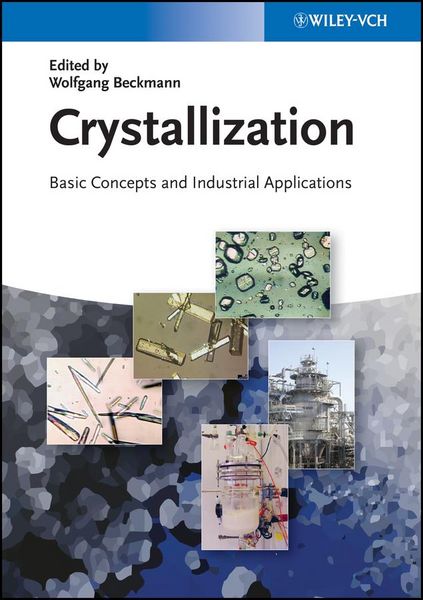
Crystallization Basic Concepts and Industrial Applications
-
Form:Einzelkauf Download
-
Sprache:Englisch
-
eBook Format:ePUB
- PDF Fr. 142.00
- ePUB Fr. 142.00 ausgewählt
Fr. 142.00
inkl. gesetzl. MwSt.Beschreibung
Produktdetails
Format
ePUB
Kopierschutz
Ja
Family Sharing
Nein
Text-to-Speech
Ja
Erscheinungsdatum
14.01.2013
Herausgeber
Wolfgang BeckmannVerlag
Wiley-VCHSeitenzahl
360 (Printausgabe)
Dateigröße
8695 KB
Auflage
1. Auflage
Sprache
Englisch
EAN
9783527650347
Crystallization is a natural occurring process but also a process abundantly used in the industry. Crystallization can occur from a solution, from the melt or via deposition of material from the gas phase (desublimation). Crystals distinguish themself from liquids, gases and amorphous substances by the long-range order of its building blocks that entail the crystals to be formed of well-defined faces, and give rise to a large number of properties of the solid.
Crystallization is used at some stage in nearly all process industries as a method of production, purification or recovery of solid materials. Crystallization is practiced on all scales: from the isolation of the first milligrams of a newly synthesized substance in the research laboratory to isolating products on the mulit-million tonne scale in industry. The book describes the breadth of crystallization operations, from isolation from a reaction broth to purification and finally to tailoring product properties.
In the first section of the book, the basic mechanisms - nucleation, growth, attrition and agglomeration are introduced. It ensures an understanding of supersaturation, the driving force of crystallization. Furthermore, the solubility of the substance and its dependences on process conditions and the various techniques of crystallization and their possibilities and limitations are discussed. Last but not least, the first part includes an intensive treatment of polymorphism . The second part builds on the basics, exploring how crystallization processes can be developed, either batch-wise or continuous, from solution or from the melt. A discussion of the purification during crystallization serves as a link between the two sections, where practical aspects and an insight using theoretical concepts are combined. Mixing and its influence on the
crystallization as well as the mutual interference of down-stream processes with the crystallization are also treated. Finally, techniques to characterize the crop are discussed.
The third part of the book is dedicated to accounts of actual developments and of carried-out crystallizations. Typical pitfalls and strategies to avoid these as well as the design of robust processes are presented.
Crystallization is used at some stage in nearly all process industries as a method of production, purification or recovery of solid materials. Crystallization is practiced on all scales: from the isolation of the first milligrams of a newly synthesized substance in the research laboratory to isolating products on the mulit-million tonne scale in industry. The book describes the breadth of crystallization operations, from isolation from a reaction broth to purification and finally to tailoring product properties.
In the first section of the book, the basic mechanisms - nucleation, growth, attrition and agglomeration are introduced. It ensures an understanding of supersaturation, the driving force of crystallization. Furthermore, the solubility of the substance and its dependences on process conditions and the various techniques of crystallization and their possibilities and limitations are discussed. Last but not least, the first part includes an intensive treatment of polymorphism . The second part builds on the basics, exploring how crystallization processes can be developed, either batch-wise or continuous, from solution or from the melt. A discussion of the purification during crystallization serves as a link between the two sections, where practical aspects and an insight using theoretical concepts are combined. Mixing and its influence on the
crystallization as well as the mutual interference of down-stream processes with the crystallization are also treated. Finally, techniques to characterize the crop are discussed.
The third part of the book is dedicated to accounts of actual developments and of carried-out crystallizations. Typical pitfalls and strategies to avoid these as well as the design of robust processes are presented.
Kundinnen und Kunden meinen
Verfassen Sie die erste Bewertung zu diesem Artikel
Helfen Sie anderen Kund*innen durch Ihre Meinung