Gutscheinbedingungen

*Gültig bis 20.09.2026 auf (fast) alles. Ausgeschlossen sind Smartboxen, Zeitschriften, Tickets, Lebensmittel, Gaming-Elektroartikel, Tinte/Toner, Gutscheine, Geschenkkarten, Blumen und Abos | Einlösbar in allen Buchhandlungen von Orell Füssli, Barth Bücher, Buchladen Rapunzel, Schuler Orell Füssli, Stauffacher und ZAP unter Vorweisung des Gutscheins, auf www.orellfüssli.ch durch Eingabe des Gutscheincodes. Beim Service „eBooks verschenken“ und bei eBook-Käufen via eReader nicht einlösbar | Mindesteinkaufswert: Fr. 100.- | Nicht mit anderen Rabatten kumulierbar.

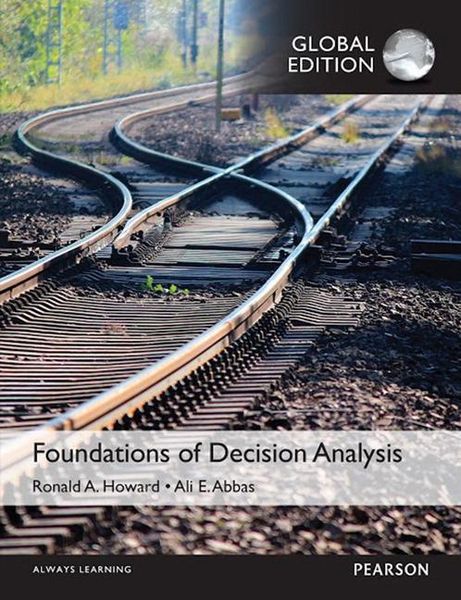
Produktbild: Abbas, A: Foundations of Decision Analysis, Global Edition

Abbas, A: Foundations of Decision Analysis, Global Edition

Fr. 102.00

inkl. gesetzl. MwSt., Versandkostenfrei


Beschreibung

Produktdetails

Einband

Taschenbuch

Erscheinungsdatum

19.03.2015

Verlag

Pearson Academic

Seitenzahl

832

Maße (L/B/H)

23.4/18/3.8 cm

Gewicht

1320 g

Sprache

Englisch

ISBN

978-1-292-07969-1

Beschreibung

Produktdetails

Einband

Taschenbuch

Erscheinungsdatum

19.03.2015

Verlag

Pearson Academic

Seitenzahl

832

Maße (L/B/H)

23.4/18/3.8 cm

Gewicht

1320 g

Sprache

Englisch

ISBN

978-1-292-07969-1

Noch keine Bewertungen vorhanden

Verfassen Sie die erste Bewertung zu diesem Artikel

Helfen Sie anderen Kundinnen und Kunden durch Ihre Meinung.

Kundinnen und Kunden meinen

Bewertungen (0)

  • Produktbild: Abbas, A: Foundations of Decision Analysis, Global Edition
    • Part 1 Defining a Good Decision
    • Chapter 1: Introduction to Quality Decision Making
    • Chapter 2: Experiencing a Decision
    •  
    • Part 2 Clear Thinking and Characterization
    • Chapter 3: Clarifying Values
    • Chapter 4: Precise Decision Language
    • Chapter 5: Possibilities
    • Chapter 6: Handling Uncertainty
    • Chapter 7: Relevance
    •  
    • Part 3 Making any Decision
    • Chapter 8: Rules of Actional Thought
    • Chapter 9: The Party Problem
    • Chapter 10: Using a Value Measure
    •  
    • Part 4 Building on the Rules
    • Chapter 11: Risk Attitude
    • Chapter 12: Sensitivity Analysis
    • Chapter 13: Basic Information Gathering
    • Chapter 14: Decision Diagrams
    •  
    • Part 5 Characterizing What you Know
    • Chapter 15: Encoding a Probability Distribution on a Measure
    • Chapter 16: From Phenomenon to Assessment
    •  
    • Part 6 Framing a Decision
    • Chapter 17: Framing a Decision
    •  
    • Part 7 Advanced Information Gathering
    • Chapter 18: Valuing Information from Multiple Sources
    • Chapter 19: Options
    • Chapter 20: Detectors with Multiple Indications
    • Chapter 21: Decisions with Influences
    •  
    • Part 8 Characterizing What You Want
    • Chapter 22: The Logarithmic u-Curve
    • Chapter 23: The Linear Risk Tolerance u-Curve
    • Chapter 24: Approximate Expressions for the Certain
    • Chapter 25: Deterministic and Probabilistic Dominance
    • Chapter 26: Decisions with Multiple Attributes (1)–Ordering
    • Chapter 27: Decisions with Multiple Attributes (2)–Value Functions
    • Chapter 28: Decisions with Multiple Attributes (3)–Preference Equivalent
    • Prospects with Preference and Value Functions
    • for Investment Cash Flows: Time Preference
    • Probabilities Over Value
    •  
    • Part 9 Some Practical Extensions
    • Chapter 29: Betting on Disparate Belief
    • Chapter 30: Learning from Experimentation
    • Chapter 31: Auctions and Bidding
    • Chapter 32: Evaluating, Scaling, and Sharing Uncertain Deals
    • Chapter 33: Making Risky Decisions
    • Chapter 34: Decisions with a High Probability of Death
    •  
    • Part 10 Computing Decision Problems
    • Chapter 35: Discretizing Continuous Probability Distributions
    • Chapter 36: Solving Decision Problems by Simulation
    •  
    • Part 11 Professional Decisions
    • Chapter 37: The Decision Analysis Cycle
    • Chapter 38: Topics in Organizational Decision Making
    • Chapter 39: Coordinating the Decision Making of Large
    •  
    • Part 12 Ethical Considerations
    • Chapter 40: Decisions and Ethics Groups