Capillary Electrophoresis Methods and Potentials
-
- Englisch ausgewählt
Fr. 72.90
inkl. gesetzl. MwSt.,
Beschreibung
Produktdetails
Einband
Taschenbuch
Erscheinungsdatum
12.06.2012
Abbildungen
X, 215 p. 19 illus.
Verlag
Springer BerlinSeitenzahl
215
Maße (L/B/H)
24.4/17/1.3 cm
Gewicht
402 g
Auflage
1996
Übersetzt von
G. Gutnikov
Sprache
Englisch
ISBN
978-3-642-85856-7
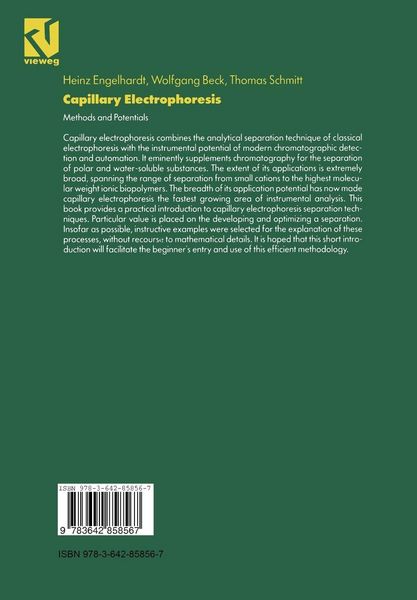
Capillary electrophoresis (CE), also designated by the acronym HPCE for "High Per formance Capillary Electrophoresis" is a rapidly growing analytical separation method. It unites the separation technique of classical electrophoresis on plates with the instrumental methods of chromatography with respect to direct detection of the solutes separated in the capillary and their ready identification and quantification. The initial problems of inadequate reproducibility in quantitative analysis, due to the necessity of handling extremely small volumes, have largely been solved in the sec ond generation commercial instruments. Hence, a rapid and reliable separation sys tem is available for ionic compounds from the smallest cation (the lithium ion) up to poly anions with molecular weights ranging in the millions (such as DNA molecules). The methods of gel electrophoresis and isoelectric focusing can be readily extended to separation techniques carried out in a capillary. For nonionic compounds an addi tional separation method is available in the form of micellar electrokinetic chroma tography (MEKC). This involves a true chromatographic separation process because the distribution of the analytes between the buffer and the micelles is superimposed on the electrophoretic migration, which contributes substantially to the selectivity.
Noch keine Bewertungen vorhanden
Verfassen Sie die erste Bewertung zu diesem Artikel
Helfen Sie anderen Kundinnen und Kunden durch Ihre Meinung.