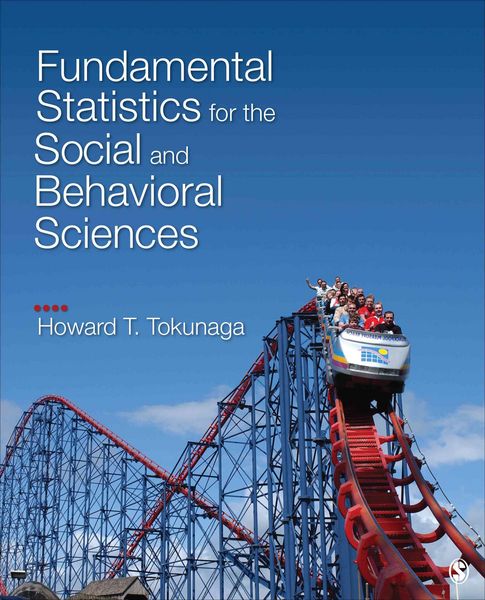
Produktbild: Fundamental Statistics For The

Fundamental Statistics For The

Fr. 122.00

inkl. gesetzl. MwSt., Versandkostenfrei


Produktdetails

Einband

Taschenbuch

Erscheinungsdatum

03.02.2015

Verlag

Sage Publications

Seitenzahl

816

Maße (L/B/H)

23/19.7/2.9 cm

Gewicht

1179 g

Sprache

Englisch

ISBN

978-1-4833-1879-0

Produktdetails

Einband

Taschenbuch

Erscheinungsdatum

03.02.2015

Verlag

Sage Publications

Seitenzahl

816

Maße (L/B/H)

23/19.7/2.9 cm

Gewicht

1179 g

Sprache

Englisch

ISBN

978-1-4833-1879-0

Noch keine Bewertungen vorhanden

Verfassen Sie die erste Bewertung zu diesem Artikel

Helfen Sie anderen Kundinnen und Kunden durch Ihre Meinung.

Kundinnen und Kunden meinen

Bewertungen (0)

  • Produktbild: Fundamental Statistics For The
  • Chapter 1: Introduction to Statistics
    1.1 What Is Statistics?
    1.2 Why Learn Statistics?
    1.3 Introduction to the Stages of the Research Process
    1.4 Plan of the Book
    Chapter 2: Examining Data: Tables and Figures
    2.1 An Example From the Research: Winning the Lottery
    2.2 Why Examine Data?
    2.3 Examining Data Using Tables
    2.4 Grouped Frequency Distribution Tables
    2.5 Examining Data Using Figures
    2.6 Examining Data: Describing Distributions
    Chapter 3: Measures of Central Tendency
    3.1 An Example From the Research: The 10% Myth
    3.2 Understanding Central Tendency
    3.3 The Mode
    3.4 The Median
    3.5 The Mean
    3.6 Comparison of the Mode, Median, and Mean
    3.7 Measures of Central Tendency: Drawing Conclusions
    Chapter 4: Measures of Variability
    4.1 An Example From the Research: How Many "Sometimes" in an "Always"?
    4.2 Understanding Variability
    4.3 The Range
    4.4 The Interquartile Range
    4.5 The Variance (s2)
    4.6 The Standard Deviation (s)
    4.7 Measures of Variability for Populations
    4.8 Measures of Variability: Drawing Conclusions
    Chapter 5: Normal Distributions
    5.1 Example: SAT Scores
    5.2 Normal Distributions
    5.3 The Standard Normal Distribution
    5.4 Applying z-Scores to Normal Distributions
    5.5 Standardizing Frequency Distributions
    Chapter 6: Probability and Introduction to Hypothesis Testing
    6.1 A Brief Introduction to Probability
    6.2 Example: Making Heads or Tails of the Super Bowl
    6.3 Introduction to Hypothesis Testing
    6.4 Issues Related to Hypothesis Testing: An Introduction
    Chapter 7: Testing One Sample Mean
    7.1 An Example From the Research: Do You Read Me?
    7.2 The Sampling Distribution of the Mean
    7.3 Inferential Statistics: Testing One Sample Mean (s Known)
    7.4 A Second Example From the Research: Unique Invulnerability
    7.5 Introduction to the t-Distribution
    7.6 Inferential Statistics: Testing One Sample Mean (s Not Known)
    7.7 Factors Affecting the Decision About the Null Hypothesis
    Chapter 8: Estimating the Mean of a Population
    8.1 An Example From the Research: Salary Survey
    8.2 Introduction to the Confidence Interval for the Mean
    8.3 The Confidence Interval for the Mean (s Not Known)
    8.4 The Confidence Interval for the Mean (s Known)
    8.5 Factors Affecting the Width of the Confidence Interval for the Mean
    8.6 Interval Estimation and Hypothesis Testing
    Chapter 9: Testing the Difference Between Two Means
    9.1 An Example From the Research: You Can Just Wait
    9.2 The Sampling Distribution of the Difference
    9.3 Inferential Statistics: Testing the Difference Between Two Sample Means
    9.4 Inferential Statistics: Testing the Difference Between Two Sample Means (Unequal Sample Sizes)
    9.5 Inferential Statistics: Testing the Difference Between Paired Means
    Chapter 10: Errors in Hypothesis Testing, Statistical Power, and Effect Size
    10.1 Hypothesis Testing vs. Criminal Trials
    10.2 An Example From the Research: Truth or Consequences
    10.3 Two Errors in Hypothesis Testing: Type I and Type II Error
    10.4 Controlling Type I and Type II Error
    10.5 Measures of Effect Size
    Chapter 11: One-Way Analysis of Variance (ANOVA)
    11.1 An Example From the Research: It's Your Move
    11.2 Introduction to Analysis of Variance (ANOVA)
    11.3 Inferential Statistics: One-Way Analysis of Variance (ANOVA)
    11.4 A Second Example: The Parking Lot Study Revisited
    11.5 Analytical Comparisons Within the One-Way ANOVA
    Chapter 12: Two-Way Analysis of Variance (ANOVA)
    12.1 An Example From the Research: Vote-or Else!
    12.2 Introduction to Factorial Research Designs
    12.3 The Two-Factor (A × B) Research Design
    12.4 Introduction to Analysis of Variance (ANOVA) for the Two-Factor Research Design
    12.5 Inferential Statistics: Two-Way Analysis of Variance (ANOVA)
    12.6 Investigating a Significant A × B Interaction Effect: Analysis of Simple Effects
    *********************************************************************************************************
    Chapter 13: Correlation and Linear Regression
    13.1 An Example From the Research: Snap Judgment
    13.2 Introduction to the Concept of Correlation
    13.3 Inferential Statistics: Pearson Correlation Coefficient
    13.4 Predicting One Variable From Another: Linear Regression
    13.5 Correlating Two Sets of Ranks: The Spearman Rank-Order Correlation
    13.6 Correlational Statistics vs. Correlational Research
    Chapter 14: Chi-Square
    14.1 An Example From the Research (One Categorical Variable): Are You My Type?
    14.2 Introduction to the Chi-Square Statistic
    14.3 Inferential Statistic: Chi-Square Goodness-of-Fit Test
    14.4 An Example From the Research (Two Categorical Variables): Seeing Red
    14.5 Inferential Statistic: Chi-Square Test of Independence
    14.6 Parametric and Nonparametric Statistical Tests