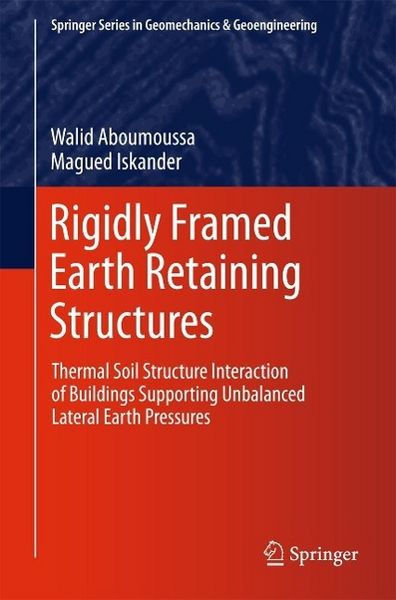
Rigidly Framed Earth Retaining Structures Thermal soil structure interaction of buildings supporting unbalanced lateral earth pressures
-
- Hardcover
- Taschenbuch
- eBook ausgewählt
-
Form:Einzelkauf Download
-
Sprache:Englisch
Fr. 213.90
inkl. gesetzl. MwSt.Beschreibung
Produktdetails
Format
Kopierschutz
Nein
Family Sharing
Nein
Text-to-Speech
Nein
Erscheinungsdatum
23.06.2014
Verlag
SpringerSeitenzahl
318 (Printausgabe)
Dateigröße
15364 KB
Sprache
Englisch
EAN
9783642546433
Structures placed on hillsides often present a number of challenges and a limited number of economical choices for site design. An option sometimes employed is to use the building frame as a retaining element, comprising a Rigidly Framed Earth Retaining Structure (RFERS). The relationship between temperature and earth pressure acting on RFERS, is explored in this monograph through a 4.5 year monitoring program of a heavily instrumented in service structure. The data indicated that the coefficient of earth pressure behind the monitored RFERS had a strong linear correlation with temperature. The study also revealed that thermal cycles, rather than lateral earth pressure, were the cause of failure in many structural elements.
The book demonstrates that depending on the relative stiffness of the retained soil mass and that of the structural frame, the developed lateral earth pressure, during thermal expansion, can reach magnitudes several times larger than those determined using classical earth pressure theories. Additionally, a nearly perpetual lateral displacement away from the retained soil mass may occur at the free end of the RFERS leading to unacceptable serviceability problems. These results suggest that reinforced concrete structures designed for the flexural stresses imposed by the backfill soil will be inadequately reinforced to resist stresses produced during the expansion cycles.
Parametric studies of single and multi-story RFERS with varying geometries and properties are also presented to investigate the effects of structural stiffness on the displacement of RFERS and the lateral earth pressure developed in the soil mass. These studies can aid the reader in selecting appropriate values of lateral earth pressure for the design of RFERS. Finally, simplified closed form equations that can be used to predict the lateral drift of RFERS are presented.
KEY WORDS: Earth Pressure; Soil-Structure Interaction; Mechanics; Failure;Distress; Temperature; Thermal Effects; Concrete; Coefficient of Thermal Expansion; Segmental Bridges; Jointless Bridges; Integral Bridges; Geotechnical Instrumentation; Finite Element Modeling; FEM; Numerical Modeling.
Noch keine Bewertungen vorhanden
Verfassen Sie die erste Bewertung zu diesem Artikel
Helfen Sie anderen Kundinnen und Kunden durch Ihre Meinung.