
Introduction to Discrete Event Simulation and Agent-based Modeling Voting Systems, Health Care, Military, and Manufacturing
-
- Hardcover
- Taschenbuch ausgewählt
- eBook
-
Sprache:Englisch
Fr. 86.90
inkl. gesetzl. MwSt.,
Beschreibung
Produktdetails
Einband
Taschenbuch
Erscheinungsdatum
20.08.2014
Verlag
Springer LondonSeitenzahl
215
Maße (L/B/H)
22.9/15.2/1.3 cm
Gewicht
337 g
Auflage
2011
Sprache
Englisch
ISBN
978-1-4471-5725-0
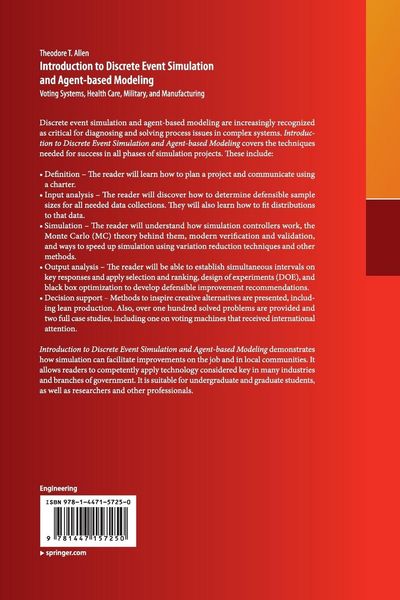
Discrete event simulation and agent-based modeling are increasingly recognized as critical for diagnosing and solving process issues in complex systems. Introduction to Discrete Event Simulation and Agent-based Modeling covers the techniques needed for success in all phases of simulation projects. These include:
• Definition – The reader will learn how to plan a project and communicate using a charter.
• Input analysis – The reader will discover how to determine defensible sample sizes for all needed data collections. They will also learn how to fit distributions to that data.
• Simulation – The reader will understand how simulation controllers work, the Monte Carlo (MC) theory behind them, modern verification and validation, and ways to speed up simulation using variation reduction techniques and other methods.
• Output analysis – The reader will be able to establish simultaneous intervals on key responses and apply selection and ranking, design of experiments (DOE), and black box optimization to develop defensible improvement recommendations.
• Decision support – Methods to inspire creative alternatives are presented, including lean production. Also, over one hundred solved problems are provided and two full case studies, including one on voting machines that received international attention.
Introduction to Discrete Event Simulation and Agent-based Modeling demonstrates how simulation can facilitate improvements on the job and in local communities. It allows readers to competently apply technology considered key in many industries and branches of government. It is suitable for undergraduate and graduate students, as well as researchers and other professionals.
• Definition – The reader will learn how to plan a project and communicate using a charter.
• Input analysis – The reader will discover how to determine defensible sample sizes for all needed data collections. They will also learn how to fit distributions to that data.
• Simulation – The reader will understand how simulation controllers work, the Monte Carlo (MC) theory behind them, modern verification and validation, and ways to speed up simulation using variation reduction techniques and other methods.
• Output analysis – The reader will be able to establish simultaneous intervals on key responses and apply selection and ranking, design of experiments (DOE), and black box optimization to develop defensible improvement recommendations.
• Decision support – Methods to inspire creative alternatives are presented, including lean production. Also, over one hundred solved problems are provided and two full case studies, including one on voting machines that received international attention.
Introduction to Discrete Event Simulation and Agent-based Modeling demonstrates how simulation can facilitate improvements on the job and in local communities. It allows readers to competently apply technology considered key in many industries and branches of government. It is suitable for undergraduate and graduate students, as well as researchers and other professionals.
Noch keine Bewertungen vorhanden
Verfassen Sie die erste Bewertung zu diesem Artikel
Helfen Sie anderen Kundinnen und Kunden durch Ihre Meinung.