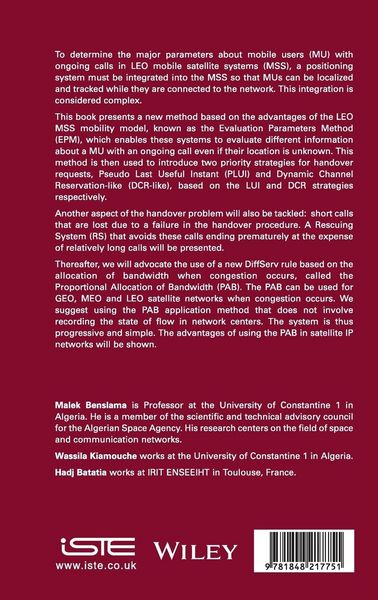
• Produktbild: Connections Management Strategies in Satellite Cellular Networks
  • Produktbild: Connections Management Strategies in Satellite Cellular Networks

Connections Management Strategies in Satellite Cellular Networks

Fr. 195.00

inkl. gesetzl. MwSt., Versandkostenfrei


Beschreibung

Produktdetails

Einband

Gebundene Ausgabe

Erscheinungsdatum

16.02.2015

Verlag

Wiley

Seitenzahl

230

Maße (L/B/H)

24/16.1/1.7 cm

Gewicht

516 g

Sprache

Englisch

ISBN

978-1-84821-775-1

Beschreibung

Produktdetails

Einband

Gebundene Ausgabe

Erscheinungsdatum

16.02.2015

Verlag

Wiley

Seitenzahl

230

Maße (L/B/H)

24/16.1/1.7 cm

Gewicht

516 g

Sprache

Englisch

ISBN

978-1-84821-775-1

Herstelleradresse

Libri GmbH
Europaallee 1
36244 Bad Hersfeld
DE

Email: gpsr@libri.de

Noch keine Bewertungen vorhanden

Verfassen Sie die erste Bewertung zu diesem Artikel

Helfen Sie anderen Kundinnen und Kunden durch Ihre Meinung.

Kundinnen und Kunden meinen

Bewertungen (0)

Die Leseprobe wird geladen.
  • Produktbild: Connections Management Strategies in Satellite Cellular Networks
  • Produktbild: Connections Management Strategies in Satellite Cellular Networks
  • PREFACE ix

    ABBREVIATIONS xi

    INTRODUCTION xv

    CHAPTER 1. THE FOUNDATIONS OF SATELLITE NETWORKS 1

    1.1. Introduction 1

    1.2. Satellite orbits 3

    1.2.1. Characteristics of the ellipse 3

    1.2.2. Kepler's laws 4

    1.2.3. Orbital parameters for earth satellites 5

    1.2.4. Orbital perturbations 7

    1.2.5. Maintaining and surviving an orbit 7

    1.3. Time, time variation and coverage 8

    1.3.1. Geometric data 8

    1.3.2. Approximation of coverage 11

    1.3.3. Time interval between two successive intersatellite transfers 12

    1.3.4. Time and time variation 12

    1.4. Orbital paths 13

    1.4.1. GEO-type systems 14

    1.4.2. Elliptical systems 15

    1.4.3. MEO-type systems 17

    1.4.4. LEO-type systems 17

    1.5. Characteristics of cellular satellite systems 19

    1.6. The advantages of LEO systems 22

    1.7. Handover in LEO satellite networks 23

    1.7.1. Link-layer handover 24

    1.7.2. Network-layer handover 25

    CHAPTER 2. AN INTRODUCTION TO TELETRAFFIC 27

    2.1. Introduction 27

    2.2. The history of teletraffic theory and technique 28

    2.2.1. Queuing theory 28

    2.2.2. Teletraffic theory 29

    2.3. Basic concepts 30

    2.3.1. The birth-death process 31

    2.3.2. Poisson process 32

    2.4. Erlang-B and Erlang-C models 34

    2.4.1. Blocking probability and the Erlang-B formula 34

    2.4.2. Queuing probability and the Erlang-C formula 36

    CHAPTER 3. CHANNEL ALLOCATION STRATEGIES AND THE MOBILITY MODEL 39

    3.1. Introduction 39

    3.2. Channel allocation techniques 40

    3.2.1. Fixed channel allocation techniques 41

    3.2.2. Dynamic channel allocation techniques 41

    3.3. Spotbeam handover and priority strategies 43

    3.3.1. Spotbeam handover 43

    3.3.2. Priority strategies for handover requests 45

    3.4. Mobility model 48

    3.5. Analysis of the mobility model 53

    CHAPTER 4. EVALUATION PARAMETERS METHOD 63

    4.1. Introduction 63

    4.2. The advantages of the LEO MSS mobility model 64

    4.3. Evaluation parameters method 71

    4.3.1. Position of the MU in the cell 71

    4.3.2. The moment the next handover request initializes 72

    4.3.3. Maximum queuing time 74

    4.4. Pseudo-last useful instant queuing strategy 77

    4.4.1. Putting handover requests in a queue 77

    4.4.2. Handover request management 77

    4.4.3. LUI queuing strategy 78

    4.4.4. Pseudo-LUI queuing strategy 79

    4.5. Guard channel strategy: dynamic channel reservation-like 81

    4.5.1. Dynamic channel reservation technique 81

    4.5.2. Dynamic channel reservation DCR-like technique 83

    CHAPTER 5. ANALYTICAL STUDY 85

    5.1. Introduction 85

    5.2. An analysis of FCA-QH with different queuing strategies 85

    5.3. Analytical study of FCR and FCR-like 91

    5.3.1. An analysis of FCR 91

    5.3.2. An analysis of FCR-like 94

    CHAPTER 6. THE RESCUING SYSTEM 101

    6.1. Introduction 101

    6.2. Fuzzy logic 102

    6.2.1. Definition of fuzzy subsets 102

    6.2.2. Decisions in the fuzzy environment 102

    6.3. The problem 103

    6.4. Rescuing system 105

    CHAPTER 7. RESULTS AND SIMULATION 109

    7.1. Introduction 109

    7.2. The (folded) simulated network 110

    7.3. Simulation results 112

    7.3.1. Verifying the simulation: a comparison with the analytical results of the FCA-QH case with different queuing strategies 113

    7.3.2. A comparison of FCA and DCA, DCA-QH & FCA-QH simulation using LUI 115

    7.3.3. A comparison of NPS and QH, DCA-NPS & DCA-QH simulation 116

    7.3.4. Comparison of QH strategies, DCA-QH FIFO, LUI, PLUI simulation 117

    7.3.5. Verifying the simulation: a comparison with the analytical results of the FCR and FCR-like case 119

    7.3.6. A comparison of DCR and DCR-like 120

    CHAPTER 8. PAB FOR IP TRAFFIC IN SATELLITE NETWORKS 127

    8.1. Introduction 127

    8.2. Proportional allocation of bandwidth 129

    8.2.1. Implementation of PAB 130

    8.3. Determination of the label fraction 135

    8.3.1. Equal fractions 135

    8.3.2. AP fractions 135

    8.3.3. GP fractions 135

    8.4. Simulation and results 136

    8.4.1. Single congested link 137

    8.4.2. Multiple congested link 146

    8.5. Conclusion 149

    GENERAL CONCLUSION 151

    APPENDIX 1 157

    APPENDIX 2 161

    APPENDIX 3 163

    APPENDIX 4 167

    APPENDIX 5 169

    BIBLIOGRAPHY 181

    INDEX 201