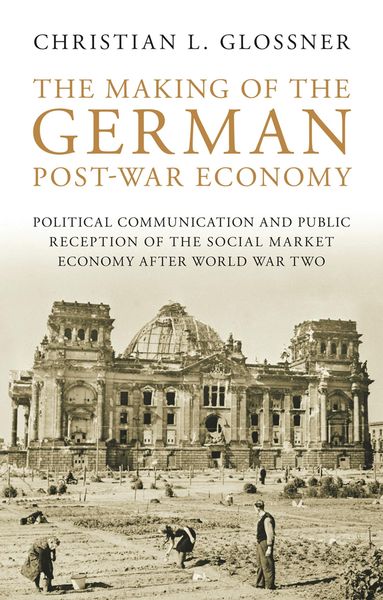
The Making of the German Post-War Economy Political Communication and Public Reception of the Social Market Economy After World War Two
-
- Hardcover
- Taschenbuch
- eBook ausgewählt
-
Form:Einzelkauf Download
-
Sprache:Englisch
Fr. 45.90
inkl. gesetzl. MwSt.Beschreibung
Produktdetails
Format
Kopierschutz
Ja
Family Sharing
Nein
Text-to-Speech
Nein
Erscheinungsdatum
28.02.2010
Verlag
Bloomsbury eBooks UKSeitenzahl
320 (Printausgabe)
Auflage
1. Auflage
Sprache
Englisch
EAN
9780857714589
The years following the end of World War II in Germany were a significant period of change and upheaval. This book on the economic reconstruction of post-war West Germany traces the development of economic and socio-political ideas, and their gradual absorption by mainstream politicians, officials and the general public during the period of transition between 1945 and 1949.
In the aftermath of World War II, several German think-tanks, political parties and individuals gave impulse to and then shaped the development of a viable socio-political and economic model between the extremes of laissez-faire capitalism and the collectivist planned economy. In their endeavours to bring into effect their particular economic ideas - often diametrically opposed to one another - the parties of left and right stimulated not only academic and political debate, but also public debate about the political and economic reconstruction of occupied post-war Germany. While all the various neo-liberal approaches assigned to the people sovereign and decisive status in the institutional economic order, and recognised the interdependence of politics, economics and the public, one particular school of economic thought outpaced the others in communicating a model of coordinated economic and social policy, namely the Social Market Economy.
Christian Glossner here investigates whether or not it was primarily the subtlety of the political campaign for this model that led to its implementation by the then Economic Council and eventual validation by the German electorate. The programmes published by the principal academic and political groups of the time and the practical day-to-day decisions of the first parliament in post-war Germany are analysed with reference to popular preferences. By examining both the formative involvement of German parties in post-war reconstruction and the role of the public during the process of economic liberalisation, this book provides explanations for why the Social Market Economy prevailed as the socio-political and economic model for the Federal Republic of Germany. It will be of interest to scholars of German, economic and twentieth-century history.
In the aftermath of World War II, several German think-tanks, political parties and individuals gave impulse to and then shaped the development of a viable socio-political and economic model between the extremes of laissez-faire capitalism and the collectivist planned economy. In their endeavours to bring into effect their particular economic ideas - often diametrically opposed to one another - the parties of left and right stimulated not only academic and political debate, but also public debate about the political and economic reconstruction of occupied post-war Germany. While all the various neo-liberal approaches assigned to the people sovereign and decisive status in the institutional economic order, and recognised the interdependence of politics, economics and the public, one particular school of economic thought outpaced the others in communicating a model of coordinated economic and social policy, namely the Social Market Economy.
Christian Glossner here investigates whether or not it was primarily the subtlety of the political campaign for this model that led to its implementation by the then Economic Council and eventual validation by the German electorate. The programmes published by the principal academic and political groups of the time and the practical day-to-day decisions of the first parliament in post-war Germany are analysed with reference to popular preferences. By examining both the formative involvement of German parties in post-war reconstruction and the role of the public during the process of economic liberalisation, this book provides explanations for why the Social Market Economy prevailed as the socio-political and economic model for the Federal Republic of Germany. It will be of interest to scholars of German, economic and twentieth-century history.
Noch keine Bewertungen vorhanden
Verfassen Sie die erste Bewertung zu diesem Artikel
Helfen Sie anderen Kundinnen und Kunden durch Ihre Meinung.