KI-Beratung Beta

Produktbild: Morning Hours
Band 12

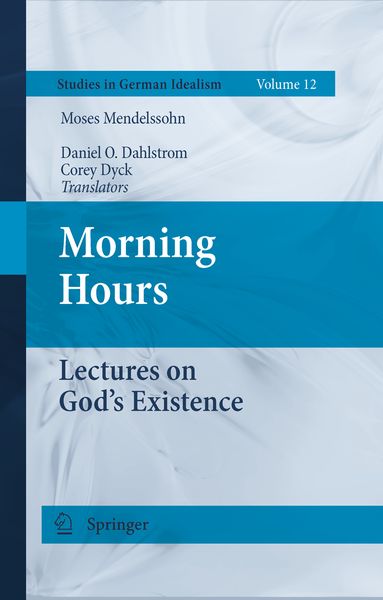
Morning Hours Lectures on God's Existence

Fr. 137.00

inkl. gesetzl. MwSt., Versandkostenfrei


Beschreibung

The last work published by Moses Mendelssohn during his lifetime, Morning Hours (1785) is also the most sustained presentation of his mature epistemological and metaphysical views, all elaborated in the service of presenting proofs for the existence of God. But Morning Hours is much more than a theoretical...

Beschreibung

The last work published by Moses Mendelssohn during his lifetime, Morning Hours (1785) is also the most sustained presentation of his mature epistemological and metaphysical views, all elaborated in the service of presenting proofs for the existence of God. But Morning Hours is much more than a theoretical treatise. It also plays a central role in the drama of the Pantheismusstreit, Mendelssohn's "dispute" with F. H. Jacobi over the nature and scope of Lessing's attitude toward Spinoza and "pantheism". As the latest salvo in a war of texts with Jacobi, Morning Hours is also Mendelssohn's attempt to set the record straight regarding his beloved Lessing in this connection, not least by demonstrating the absence of any practical (i.e., religious or moral) difference between theism and a "purified pantheism".

Produktdetails

Einband

Taschenbuch

Erscheinungsdatum

15.10.2014

Abbildungen

XX, 142 p.

Herausgeber Daniel O. Dahlstrom + weitere

Produktdetails

Einband

Taschenbuch

Erscheinungsdatum

15.10.2014

Abbildungen

XX, 142 p.

Herausgeber
Verlag Springer Netherland
Seitenzahl

142

Maße (L/B/H)

23.5/15.5/1 cm

Gewicht

260 g

Auflage

2011

Originaltitel Morgenstunden
Sprache

Englisch

ISBN

978-94-007-3520-0

Herstelleradresse

Springer-Verlag KG
Sachsenplatz 4-6
1201 Wien
AT

Email: ProductSafety@springernature.com

Noch keine Bewertungen vorhanden

Verfassen Sie die erste Bewertung zu diesem Artikel

Helfen Sie anderen Kundinnen und Kunden durch Ihre Meinung.

Kundinnen und Kunden meinen

Bewertungen (0)

  • Produktbild: Morning Hours
  • First Part.- Preliminary report.- Preliminary Knowledge of Truth, Semblance, and Error.- I.  What is truth?- II.  Cause – Effect – Ground – Force.- III.  Evidence – Of immediate Knowledge.  Rational Knowledge – Knowledge of Nature.- IV.  Truth and Illusion.- V.  Existence – Being Awake – Dreams – Rapture.- VI.  Combination of Ideas – Idealism.- VII.  Continuation.  The Idealist's Dispute with the Dualist.  Truth-Drive and Approval- Drive. - Second Part.- Scientific Doctrinal Concepts of God's Existence.- VIII.  Importance of the Investigation.  On Basedow’s Principle of the Duty to Believe.-      Axiomata.- IX.  The evidence of the pure and the applied doctrine of magnitudes. Comparison with the evidence for the proofs of God's existence.  Different methods of those proofs.- X.  Allegorical Dream. – Reason and Common Sense.- XI.  Epicureanism. – Accident. – Chance.  A Series of Causes and Effects, without End, without Beginning.  Progression into Infinity, Forwards and Backwards. – The  Timeless, without Beginning, without End and without Progression.- XII.  Sufficient Reason for the Contingent in the Necessary. – The former is somewhere and sometimes, the latter is everywhere and all times. – The former is only in   relation to space and time; the latter is unqualifiedly the best and most perfect. Everything that is, is best.  –  All God's thoughts, insofar as they have the best as   their subject, attain actuality.- XIII.  Spinozism. – Pantheism. – All is One and One is All. – Refutation.- XIV.  Continued dispute with the pantheists.  –  Approximation.  –  Point of unison with them.  –  Innocuousness of the purified patheism. –  Compatibility with religion and ethics insofar as they are practical.- XV.  Lessing. – His Contribution to the Religion of Reason. – His Thoughts on Purified Pantheism.- XVI.  Elucidation of the concepts ofnecessity, contingency, independence, and dependence.  –  Attempt at a new proof for the existence of God on the basis of the incompleteness of self-knowledge.- XVII.  The a priori Grounds of Proof of the Existence of a supremely perfect, necessary, independent Being.