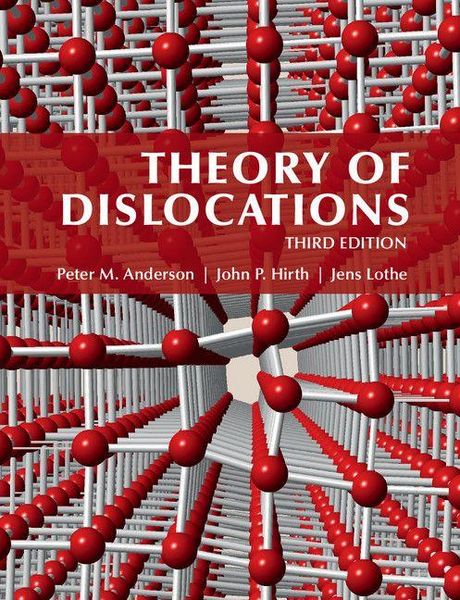
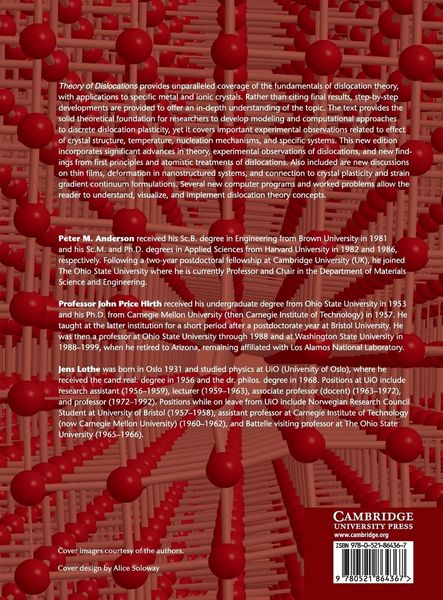
• Produktbild: Theory of Dislocations
  • Produktbild: Theory of Dislocations

Theory of Dislocations 3rd edition

Fr. 172.00

inkl. gesetzl. MwSt., Versandkostenfrei


Beschreibung

Produktdetails

Einband

Gebundene Ausgabe

Erscheinungsdatum

03.10.2018

Verlag

Cambridge Academic

Seitenzahl

950

Maße (L/B/H)

28.6/22.1/4.3 cm

Gewicht

2200 g

Sprache

Englisch

ISBN

978-0-521-86436-7

Beschreibung

Produktdetails

Einband

Gebundene Ausgabe

Erscheinungsdatum

03.10.2018

Verlag

Cambridge Academic

Seitenzahl

950

Maße (L/B/H)

28.6/22.1/4.3 cm

Gewicht

2200 g

Sprache

Englisch

ISBN

978-0-521-86436-7

Herstelleradresse

Libri GmbH
Europaallee 1
36244 Bad Hersfeld
DE

Email: gpsr@libri.de

Kundinnen und Kunden meinen

0 Bewertungen

Informationen zu Bewertungen

Zur Abgabe einer Bewertung ist eine Anmeldung im Konto notwendig. Die Authentizität der Bewertungen wird von uns nicht überprüft. Wir behalten uns vor, Bewertungstexte, die unseren Richtlinien widersprechen, entsprechend zu kürzen oder zu löschen.

Die Bewertungen sind nach Format, Anzahl Sterne und Datum sortiert.

Verfassen Sie die erste Bewertung zu diesem Artikel

Helfen Sie anderen Kund*innen durch Ihre Meinung

Kundinnen und Kunden meinen

0 Bewertungen filtern

Die Leseprobe wird geladen.
  • Produktbild: Theory of Dislocations
  • Produktbild: Theory of Dislocations
  • Part I. Isotropic Continua: 1. Introductory material; 2. Elasticity; 3. Theory of straight dislocations; 4. Theory of curved dislocations; 5. Applications to dislocation interactions; 6. Applications to self energies; 7. Dislocations at high velocities; Part II. Effects of Crystal Structure: 8. The influence of lattice periodicity; 9. Slip systems of perfect dislocations; 10. Partial dislocations in FCC metals; 11. Partial dislocations in other structures; 12. Dislocations in ionic crystals; 13. Dislocations in anisotropic elastic media; Part III. Interactions with Point Defects: 14. Equilibrium defect concentrations; 15. Diffusive glide and climb processes; 16. Glide of jogged dislocations; 17. Dislocation motion in vacancy supersaturations; 18. Effects of solute atoms on dislocation motion; Part IV. Groups of Dislocations: 19. Grain boundaries and interfaces; 20. Dislocation sources; 21. Dislocation pileups and cracks; 22. Dislocation intersections and barriers; 23. Deformation twinning.