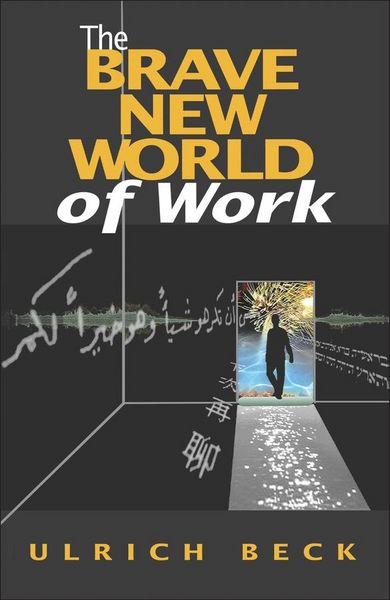
The Brave New World of Work
-
- Taschenbuch
- eBook ausgewählt
-
Form:Einzelkauf Download
-
Sprache:Englisch
-
eBook Format:PDF
- PDF Fr. 77.00 ausgewählt
- ePUB 3 Fr. 27.00
Fr. 77.00
inkl. gesetzl. MwSt.Beschreibung
Produktdetails
Format
Kopierschutz
Ja
Family Sharing
Nein
Text-to-Speech
Nein
Erscheinungsdatum
05.11.2014
Verlag
PolitySeitenzahl
208 (Printausgabe)
Dateigröße
878 KB
Auflage
1. Auflage
Sprache
Englisch
EAN
9780745692562
In this important book, Ulrich Beck - one of the leading social
thinkers in Europe today - examines how work has become unstable in
the modern world and presents a new vision for the future. Beck
begins by describing how the traditional work society, with its
life-long job paths, is giving way to a much less stable world in
which skills can be suddenly devalued, jobs obliterated, welfare
cover reduced or eliminated. The West would appear to be heading
towards a social structure of ambiguity and multiple activity that
has hitherto been more characteristic of the developing world. But
what appears to be the end of traditional working practices can
also be seen as an opportunity to develop new ideas and models for
work in the twenty-first century.
Beck's alternative vision is centred on the concept of active
citizens democratically organized in local, and increasingly also
regional or transnational, networks. Against the threat of social
exclusion, everyone can and must have a right to be included in a
new definition and distribution of work. This will involve constant
movement between formal employment (with a major reduction in
working hours) and forms of self-organized artistic, cultural and
political 'civil labour', providing equal access to comprehensive
social protection. The aim must be to turn insecurity around, so
that it becomes a positive and enriching discontinuity of life.
Drawing on his earlier work on risk and reflexive modernization,
The Brave New World of Work is also closely linked to his
studies on globalization and individualization. These processes are
part of the same challenge upon which a politics of modernity must
now base itself. Not only the future of work, but also the very
survival of democracy and the welfare state will depend on the
development of a newly committed and 'multi-active' transnational
citizenship.
This book will be of great interest to second- and third-year
students in sociology, politics, geography and the social sciences
generally. It will also appeal to a broader audience interested in
the issues and debates surrounding the changing nature of work.
thinkers in Europe today - examines how work has become unstable in
the modern world and presents a new vision for the future. Beck
begins by describing how the traditional work society, with its
life-long job paths, is giving way to a much less stable world in
which skills can be suddenly devalued, jobs obliterated, welfare
cover reduced or eliminated. The West would appear to be heading
towards a social structure of ambiguity and multiple activity that
has hitherto been more characteristic of the developing world. But
what appears to be the end of traditional working practices can
also be seen as an opportunity to develop new ideas and models for
work in the twenty-first century.
Beck's alternative vision is centred on the concept of active
citizens democratically organized in local, and increasingly also
regional or transnational, networks. Against the threat of social
exclusion, everyone can and must have a right to be included in a
new definition and distribution of work. This will involve constant
movement between formal employment (with a major reduction in
working hours) and forms of self-organized artistic, cultural and
political 'civil labour', providing equal access to comprehensive
social protection. The aim must be to turn insecurity around, so
that it becomes a positive and enriching discontinuity of life.
Drawing on his earlier work on risk and reflexive modernization,
The Brave New World of Work is also closely linked to his
studies on globalization and individualization. These processes are
part of the same challenge upon which a politics of modernity must
now base itself. Not only the future of work, but also the very
survival of democracy and the welfare state will depend on the
development of a newly committed and 'multi-active' transnational
citizenship.
This book will be of great interest to second- and third-year
students in sociology, politics, geography and the social sciences
generally. It will also appeal to a broader audience interested in
the issues and debates surrounding the changing nature of work.
Kundinnen und Kunden meinen
Verfassen Sie die erste Bewertung zu diesem Artikel
Helfen Sie anderen Kund*innen durch Ihre Meinung