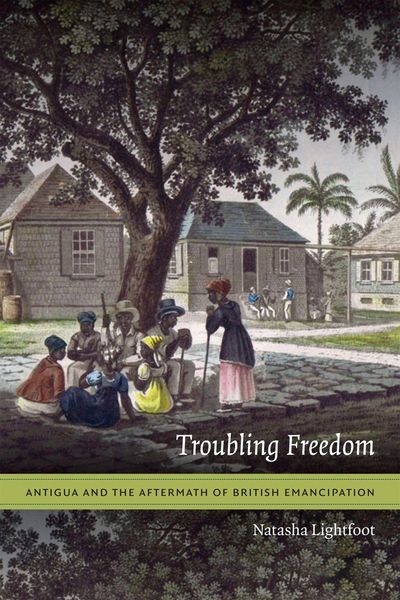
Produktbild: Troubling Freedom

Troubling Freedom Antigua and the Aftermath of British Emancipation

Fr. 144.00

inkl. gesetzl. MwSt., Versandkostenfrei


Beschreibung

Produktdetails

Einband

Gebundene Ausgabe

Erscheinungsdatum

04.12.2015

Abbildungen

10 illustrations

Verlag

Duke University Press

Seitenzahl

336

Maße (L/B/H)

23.4/15.7/2.3 cm

Gewicht

590 g

Sprache

Englisch

ISBN

978-0-8223-5975-3

Beschreibung

Rezension

"By tracing the development of Antigua in the post-emancipation period, Lightfoot has produced a work that will interest scholars who study conceptions of freedom, working-class solidarity, labor, Antigua, and the wider Caribbean. Recommended." - J. Rankin (Choice) "Lightfoot's Troubling Freedom sheds light on how freedpeople in Antigua negotiated the terms of their labor and the conditions of their freedom in Antigua....The book also illustrates that space and spatial relations were at the heart of Antiguans' struggle for freedom after emancipation: between Antigua and Barbuda, the city and the country, the free villages and estates." - Kaneesha Cherelle Parsard (American Quarterly) "Instead of a 'narrative of valiant and unified subaltern struggle,' a moral tale of progress and expanding unproblematic liberation, Lightfoot offers a more complex and ambivalent history of freedom, which contains not only hope and solidarity, but also internecine conflicts and violence. For this very reason, this is an important and insightful history that deserves to be read." - Henrique Espada Lima (Canadian Journal of History) "[Lightfoot's] deep examination of the daily lives of working class Antiguans and their views on freedom makes Troubling Freedom an excellent primer for scholars of the Caribbean. This book also provides a model for scholars of the African diaspora interested in a rereading of the agency of different social groups through older sources." - Caree A. Banton (History: Reviews of New Books) "Natasha Lightfoot offers a compelling history of the relationship between labor, race, and gender in the only British sugar colony to reject the apprenticeship program. Lightfoot provides readers with a study that is deeply appreciative of the ways in which freedpeople confronted new forms of white supremacy and material constraint after slavery's demise. What emerges is a multilayered analysis of the relationship between everyday violence, organized resistance, and collective consciousness in nineteenth-century Antigua." - James Dator (American Historical Review) "Lightfoot's carefully and deeply researched and subtly analysed study makes a valuable contribution to the literature on the transition to formal freedom in the British Caribbean." - Bridget Brereton (Slavery & Abolition)

Produktdetails

Einband

Gebundene Ausgabe

Erscheinungsdatum

04.12.2015

Abbildungen

10 illustrations

Verlag

Duke University Press

Seitenzahl

336

Maße (L/B/H)

23.4/15.7/2.3 cm

Gewicht

590 g

Sprache

Englisch

ISBN

978-0-8223-5975-3

Herstelleradresse

Libri GmbH
Europaallee 1
36244 Bad Hersfeld
DE

Email: gpsr@libri.de

Noch keine Bewertungen vorhanden

Verfassen Sie die erste Bewertung zu diesem Artikel

Helfen Sie anderen Kundinnen und Kunden durch Ihre Meinung.

Kundinnen und Kunden meinen

Bewertungen (0)

  • Produktbild: Troubling Freedom
  • Illustrations  ix

    Acknowledgments  xiii

    Introduction. "Me No B'longs to Dem": Emancipation's Possibilities and Limits in Antigua  1

    1. A Landscape That Continually Recurred in Passing: The Many Worlds of a Small Place  21

    2. So Them Make Laws for Negro, So Them Make Law for Master: Antigua's 1831 Sunday Market Rebellion  57

    3. But Freedom till Better: Labor Struggles after 1834  84

    4. An Equality with the Highest in the Land?: The Expansion of Black Private and Public Life  117

    5. Sinful Conexions: Christianity, Social Surveillance, and Black Women's Bodies in Distress  142

    6. Mashing Ants: Surviving the Economic Crisis after 1846  167

    7. Our Side: Antigua's 1858 Uprising and the Contingent Nature of Freedom  195

    8. "My Color Broke Me Down": Postslavery Violence and Incomplete Freedom in the British Caribbean  224

    Notes  233

    Bibliography  287

    Index  309