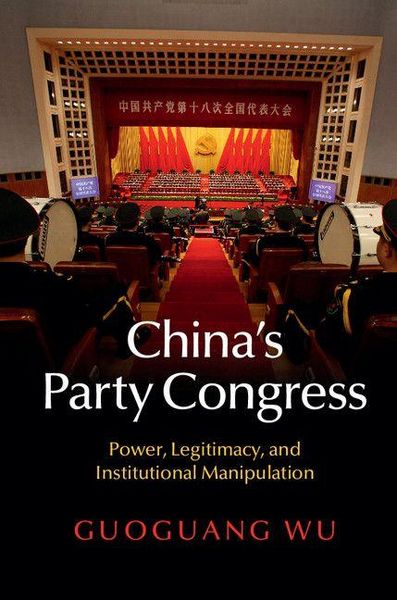
China's Party Congress Power, Legitimacy, and Institutional Manipulation
-
- Hardcover ausgewählt
- Taschenbuch
- eBook
-
Sprache:Englisch
Fr. 182.00
inkl. gesetzl. MwSt.,
Beschreibung
Produktdetails
Einband
Gebundene Ausgabe
Erscheinungsdatum
02.09.2015
Verlag
Cambridge AcademicSeitenzahl
382
Maße (L/B/H)
23.5/15.7/2.5 cm
Gewicht
680 g
Sprache
Englisch
ISBN
978-1-107-08202-1
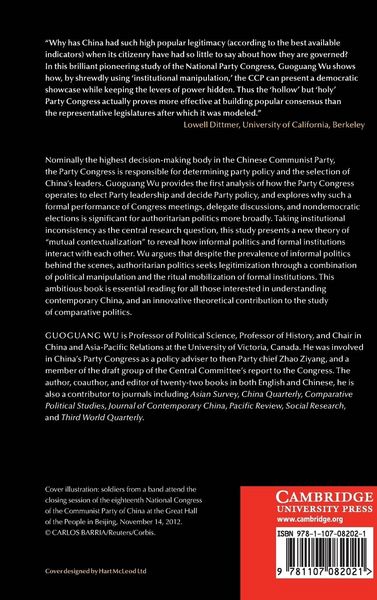
Nominally the highest decision-making body in the Chinese Communist Party, the Party Congress is responsible for determining party policy and the selection of China's leaders. Guoguang Wu provides the first analysis of how the Party Congress operates to elect Party leadership and decide Party policy, and explores why such a formal performance of congress meetings, delegate discussions, and non-democratic elections is significant for authoritarian politics more broadly. Taking institutional inconsistency as the central research question, this study presents a new theory of 'mutual contextualization' to reveal how informal politics and formal institutions interact with each other. Wu argues that despite the prevalence of informal politics behind the scenes, authoritarian politics seeks legitimization through a combination of political manipulation and the ritual mobilization of formal institutions. This ambitious book is essential reading for all those interested in understanding contemporary China, and an innovative theoretical contribution to the study of comparative politics.
Noch keine Bewertungen vorhanden
Verfassen Sie die erste Bewertung zu diesem Artikel
Helfen Sie anderen Kundinnen und Kunden durch Ihre Meinung.