• Produktbild: The Cambridge Handbook of Environment in Human Development
  • Produktbild: The Cambridge Handbook of Environment in Human Development

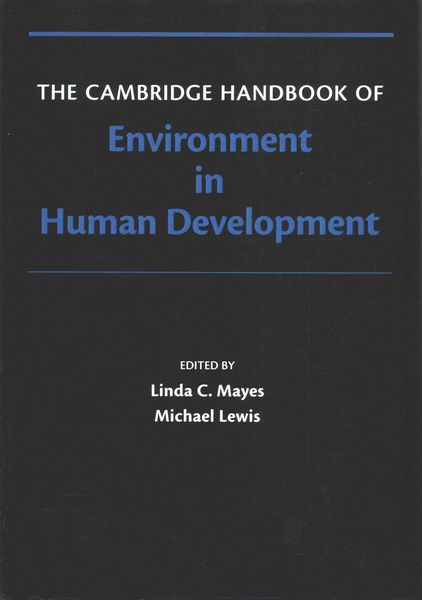
The Cambridge Handbook of Environment in Human Development

Fr. 92.90

inkl. gesetzl. MwSt., Versandkostenfrei


Beschreibung

Produktdetails

Einband

Taschenbuch

Erscheinungsdatum

02.02.2015

Herausgeber

Mayes Linda + weitere

Verlag

Cambridge Academic

Seitenzahl

740

Maße (L/B/H)

25.4/17.8/3.9 cm

Gewicht

1360 g

Sprache

Englisch

ISBN

978-1-107-53168-0

Beschreibung

Produktdetails

Einband

Taschenbuch

Erscheinungsdatum

02.02.2015

Herausgeber

Verlag

Cambridge Academic

Seitenzahl

740

Maße (L/B/H)

25.4/17.8/3.9 cm

Gewicht

1360 g

Sprache

Englisch

ISBN

978-1-107-53168-0

Herstelleradresse

Libri GmbH
Europaallee 1
36244 Bad Hersfeld
DE

Email: gpsr@libri.de

Noch keine Bewertungen vorhanden

Verfassen Sie die erste Bewertung zu diesem Artikel

Helfen Sie anderen Kundinnen und Kunden durch Ihre Meinung.

Kundinnen und Kunden meinen

Bewertungen (0)

Die Leseprobe wird geladen.
  • Produktbild: The Cambridge Handbook of Environment in Human Development
  • Produktbild: The Cambridge Handbook of Environment in Human Development
  • Introduction Linda Mayes and Michael Lewis; 1. Proximal to distal environments in child development: theoretical, structural, methodological, and empirical considerations Marc Bornstein; 2. Risk and adversity in developmental psychology Jelena Obradovic, Anne Shaffer and Anne Masten; 3. Maternal care as the central environmental variable Lynne Murray and Marc de Rosnay; 4. Novel assessment techniques aimed at identifying proximal and distal environmental risk factors for children and adolescents Linda Mayes, Stacey P. Daughters and Jessica M. Richards; 5. Beyond the Dyad Michael Lewis; 6. Social agents and genes: comments on the ontogenesis of the 'social genome' Elena Grigorenko and Sarah Ward; 7. The dynamic systems perspective: what is the system? Tom Hollenstein; 8. New approaches to the notion of 'environmental risk' Jeanne Brooks-Gunn, Aliza W. Pressman and Pamela Klebanov; 9. Environment across time Ronald Seifer; 10. Parental care and attachment Peter Fonagy and Michelle Sleed; 11. Understanding the developmental influences of the family environment Sharon Landesman Ramey and Craig T. Ramey; 12. Measuring the environments of early care, education, and intervention programs for children in poverty William Gilliam and Laura Stout Sosinsky; 13. School influences on human development Jacquelynne Eccles and Robert W. Roeser; 14. Siblings and peers in the adult-child-child triadic context Sybil L. Hart; 15. Neighborhood environments: a multi-measure, multi-level approach Ross D. Parke, Shoon Lio, Thomas J. Schofield, Louis Tuthill, Eric Vega and Scott Coltrane; 16. Rural versus urban environments Robert H. Bradley; 17. Current research and new dimensions Stephanie M. Jones, Monica Yudron, Aeliecia Pisciella and Hadas Eidelman; 18. Social networks Mary J. Levitt; 19. Marital health E. Mark Cummings and Lauren M. Papp; 20. Parental psychopathology: a developmental perspective on mechanisms of transmission Nancy E. Suchman and Cindy DeCoste; 21. Early exposure to trauma: domestic and community violence Alicia Lieberman and Patricia Van Horn; 22. Child maltreatment: a pathogenic relational environment across development Julia Kim-Cohen, Sarah Rabbitt, Jessica Henry and Andrea L. Gold; 23. The cultural organization of children's environment Sara Harkness and Charles M. Super; 24. Children and electronic media Sandra L. Calvert; 25. Parenting behavior as the environment where children grow Ruth Feldman; 26. HOME inventory Robert H. Bradley; 27. Measurement and model building in studying the influence of socioeconomic status on child development Erika Hoff, Brett Laursen and Kelly Bridges; 28. Assessment of parental psychopathology and adaptive functioning Thomas Achenbach; 29. Assessment of social support, social network, and social capital Brenda K. Bryant; 30. Stress reactivity in child development research: indices, correlates, and future directions Jelena Obradovic and W. Thomas Boyce; 31. Mixed model analyses for repeated-measures data Peter J. Molfese, Yaacov Petscher and David L. Molfese.