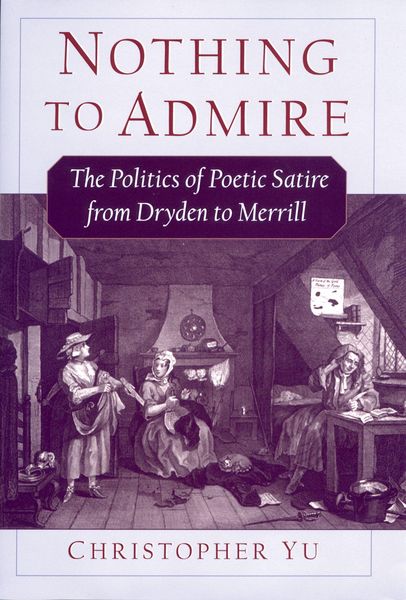
Nothing to Admire The Politics of Poetic Satire from Dryden to Merrill
-
Form:Einzelkauf Download
-
Sprache:Englisch
-
eBook Format:ePUB
- PDF Fr. 80.90
- ePUB Fr. 80.90 ausgewählt
Fr. 80.90
inkl. gesetzl. MwSt.Beschreibung
Produktdetails
Format
ePUB
Kopierschutz
Ja
Family Sharing
Nein
Text-to-Speech
Ja
Erscheinungsdatum
11.09.2003
Verlag
OUP eBookSeitenzahl
(Printausgabe)
Dateigröße
911 KB
Sprache
Englisch
EAN
9780190288655
Nothing to Admire argues for the persistence of a central tradition of poetic satire in English that extends from Restoration England to present-day America. This tradition is rooted in John Dryden's and Alexander Pope's uses of Augustan metaphor to criticize the abuse of social and political power and to promote an antithetical ideal of satiric authority based on freedom of mind. Because of their commitment to neoclassical conceptions of political virtue, the British Augustans developed a meritocratic cultural ideal grounded in poetic judgment and opposed to the political institutions and practices of their superiors in birth, wealth, and might. Their Augustanism thus gives a political meaning to the Horatian principle of nil admirari. This book calls the resulting outlook cultural liberalism in order to distinguish it from the classical liberal insistence on private property as the basis of political liberty, a conviction that arises within the same general period and often stands in adversarial relation to the Augustan mentality. Dryden and Pope's language of political satire supplies the foundation for the later and more radical liberalisms of Lord Byron, W.H. Auden, and James Merrill, each of whom looks back to the Augustan model for the poetic devices he will use to protest the increasingly conformist culture of mass society. Responding to the banality of this society, the later poets reinvigorate their predecessors' neo-Horatian attitude of skeptical worldliness through iconoclastic comic assaults on the imperial, fascist, heterosexist, and otherwise illiberal impulses of the cultural regimes prevailing during their lifetimes.
Kundinnen und Kunden meinen
Verfassen Sie die erste Bewertung zu diesem Artikel
Helfen Sie anderen Kund*innen durch Ihre Meinung