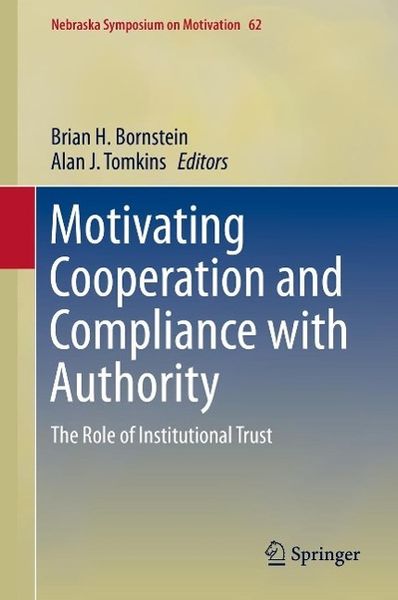
Produktbild: Motivating Cooperation and Compliance with Authority
Band 62

Motivating Cooperation and Compliance with Authority The Role of Institutional Trust

Fr. 125.90

inkl. gesetzl. MwSt.

Beschreibung

Produktdetails

Format

PDF

Kopierschutz

Nein

Family Sharing

Nein

Text-to-Speech

Nein

Erscheinungsdatum

29.04.2015

Herausgeber

Brian H. Bornstein + weitere

Verlag

Springer

Seitenzahl

220 (Printausgabe)

Dateigröße

3470 KB

Sprache

Englisch

EAN

9783319161518

Beschreibung

Portrait

Brian Bornstein is Professor of Psychology and Courtesy Professor of Law at UNL. He started at the university in 2000. He is a member of the Law-Psychology, Social, and Cognitive psychology programs. He has served as Interim Director of the Social-Personality and Law-Psychology programs and is presently Associate Director of the Law-Psychology program. He received his Ph.D. in psychology from the University of Pennsylvania in 1991 and a Master of Legal Studies from the University of Nebraska in 2001. Dr. Bornstein's research efforts focus primarily on how juries, especially in civil cases, make decisions, and the reliability of eyewitness memory. Additional areas of focus are in applying decision-making principles to everyday judgment tasks, as in medical decision making and distributive and procedural justice. He teaches courses on human memory, psychology and law, decision making, and history of psychology at the graduate and undergraduate levels. His latest books are the Handbook of Trial Consulting (co-edited with Richard Wiener, Springer Publishing, 2011) and Trauma, Stress and Wellbeing in the Legal System (co-edited with Monica Miller, Oxford University Press, 2013). He is co-editor of the journal Psychology, Crime & Law, the NYU Press Psychology & Crime book series, and the Springer Advances in Psychology & Law book series.Alan Tomkins is the Director of the University of Nebraska Public Policy Center, located off-campus at the Lincoln Community Foundation Building (215 Centennial Mall, South, Suite 401, Lincoln, NE 68588-0308). He was named director when the PPC was created in July, 1998. Dr. Tomkins is also a Professor in the UNL Law/Psychology Program.Dr. Tomkins received a B. A. degree from Boston University (1975) with a joint major in Psychology and Philosophy. He earned a J. D. and Ph.D. in Social Psychology from Washington University in St. Louis in 1984. He joined the faculty of the Law/Psychology Program at the University of Nebraska-Lincoln in 1986. Prior to coming to UNL, Dr. Tomkins was a Research Associate at the Federal Judicial Center, a Visiting Assistant Professor of Psychology at the University of Illinois, Urbana-Champaign and a Research Assistant Professor at St. Louis University. He also has served as a Visiting Professor of Law at the University of Southampton (England) and as a Visiting Scholar of Psychology at Yonsei University (Seoul, Korea). In 2005-06 Tomkins served as William J. Clinton Distinguished Fellow at the University of Arkansas Clinton School of Public Service while also continuing as director the Public Policy Center.His policy research interests include mental health policy, community health and human services, the use of information for decision making, and stakeholder input into the policy process. Dr. Tomkins is co-editor Court Review, the journal of the American Judges Association. Previously, he served as co-Editor and then Editor of the interdisciplinary journal, Behavioral Sciences & the Law from 1989-2001 and served on the editorial board for Law & Human Behavior since 1991 and on Expert Evidence: The International Digest of Human Behaviour Science and Law from 1998-2001. He is a Fellow of the American-Psychology Law Society, Division 41 of the American Psychological Association.

Produktdetails

Format

PDF

eBooks im PDF-Format haben eine festgelegte Seitengröße und eignen sich daher nur bedingt zum Lesen auf einem tolino eReader oder Smartphone. Für den vollen Lesegenuss empfehlen wir Ihnen bei PDF-eBooks die Verwendung eines Tablets oder Computers.

Kopierschutz

Nein

Dieses eBook können Sie uneingeschränkt auf allen Geräten der tolino Familie, allen sonstigen eReadern und am PC lesen. Das eBook ist nicht kopiergeschützt und kann ein personalisiertes Wasserzeichen enthalten. Weitere Hinweise zum Lesen von eBooks mit einem personalisierten Wasserzeichen finden Sie unter Hilfe/Downloads.

Family Sharing

Nein

Mit Family Sharing können Sie eBooks innerhalb Ihrer Familie (max. sechs Mitglieder im gleichen Haushalt) teilen. Sie entscheiden selbst, welches Buch Sie mit welchem Familienmitglied teilen möchten. Auch das parallele Lesen durch verschiedene Familienmitglieder ist durch Family Sharing möglich. Um eBooks zu teilen oder geteilt zu bekommen, muss jedes Familienmitglied ein Konto bei Thalia oder einem anderen tolino-Buchhändler haben. Weitere Informationen finden Sie unter Hilfe/Family-Sharing.

Text-to-Speech

Nein

Bedeutet Ihnen Stimme mehr als Text? Mit der Funktion Text-to-Speech können Sie sich im tolino webReader und in der aktuellen Thalia – Lesen & Hören App das eBook vorlesen lassen. Weitere Informationen finden Sie unter Hilfe/Text-to-Speech.

Barrierefreiheit

  • keine Information zur Barrierefreiheit bekannt

Erscheinungsdatum

29.04.2015

Herausgeber

Verlag

Springer

Seitenzahl

220 (Printausgabe)

Dateigröße

3470 KB

Sprache

Englisch

EAN

9783319161518

Kundinnen und Kunden meinen

0 Bewertungen

Informationen zu Bewertungen

Zur Abgabe einer Bewertung ist eine Anmeldung im Konto notwendig. Die Authentizität der Bewertungen wird von uns nicht überprüft. Wir behalten uns vor, Bewertungstexte, die unseren Richtlinien widersprechen, entsprechend zu kürzen oder zu löschen.

Die Bewertungen sind nach Format, Anzahl Sterne und Datum sortiert.

Verfassen Sie die erste Bewertung zu diesem Artikel

Helfen Sie anderen Kund*innen durch Ihre Meinung

Kundinnen und Kunden meinen

0 Bewertungen filtern

Weitere Artikel finden Sie in

  • Produktbild: Motivating Cooperation and Compliance with Authority
  • 1. Institutional Trust: An Introduction. Brian H. Bornstein & Alan J. Tomkins2. Would Trust by Any Other Name Smell as Sweet? Reflections on the Meanings and Uses of Trust across Disciplines and Context. F. David Schoorman, Mallory M. Wood, & Christina Breuer3. Trust as a Leap of Hope for Transaction Value: A Two-Way Street above and beyond Trust Propensity and Expected Trustworthiness. Peter Ping Li4. Creating Legitimacy: The Interrelated Roles of Justice and Trust. Karen A. Hegtvedt5. Legitimacy Is for Losers: The Interconnections of Institutional Legitimacy, Performance Evaluations, and the Symbols of Judicial Authority. James L. Gibson6. Who Trusts the Trial Courts, How Much, and Why? David B. Rottman7. On the Dual Motivational Force of Legitimacy. Jonathan Jackson8. Political Trust in Polarized Times. Elizabeth Theiss-Morse, Dona-Gene Barton, & Michael W. Wagner9. The Epistemic Contract: Fostering an Appropriate Level of Public Trust in Experts. Robert J. MacCoun