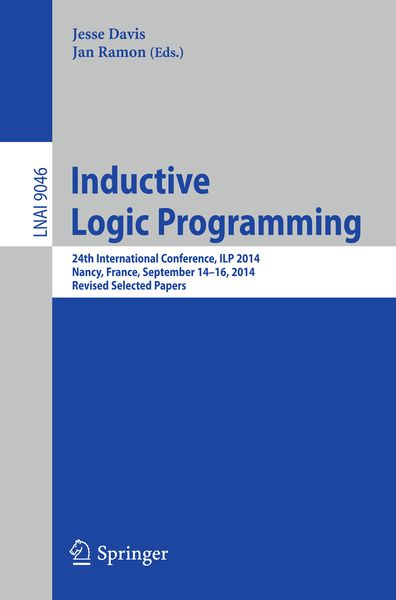

Inductive Logic Programming 24th International Conference, ILP 2014, Nancy, France, September 14-16, 2014, Revised Selected Papers
-
- Taschenbuch ausgewählt
- eBook
-
Sprache:Englisch
-
Verlag:Springer
- Springer Fr. 71.90 ausgewählt
- Springer Berlin Fr. 73.90
Fr. 71.90
inkl. gesetzl. MwSt.,
Beschreibung
Produktdetails
Einband
Taschenbuch
Erscheinungsdatum
27.12.2015
Abbildungen
X, 62 illus. in color., farbige Illustrationen
Herausgeber
Jesse Davis + weitereVerlag
SpringerSeitenzahl
211
Maße (L/B/H)
23.5/15.5/1.3 cm
Gewicht
347 g
Auflage
1st ed. 2015
Sprache
Englisch
ISBN
978-3-319-23707-7
This book constitutes the thoroughly refereed post-conference proceedings of the 24th International Conference on Inductive Logic Programming, ILP 2014, held in Nancy, France, in September 2014.
The 14 revised papers presented were carefully reviewed and selected from 41 submissions. The papers focus on topics such as the inducing of logic programs, learning from data represented with logic, multi-relational machine learning, learning from graphs, and applications of these techniques to important problems in fields like bioinformatics, medicine, and text mining.Noch keine Bewertungen vorhanden
Verfassen Sie die erste Bewertung zu diesem Artikel
Helfen Sie anderen Kundinnen und Kunden durch Ihre Meinung.