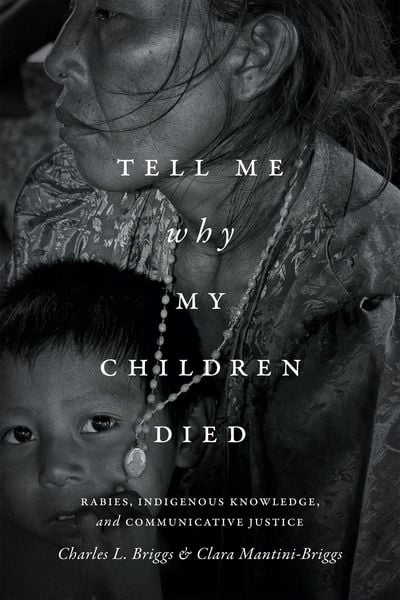
Produktbild: Tell Me Why My Children Died

Tell Me Why My Children Died Rabies, Indigenous Knowledge, and Communicative Justice

Fr. 148.00

inkl. gesetzl. MwSt., Versandkostenfrei


Beschreibung

Produktdetails

Einband

Gebundene Ausgabe

Erscheinungsdatum

23.05.2016

Abbildungen

52 illustrations

Verlag

Duke University Press

Seitenzahl

344

Maße (L/B/H)

23.4/15.5/2.3 cm

Gewicht

612 g

Sprache

Englisch

ISBN

978-0-8223-6105-3

Beschreibung

Rezension

"Briggs and Mantini-Briggs do more than shed light on a tragedy-they give voice to the grieving parents and offer examples of innovative ways to combat health disparities around the world, such as examining the 'relational division of the labor of producing and circulating health knowledge.'" - Tracy Gnadinger (Health Affairs) "There are no easy explanations in this book, but it serves a valuable role by reminding us that lofty ideological claims and even passionate practical commitment are, in themselves, insufficient for eradicating deep structural inequalities, the real solutions to which can sometimes only be found among the people themselves." - Eugene Carey (Latin American Review of Books) "It is in this combination of ambitious scope and gut-wrenching intimacy that Tell Me Why My Children Died really shines. This book is a model not just for anthropologists interested in epidemics (Ebola and Zika were frequently on my mind while I was reading, and they are occasionally invoked in the text), but, just as importantly, for readers interested in a first-hand account of the messy, frustrating and ambivalent work of communicating calls for justice." - Alex Nading (Journal of Latin American Studies) "This ethnography will undoubtedly be embraced by scholars and graduate students in the fields of medical and linguistic anthropology, Latin American Studies and Indigenous Studies. Nevertheless, in my opinion, a book like this is most needed to encourage critical approaches to communication, global health and public health disciplines, as well as engaging lower level students in sophisticated discussions around contemporary American societies." - Nicole S. Berry (Bulletin of Latin American Research) "The book will be useful and provocative for researchers, students, and faculties in the social sciences, medicine, and science and technology studies. I strongly recommend it." - Linda M. Whiteford (Ethnohistory)

Produktdetails

Einband

Gebundene Ausgabe

Erscheinungsdatum

23.05.2016

Abbildungen

52 illustrations

Verlag

Duke University Press

Seitenzahl

344

Maße (L/B/H)

23.4/15.5/2.3 cm

Gewicht

612 g

Sprache

Englisch

ISBN

978-0-8223-6105-3

Herstelleradresse

Libri GmbH
Europaallee 1
36244 Bad Hersfeld
DE

Email: gpsr@libri.de

Kundinnen und Kunden meinen

0 Bewertungen

Informationen zu Bewertungen

Zur Abgabe einer Bewertung ist eine Anmeldung im Konto notwendig. Die Authentizität der Bewertungen wird von uns nicht überprüft. Wir behalten uns vor, Bewertungstexte, die unseren Richtlinien widersprechen, entsprechend zu kürzen oder zu löschen.

Die Bewertungen sind nach Format, Anzahl Sterne und Datum sortiert.

Verfassen Sie die erste Bewertung zu diesem Artikel

Helfen Sie anderen Kund*innen durch Ihre Meinung

Kundinnen und Kunden meinen

0 Bewertungen filtern

  • Produktbild: Tell Me Why My Children Died
  • Illustrations  ix

    Prologue  xiii

    Preface  xvii

    Introduction  1

    Part I.

    1. Reliving the Epidemic: Parents' Perspectives  29

    2. When Caregivers Fail: Doctors, Nurses, and Healers Facing an Intractable Disease  76

    3. Explaining the Inexplicable in Mukoboina: Epidemiologists, Documents, and the Dialogue That Failed  109

    4. Heroes, Bureaucrats, and Millenarian Wisdom: Journalists Cover an Epidemic Conflict  127

    Part II.

    5. Narratives, Communicative Monopolies, and Acute Health Inequities  159

    6. Knowledge Production and Circulation  179

    7. Laments, Psychoanalysis, and the Work of Mourning  205

    8. Biomediatization: Health/Communicative Inequities and Health News  225

    9. Toward Health/Communicative Equities and Justice  245

    Conclusion  260

    Acknowledgments  275

    Notes  279

    References  287

    Index  303