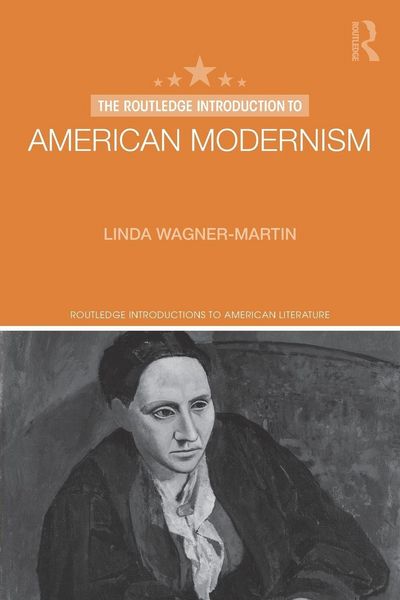
• Produktbild: The Routledge Introduction to American Modernism
  • Produktbild: The Routledge Introduction to American Modernism

The Routledge Introduction to American Modernism

Fr. 73.90

inkl. gesetzl. MwSt., Versandkostenfrei


Beschreibung

Produktdetails

Einband

Taschenbuch

Erscheinungsdatum

22.02.2016

Verlag

Taylor & Francis

Seitenzahl

202

Maße (L/B/H)

23.4/15.6/1.1 cm

Gewicht

322 g

Sprache

Englisch

ISBN

978-1-138-84740-8

Beschreibung

Rezension

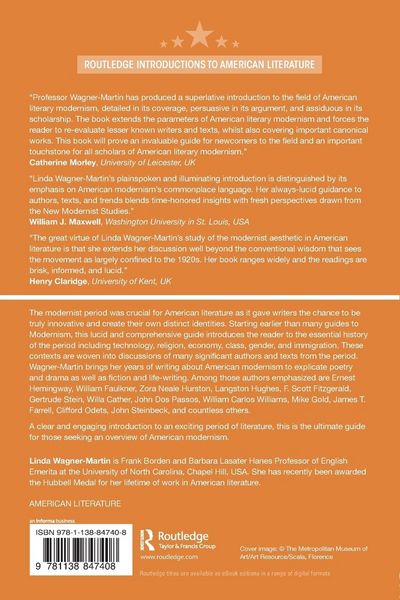
'Linda Wagner-Martin's plainspoken and illuminating introduction is distinguished by its emphasis on American modernism's commonplace language and surprising dose of common sense. Her always-lucid guidance to authors, texts, and trends blends time-honored insights with fresh perspectives drawn from the New Modernist Studies.' William J. Maxwell, Washington University in St. Louis, USA

'The great virtue of Linda Wagner-Martin's study of the modernist aesthetic in American literature is that she extends her discussion well beyond the conventional wisdom that sees the movement as largely confined to the 1920s. She is aware that movements in the arts don't suddenly end at some convenient point to suit the timetable of the literary historian. Thus we are presented with readings of authors frequently ignored in other studies, such as Jack Conroy and Tom Kromer, as well as an account of the Harlem Renaissance that emphasizes the continuities between the 'black aesthetic' and the formal experimentation of 'white' writers. Her book ranges widely and the readings are brisk, informed, and lucid.' Henry Claridge, University of Kent, UK

'Professor Wagner-Martin has produced a superlative introduction to the field of American literary modernism, detailed in its coverage, persuasive in its argument, and assiduous in its scholarship. The book extends the parameters of American literary modernism and forces the reader to re-evaluate lesser known writers and texts, whilst also covering important canonical works. The Routledge Introduction to American Modernism will prove an invaluable guide for newcomers to the field and an important touchstone for all scholars of American literary modernism.' Catherine Morley, University of Leicester, UK

'The survey is straightforward and moves quickly, but it is always insightful. Wagner-Martin includes dozens of brief excerpts from key works to help students at the beginning of their studies glean enough information to follow the argument. She is masterful in weaving interpretations of primary texts with concise author biographies, a bit of historical context, and information about critical tradition and new approaches. Each chapter includes a list of suggested further reading, and the volume concludes with a full bibliography. An introduction in the best sense, this well-written volume will be accessible to the uninitiated, and it is sophisticated enough for those who think they are beyond an introduction. Summing Up: Highly Recommended' J. W. Miller, Gonzaga University, CHOICE January 2017


Produktdetails

Einband

Taschenbuch

Erscheinungsdatum

22.02.2016

Verlag

Taylor & Francis

Seitenzahl

202

Maße (L/B/H)

23.4/15.6/1.1 cm

Gewicht

322 g

Sprache

Englisch

ISBN

978-1-138-84740-8

Herstelleradresse

Produktsicherheitsverantwortliche/r
Europaallee 1
36244 Bad Hersfeld
DE

Email: gpsr@libri.de

Noch keine Bewertungen vorhanden

Verfassen Sie die erste Bewertung zu diesem Artikel

Helfen Sie anderen Kundinnen und Kunden durch Ihre Meinung.

Kundinnen und Kunden meinen

Bewertungen (0)

Die Leseprobe wird geladen.
  • Produktbild: The Routledge Introduction to American Modernism
  • Produktbild: The Routledge Introduction to American Modernism
  • Introduction

    1. Struggles (against England and for national aesthetic freedom)

    2. United States Expatriation

    3. Poetry as Origin

    4. Ernest Hemingway as star pupil

    5. Fitzgerald and Faulkner - United Stated Romanticism

    6. The Harlem Renaissance and After

    7. The 1930s and omnipresent class distinctions

    8. World War II and after: is this what postmodernism looks like?