
• Produktbild: The Dissociative Mind in Psychoanalysis
  • Produktbild: The Dissociative Mind in Psychoanalysis

The Dissociative Mind in Psychoanalysis Understanding and Working With Trauma

Fr. 83.90

inkl. gesetzl. MwSt., Versandkostenfrei


Beschreibung

Produktdetails

Einband

Taschenbuch

Erscheinungsdatum

16.02.2016

Herausgeber

Elizabeth Howell + weitere

Verlag

Taylor & Francis

Seitenzahl

294

Maße (L/B/H)

23.4/15.6/1.7 cm

Gewicht

1080 g

Sprache

Englisch

ISBN

978-0-415-73601-5

Beschreibung

Rezension

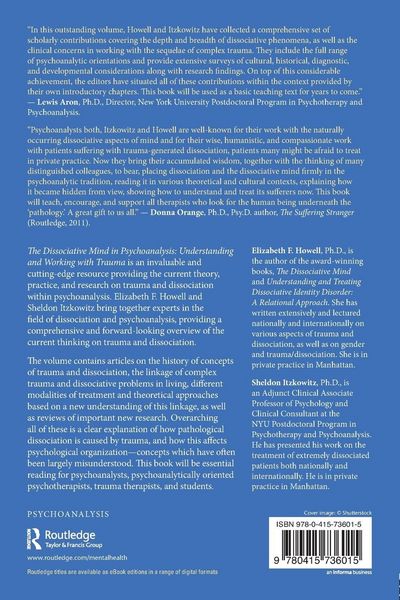
"In this outstanding volume, Howell and Itzkowitz have collected a comprehensive set of scholarly contributions covering the depth and breadth of dissociative phenomena, as well as the clinical concerns in working with the sequelae of complex trauma. They include the full range of psychoanalytic orientations and provide extensive surveys of cultural, historical, diagnostic, and developmental considerations along with research findings. On top of this considerable achievement, the editors have situated all of these contributions within the context provided by their own introductory chapters. This book will be used as a basic teaching text for years to come."- Lewis Aron, Ph.D., Director, New York University Postdoctoral Program in Psychotherapy & Psychoanalysis.

Psychoanalysts both, Itzkowitz and Howell are well-known for their work with the naturally occurring dissociative aspects of mind and for their wise, humanistic, and compassionate work with patients suffering with trauma-generated dissociation, patients many might be afraid to treat in private practice. Now they bring their accumulated wisdom, together with the thinking of many distinguished colleagues, to bear, placing dissociation and the dissociative mind firmly in the psychoanalytic tradition, reading it in various theoretical and cultural contexts, explaining how it became hidden from view, showing how to understand and treat its sufferers now. This book will teach, encourage, and support all therapists who look for the human being underneath the "pathology." A great gift to us all. - Donna Orange, Ph.D., Psy.D. author, The Suffering Stranger (Routledge, 2011)

Drs. Howell and Itzkowitz have fashioned a resource for those who are interested in learning more about psychoanalytic treatment and how psychoanalysts work with and help victims of trauma, traumatic, dissociation and dissociative disorders. Psychoanalysis, cognitive science, cognitive neuroscience, and trauma research all have a say in this outstanding volume which explores trauma and dissociation within a broad psychoanalytic context. The editors should be commended for their written contributions, for gathering chapters from leading experts in the area, and for the scope and depth of the issues addressed.- Judith Alpert, Ph.D. is Professor, Department of Applied Psychology, New York University and Professor and Clinical Consultant at New York University Postdoctoral Program in Psychotherapy and Psychoanalysis

Produktdetails

Einband

Taschenbuch

Erscheinungsdatum

16.02.2016

Herausgeber

Verlag

Taylor & Francis

Seitenzahl

294

Maße (L/B/H)

23.4/15.6/1.7 cm

Gewicht

1080 g

Sprache

Englisch

ISBN

978-0-415-73601-5

Herstelleradresse

Libri GmbH
Europaallee 1
36244 Bad Hersfeld
DE

Email: gpsr@libri.de

Kundinnen und Kunden meinen

0 Bewertungen

Informationen zu Bewertungen

Zur Abgabe einer Bewertung ist eine Anmeldung im Konto notwendig. Die Authentizität der Bewertungen wird von uns nicht überprüft. Wir behalten uns vor, Bewertungstexte, die unseren Richtlinien widersprechen, entsprechend zu kürzen oder zu löschen.

Die Bewertungen sind nach Format, Anzahl Sterne und Datum sortiert.

Verfassen Sie die erste Bewertung zu diesem Artikel

Helfen Sie anderen Kund*innen durch Ihre Meinung

Kundinnen und Kunden meinen

0 Bewertungen filtern

Die Leseprobe wird geladen.
  • Produktbild: The Dissociative Mind in Psychoanalysis
  • Produktbild: The Dissociative Mind in Psychoanalysis
  • Introduction Elizabeth F. Howell, Ph.D. & Sheldon Itzkowitz, Ph.D.

    SECTION 1 History of Complex Trauma and Dissociative Problems in Living

    1. Is Trauma-Analysis Psycho-Analysis Elizabeth F. Howell, Ph.D. & Sheldon Itzkowitz, Ph.D.

    2. From Trauma-Analysis to Psycho-Analysis And Back Again Elizabeth F. Howell, Ph.D. & Sheldon Itzkowitz, Ph.D.

    3. The Everywhereness of Trauma and the Dissociative Structuring of the Mind Elizabeth F. Howell, Ph.D. & Sheldon Itzkowitz, Ph.D.

    4. Pierre Janet, Sigmund Freud, and Dissociation of the Personality: The First Codification of a Psychodynamic Depth Psychology Onno van der Hart, Ph.D.

    5. The Ferenczi Paradox: His Importance in Understanding Dissociation and the Dissociation of His Importance in Psychoanalysis Margaret L. Hainer, LCSW

    SECTION 2 Psychoanalytic Orientations and the Treatment of Complex Trauma Dissociation and Dissociative Disorders

    6. Models of Dissociation in Freud's Work: Outcomes of Dissociation of Trauma in Theory and Practice Elizabeth F. Howell, Ph.D.

    7. Jung and Dissociation: Complexes, Dreams, and the Mythopoetic Psyche Donald Kalsched, Ph.D.

    8. 'A Queer Kind of Truth': Winnicott and the Uses of Dissociation  Dodi Goldman, Ph.D.

    9. A Kleinian Perspective on Dissociation and Trauma: Miscarriages in Symbolization Joseph Newirth, Ph.D.

    10. It Never Entered My Mind Philip Bromberg, Ph.D.

    11. Precarious Places: Intersubjectivity in Traumatized States Jennifer Leighton LCSW

    12. Latah: An Ethnic Syndrome With Dissociative Features - A Sadomasochistic Pattern? Elizabeth Hegeman, Ph.D.

    SECTION 3 Aspects of Psychoanalytic Treatment of Complex Trauma and Dissociation

    13. Thoughts on Working with the Dreams of DID and DDNOS Patients Richard P. Kluft, M.D., Ph.D.

    14. Who Moved My 'Swiss' Cheese? Eating Disorders And The Use Of Dissociation As An Attempt To Fill In The 'Whole' Jean Petrucelli, Ph.D.

    15. A Bell Rings In The Empty Sky: Dissociative Attunement In A Resonant World Karen Hopenwasser, M.D.

    16. Divide and Multiply; A Multi-Dimensional View of Dissociative Processes Wilma Bucci, Ph.D.

    17. The Personal Diagnostic Crisis: The Acknowledgement of Self-States in DID Richard A. Chefetz, M.D.

    18. Psychoactive Therapy Of DID: A Multiphasic Model Ira Brenner, M.D.

    19. The Seeming Absence of Children With DID Valerie Sinason, Ph.D.

    SECTION 4 Current Research Trends in Complex Trauma Dissociation and Dissociative Disorders

    20. A Tale of Two Offenders: Why Dissociation Is Under-Diagnosed In Forensic Populations Abby Stein, Ph.D.

    21. An Update On Research About the Validity, Assessment, and Treatment of DID Bethany Brand, Ph.D. & Daniel Brown B.S.

    22. Speaking One's Dissociated Mind: So Should My Thoughts Be Severed From My Griefs and Woes Brian Koehler, Ph.D.