KI-Beratung Beta

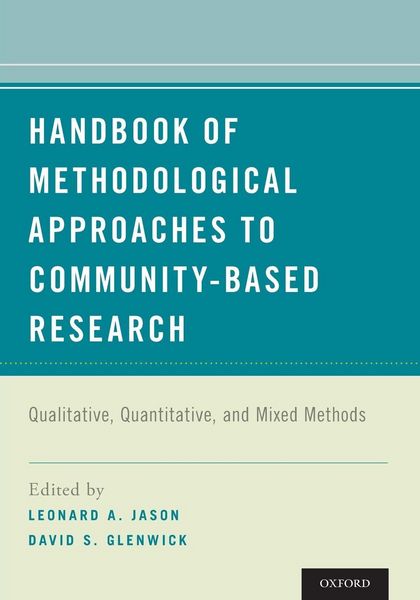
Produktbild: Handbook of Methodological Approaches to Community-Based Research

Handbook of Methodological Approaches to Community-Based Research Qualitative, Quantitative, and Mixed Methods

Fr. 148.00

inkl. gesetzl. MwSt., Versandkostenfrei


Beschreibung

The Handbook of Methodological Approaches to Community-Based Research is intended to aid the community-oriented researcher in learning about and applying cutting-edge quantitative, qualitative, and mixed methods approaches.

Beschreibung

The Handbook of Methodological Approaches to Community-Based Research is intended to aid the community-oriented researcher in learning about and applying cutting-edge quantitative, qualitative, and mixed methods approaches.

Produktdetails

Einband

Taschenbuch

Erscheinungsdatum

08.01.2016

Herausgeber Jason Leonard A. + weitere
Verlag Oxford University Press

Produktdetails

Einband

Taschenbuch

Erscheinungsdatum

08.01.2016

Herausgeber
Verlag Oxford University Press
Seitenzahl

404

Maße (L/B/H)

25.4/17.8/2.2 cm

Gewicht

757 g

Sprache

Englisch

ISBN

978-0-19-024365-4

Herstelleradresse

Libri GmbH
Europaallee 1
36244 Bad Hersfeld
DE

Email: gpsr@libri.de

Noch keine Bewertungen vorhanden

Verfassen Sie die erste Bewertung zu diesem Artikel

Helfen Sie anderen Kundinnen und Kunden durch Ihre Meinung.

Kundinnen und Kunden meinen

Bewertungen (0)

  • Produktbild: Handbook of Methodological Approaches to Community-Based Research
    • Foreword by Raymond P. Lorion
    • Acknowledgments
    • About the Editors
    • Contributors
    • Chapter 1. Introduction to Community-Based Methodological Approaches
    • Leonard A. Jason and David S. Glenwick
    • Section I. Qualitative Approaches
    • Chapter 2. Introduction to Qualitative Approaches
    • Anne E. Brodsky, Sara L. Buckingham, Jill E. Scheibler, and Terri Mannarini
    • Chapter 3. Grounded Theory
    • Andrew Rasmussen, Adeyinka M. Akinsulure-Smith, and Tracy Chu
    • Chapter 4. Thematic Analysis
    • Stephanie Riger and Rannveig Sigurvinsdottir
    • Chapter 5. Community Narratives
    • Bradley Olson, Daniel Cooper, Judah Viola, and Brian Clark
    • Chapter 6. Appreciative Inquiry
    • Neil Boyd
    • Chapter 7. The Delphi Method
    • Shane R. Brady
    • Chapter 8. Ethnographic Approaches
    • Urmitapa Dutta
    • Chapter 9. Photovoice and House Meetings Within Participatory Action Research
    • Regina Day Langhout, Jesica Siham Fernández, Denise Wyldbore, and Jorge Savala
    • Chapter 10. Geographic Information Systems
    • Andrew Lohmann
    • Chapter 11. Causal Layered Analysis
    • Lauren J. Breen, Peta L. Dzidic, and Brian J. Bishop
    • Chapter 12. Emotional Textual Analysis
    • Renzo Carli, Rosa Maria Paniccia, Fiammetta Giovagnoli, Agostino Carbone, and Fiorella Bucci
    • Section II. Quantitative Approaches
    • Chapter 13. Introduction to Quantitative Approaches
    • Christian M. Connell
    • Chapter 14. Latent Growth Curves
    • Megan R. Greeson
    • Chapter 15. Latent Class Analysis and Latent Profile Analysis
    • Glenn Williams and Fraenze Kibowski
    • Chapter 16. Multilevel Structural Equation Modeling
    • John P. Barile
    • Chapter 17. Cluster-Randomized Trials
    • Nathan R. Todd and Patrick Fowler
    • Chapter 18. Behavioral and Time-Series Approaches
    • Mark Mattaini, Leonard A. Jason, and David S. Glenwick
    • Chapter 19. Data Mining
    • Jacob Furst, Daniela Stan Raicu, and Leonard A. Jason
    • Chapter 20. Agent-Based Models
    • Zachary P Neal and Jennifer Lawlor
    • Chapter 21. Social Network Analysis
    • Mariah Kornbluh and Jennifer Watling Neal
    • Chapter 22. Dynamic Social Networks
    • Leonard A. Jason, John Light, and Sarah Callahan
    • Section III. Mixed Methods Approaches
    • Chapter 23. Introduction to Mixed Methods Approaches
    • Valerie R. Anderson
    • Chapter 24. Action Research
    • Brian Christens, Victoria Faust, Jennifer Gaddis, Paula Tran Inzeo, Carolina S. Sarmiento,
    • and Shannon M. Sparks
    • Chapter 25. Community-Based Participatory Action Research
    • Michael J. Kral and James Allen
    • Chapter 26. Youth-Led Participatory Action Research
    • Emily J. Ozer
    • Chapter 27. Participatory Mixed Methods Research Across Cultures
    • Rebecca Volino Robinson, E.J.R. David, and Mara Hill
    • Chapter 28. Photoethnography in Community-Based Participatory Research
    • Katherine Cloutier
    • Chapter 29. Data Visualization
    • Gina Cardazone and Ryan T. Tolman
    • Chapter 30. Concept Mapping
    • Lisa M. Vaughn and Daniel McLinden
    • Chapter 31. Functional Analysis of Community Concerns in Participatory Action Research
    • Yolanda Suarez-Balcazar and Fabricio Balcazar
    • Chapter 32. Network Analysis and Stakeholder Analysis in Mixed Methods Research
    • Isidro Maya-Jariego, David Florido-del-Corral, Daniel Holgado, and Javier Hernández-Ramírez
    • Chapter 33. Mixed Methodology in Multilevel, Multisetting Inquiry
    • Nicole E. Allen, Angela Walden, Emily Dworkin, and Shabnam Javdani
    • Chapter 34. Mixed Methods and Dialectical Pluralism
    • Tres Stefurak, R. Burke Johnson, and Erynne Shatto
    • Chapter 35. Community Profiling in Participatory Action Research
    • Caterina Arcidiacono, Teresa Tuozzi, and Fortuna Procentese
    • Afterword by G. Anne Bogat
    • Index