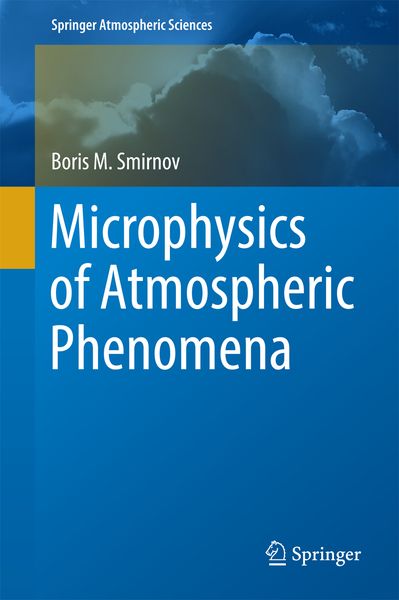
Microphysics of Atmospheric Phenomena
-
- Hardcover ausgewählt
- Taschenbuch
- eBook
-
Sprache:Englisch
Fr. 161.00
inkl. gesetzl. MwSt.,
Beschreibung
Produktdetails
Einband
Gebundene Ausgabe
Erscheinungsdatum
07.09.2016
Abbildungen
IX, 270 p. 111 illus., 8 illus. in color.
Verlag
SpringerSeitenzahl
270
Maße (L/B/H)
24.1/16/2.1 cm
Gewicht
536 g
Auflage
1st ed. 2017
Sprache
Englisch
ISBN
978-3-319-30812-8
This book investigates elementary processes in the Earth’s atmosphere involving photons, electrons, ions, radicals, and aerosols. It is based on global atmospheric models such as the standard atmospheric model with averaged atmospheric parameters across the globe and over time, the Earth’s energetic balance, and the global electric circuit that allows to analyze fundamental atmospheric properties to be analyzed. Rate constants of elementary processes in the Earth’s atmosphere, together with measured atmospheric parameters and existing concepts of atmospheric phenomena, are used in the analysis of global and local atmospheric processes. Atmospheric photoprocesses result from the interaction of solar radiation with the atmosphere and processes involving ions, oxygen atoms, excited atomic particles and ozone molecules. Atmospheric electricity as a secondary phenomenon to atmospheric water circulation results in a chain of processes that begins with collisions of water aerosols in different aggregate states. Cosmic rays are of importance for atmospheric electricity, as they create positive and negative ions in the air. Air breakdown in an electric field of clouds in the form of lightning may develop under the influence of cosmic ray-created seed electrons, which are necessary for electron multiplication in ionization wave-streamers. The upper atmosphere (ionosphere) is formed under solar radiation in a vacuum ultraviolet spectrum, and absorption of this radiation leads to air photoionization. The greenhouse effect is determined by atmospheric water, whereas transitions between a water vapor and aerosols may lead to a change in atmospheric optical depth. Carbon dioxide contributes in small portions to the atmospheric greenhouse effect. Cosmic rays are of importance for atmospheric discharge, the origin of lightning and cloud formation in the first stage ofaerosol growth. This book provides a qualitative description of atmospheric properties and phenomena based on elementary processes and simple models.
Noch keine Bewertungen vorhanden
Verfassen Sie die erste Bewertung zu diesem Artikel
Helfen Sie anderen Kundinnen und Kunden durch Ihre Meinung.