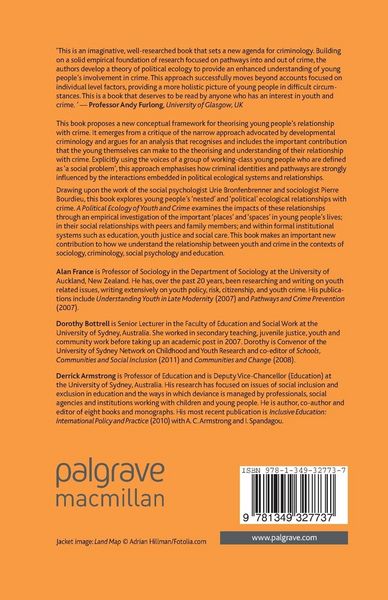
"This is an imaginative, well-researched book that sets a new agenda for criminology. Building on a solid empirical foundation of research focused on pathways into and out of crime, the authors develop a theory of political ecology to provide an enhanced understanding of young peoples involvement in crime. This approach successfully moves beyond accounts focused on individual level factors, providing a more holistic picture of young people in difficult circumstances. This is a book that deserves to be read by anyone who has an interest in youth and crime." - Professor Andy Furlong, University of Glasgow, UK
"This book makes a much-needed departure from developmental criminologies to provide an understanding of young people's relationships with crime at a time when developmental ways of thinking about young offending heavily permeate the structure and function of youth justice systems [...] a must-read for youth justice practitioners and policymakers who want to know more about the material outcomes that youth justice and school supervision processes can create for young people. I would also recommend this text to academics teaching youth justice and setting readings for their courses." - Youth Studies Australia
"The book is engagingly written and appropriately sympathetic to the subjects whose voices it records and attempts to understand [...] It is successful too in developing a 'nested political ecology' that illuminates understanding of youth and crime."
- British Journal of Criminology
"This book is a far cry from many of the 'how to do youth justice' books that crowd the shelves and reading lists of youth
offending team trainers [...] For all that it should be required reading I suspect the authors will be satisfied that it is simply rewarding." - Children and Society