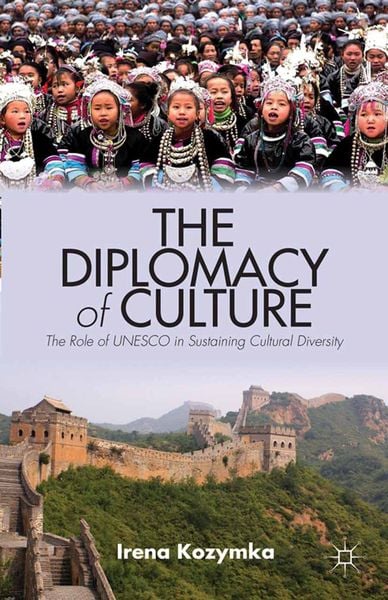
Produktbild: The Diplomacy of Culture

The Diplomacy of Culture The Role of UNESCO in Sustaining Cultural Diversity

Fr. 110.00

inkl. gesetzl. MwSt., Versandkostenfrei


Beschreibung

Produktdetails

Einband

Taschenbuch

Erscheinungsdatum

16.04.2014

Verlag

Palgrave Macmillan US

Seitenzahl

296

Maße (L/B/H)

21.6/14/1.7 cm

Gewicht

360 g

Auflage

1st ed. 2014

Sprache

Englisch

ISBN

978-1-349-47411-0

Beschreibung

Rezension

The Diplomacy of Culture is filling a void in international relations studies. With this in mind, Irena Kozymka wrote a very useful and well documented volume which will be strongly appreciated by scholars and students, and also by many readers who are interested in understanding a crucial new field of knowledge." - Bertrand Badie, Sciences Po, Paris


"Irena Kozymka has written an insightful analysis of a subject too neglected by academic International Relations how diplomacy deals with culture and cultural diversity, a rather different matter from 'cultural diplomacy.' Her comparative treatment of different national traditions, combined with an expert study of UNESCO, makes this indispensable for those concerned with both the international politics of culture and with international organizations." - Christopher Hill, Sir Patrick Sheehy Professor of International Relations, and Head of Politics and International Studies Department, University of Cambridge

Produktdetails

Einband

Taschenbuch

Erscheinungsdatum

16.04.2014

Verlag

Palgrave Macmillan US

Seitenzahl

296

Maße (L/B/H)

21.6/14/1.7 cm

Gewicht

360 g

Auflage

1st ed. 2014

Sprache

Englisch

ISBN

978-1-349-47411-0

Herstelleradresse

Libri GmbH
Europaallee 1
36244 Bad Hersfeld
DE

Email: gpsr@libri.de

Noch keine Bewertungen vorhanden

Verfassen Sie die erste Bewertung zu diesem Artikel

Helfen Sie anderen Kundinnen und Kunden durch Ihre Meinung.

Kundinnen und Kunden meinen

Bewertungen (0)

  • Produktbild: The Diplomacy of Culture
  • Table of Contents PART I: INTRODUCTION Book's Structure Definitions UNESCO: Structure and Agency 1. Legal Basis and Institutional Structure 2. Functions 3. Member States 4. Other Actors 5. UNESCO as an Actor  PART II: UNESCO'S RESPONSES, PAST AND PRESENT 6. Early Years: Protection and Diffusion of Cultural Expressions 7. Decolonisation: Stress on Cultural Identity and Promotion of Cultural Development 8. Responding to the Challenges of the Twenty-first Century  PART III: FRANCE 9. The State and Culture: An Enduring Marriage 10. From Cultural Exception to Cultural Diversity 11. The Makings of the 2005 Convention 12. Protecting and Promoting Cultural Diversity: A View from France  PART IV: THE UNITED STATES 13. Culture in the United States and its Place in the Country's Foreign Policy 14. The United States and UNESCO: An Uneasy Relationship 15. The US Opposition to the Cultural Diversity Convention  PART V: CAMBODIA 16. The Place of Culture in State Policy 17. World Heritage Sites in Cambodia: National or Common Heritage of Humanity? 18. Angkor 19. Preah Vihear 20. Protection and Promotion of Intangible Culture from the Cambodian Perspective  PART VI: BRAZIL 21. Brazil's Racial and Cultural Diversity 22. Cultural Policies in Brazil 23. Public Access 24. Culture as Economically Remunerative 25. UNESCO in Brazil and Brazil at UNESCO 26. Racism and Discrimination 27. Indigenous Cultures  PART VII: UNESCO'S DIFFICULTIES IN HANDLING CULTURAL DIVERSITY 28. Challenges in Handling Cultural Diversity 29. Weaknesses of the UNESCO Convention on the Protection and Promotion of the Diversity of Cultural Expressions 30. Gaps in UNESCO's Legal Action towards Sustaining Cultural Diversity 31. Shortcomings in UNESCO's Functioning  PART VIII: CONCLUSION 32. Double Vision: Culture or Cultural Expressions? 33. Porous Borders and Fuzzy Mandates 34. Imperfect Instruments for an Imperfect World 35. UNESCO: Puppet or Master? 36. UNESCO as Beacon ANNEX – CONVENTION ON THE PROTECTION AND PROMOTION OF THE DIVERSITY OF CULTURAL EXPRESSIONS Bibliography