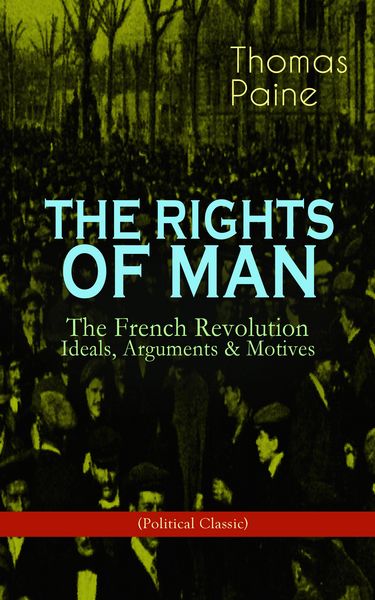
THE RIGHTS OF MAN: The French Revolution - Ideals, Arguments & Motives (Political Classic) Being an Answer to Mr. Burke's Attack on the French Revolution
-
- Taschenbuch
- eBook ausgewählt
-
Form:Einzelkauf Download
-
Sprache:Englisch
-
Verlag:E-artnow
- Musaicum Books Fr. 1.00
- E-artnow ausgewählt
Fr. 2.00
inkl. gesetzl. MwSt.Beschreibung
Produktdetails
Format
ePUB
Kopierschutz
Nein
Family Sharing
Ja
Text-to-Speech
Ja
Erscheinungsdatum
08.07.2016
Verlag
E-artnowSeitenzahl
206 (Printausgabe)
Dateigröße
658 KB
Sprache
Englisch
EAN
9788026865674
This carefully crafted ebook: "THE RIGHTS OF MAN: The French Revolution - Ideals, Arguments & Motives (Political Classic)" is formatted for your eReader with a functional and detailed table of contents.
Thomas Paine's "Rights of Man" is born from his need to defend social mutiny and it posits that popular political revolution is permissible when a government does not safeguard the natural rights of its people. Using these points as a base Paine defends the French Revolution against Edmund Burke's attack in Reflections on the Revolution in France. Paine argues that the interests of the monarch and his people are united, and insists that the French Revolution should be understood as one which attacks the despotic principles of the French monarchy, not the king himself. Principally, Rights of Man opposes the idea of hereditary government - the belief that dictatorial government is necessary, because of man's corrupt, essential nature. Rights of Man concludes in proposing practical reformations of English government: a written Constitution composed by a national assembly, in the American mould; the elimination of aristocratic titles, because democracy is incompatible with primogeniture. Thomas Paine's intellectual influence is perceptible in the two great political revolutions of the eighteenth century. He dedicated Rights of Man to George Washington and to the Marquis de Lafayette, acknowledging the importance of the American and the French revolutions in his formulating the principles of modern democratic governance.
Thomas Paine (1737-1809) was an English-American political activist, philosopher, political theorist, and revolutionary. One of the Founding Fathers of the United States, he authored the two most influential pamphlets at the start of the American Revolution, and he inspired the rebels in 1776 to declare independence from Britain. Paine's ideas reflected Enlightenment-era rhetoric of transnational human rights.
Thomas Paine's "Rights of Man" is born from his need to defend social mutiny and it posits that popular political revolution is permissible when a government does not safeguard the natural rights of its people. Using these points as a base Paine defends the French Revolution against Edmund Burke's attack in Reflections on the Revolution in France. Paine argues that the interests of the monarch and his people are united, and insists that the French Revolution should be understood as one which attacks the despotic principles of the French monarchy, not the king himself. Principally, Rights of Man opposes the idea of hereditary government - the belief that dictatorial government is necessary, because of man's corrupt, essential nature. Rights of Man concludes in proposing practical reformations of English government: a written Constitution composed by a national assembly, in the American mould; the elimination of aristocratic titles, because democracy is incompatible with primogeniture. Thomas Paine's intellectual influence is perceptible in the two great political revolutions of the eighteenth century. He dedicated Rights of Man to George Washington and to the Marquis de Lafayette, acknowledging the importance of the American and the French revolutions in his formulating the principles of modern democratic governance.
Thomas Paine (1737-1809) was an English-American political activist, philosopher, political theorist, and revolutionary. One of the Founding Fathers of the United States, he authored the two most influential pamphlets at the start of the American Revolution, and he inspired the rebels in 1776 to declare independence from Britain. Paine's ideas reflected Enlightenment-era rhetoric of transnational human rights.
Kundinnen und Kunden meinen
Verfassen Sie die erste Bewertung zu diesem Artikel
Helfen Sie anderen Kund*innen durch Ihre Meinung